
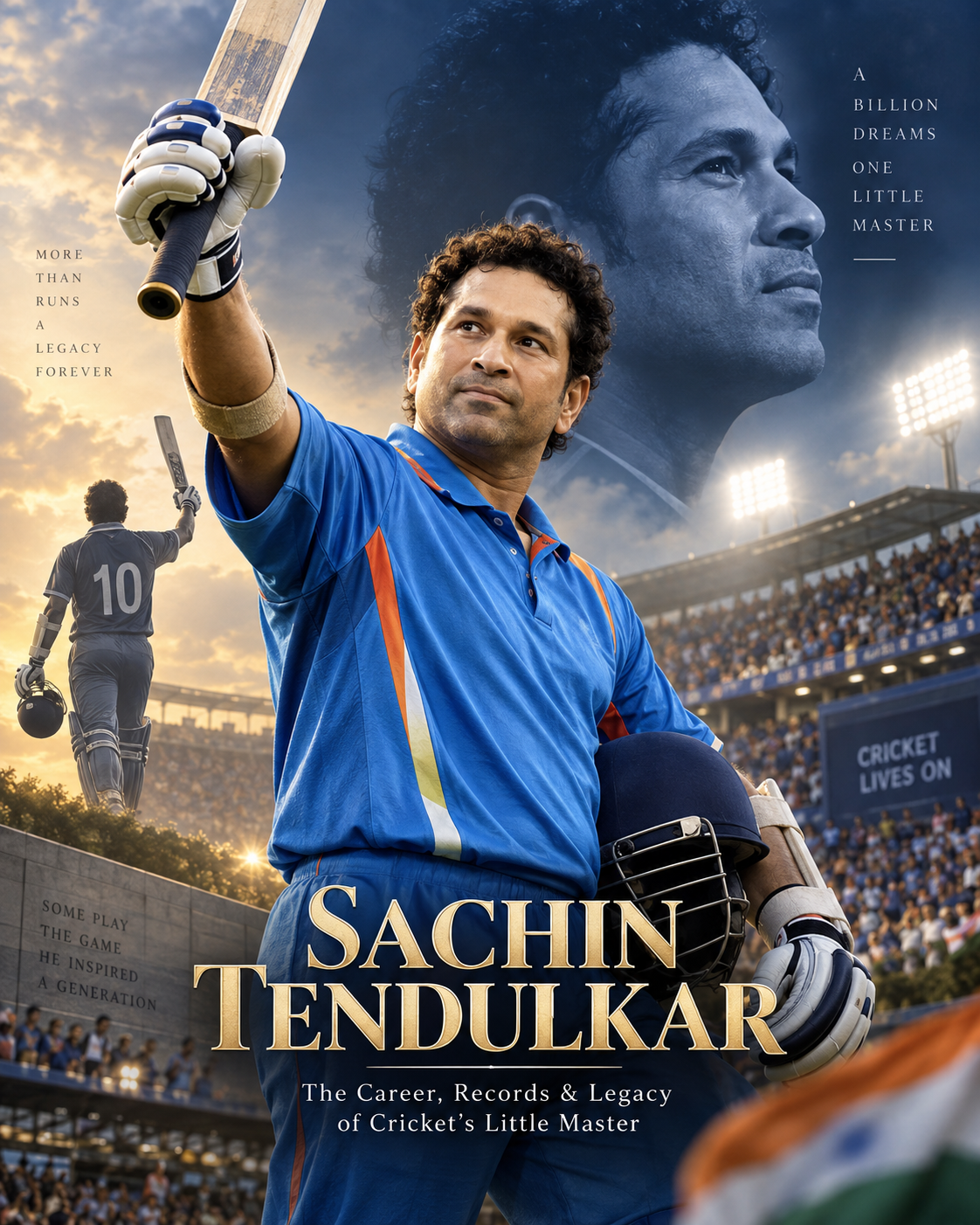

Few names in cricket carry the same weight as Sachin Tendulkar.
For more than two decades, the Indian batting legend walked to the crease with millions of people watching his every move. Expectations followed him everywhere, yet Tendulkar continued scoring runs against some of the finest bowlers cricket has ever produced.
His career was extraordinary not simply because of the records he set, but because of how long he remained among the world’s best.
From Mumbai School Cricket to the International Stage
Sachin Ramesh Tendulkar was born on 24 April 1973 in Mumbai, India.
His batting talent became apparent while he was still at school. Under the guidance of coach Ramakant Achrekar, the young Tendulkar developed the technique and discipline that would later define his international career.
He entered Test cricket remarkably early.
Tendulkar made his Test debut for India against Pakistan in Karachi in November 1989, aged just 16.
It was an intimidating place to begin.
Pakistan’s attack included world-class fast bowlers, and Tendulkar was facing international cricket before most players his age had even established themselves at domestic level.
He was young, but he did not look frightened.
That courage became an important part of the Tendulkar story.
Becoming the Centre of India’s Batting
During the 1990s, Tendulkar gradually became the player India depended on most heavily with the bat.
His technique was compact, his balance exceptional and his range of shots enormous.
He could defend patiently in Test cricket and then completely change his approach when the situation demanded aggression.
Among his many strokes, the straight drive became particularly famous.
A Tendulkar straight drive past the bowler was simple cricket at its best: balanced head, straight bat and almost perfect timing.
Yet reducing his batting to one signature shot would ignore what made him special.
He could cut, pull, drive, sweep and improvise. He learned to deal with fast bowling, swing, seam movement and world-class spin.
More importantly, he succeeded in very different conditions around the world.
Facing Cricket’s Greatest Bowlers
Tendulkar played during an era filled with exceptional bowlers.
Over the course of his career, he faced opponents including Wasim Akram, Waqar Younis, Glenn McGrath, Shane Warne, Muttiah Muralitharan, Allan Donald, Curtly Ambrose, Courtney Walsh, Shaun Pollock and Brett Lee.
Each presented a different problem.
Akram could swing the ball at high pace. McGrath attacked relentlessly accurate areas. Warne could control matches with leg-spin. Muralitharan brought an entirely different challenge with off-spin.
Tendulkar’s ability to adapt to such varied opposition was one reason he remained successful for so long.
His career stretched across generations.
Players came and went, tactics changed and limited-overs cricket evolved considerably, but Tendulkar kept finding ways to score runs.
Records That Defined an Era
By the end of his career, Tendulkar had accumulated numbers that were difficult to imagine when he first appeared as a teenager.
He finished Test cricket with 15,921 runs in 200 matches, including 51 centuries.
In One Day Internationals, he scored 18,426 runs in 463 matches, with 49 centuries.
Together, those hundreds made him the first cricketer to reach 100 international centuries.
He also finished with more than 34,000 international runs across Tests and ODIs.
One of his most memorable limited-overs achievements came in 2010.
Against South Africa in Gwalior, Tendulkar scored an unbeaten 200, becoming the first male cricketer to make a double century in a One Day International.
It was another milestone in a career already overflowing with them.
The 2011 World Cup Dream
There was, however, one achievement Tendulkar had spent years chasing.
The Cricket World Cup.
India reached the final in 2003 but lost to Australia.
By 2011, Tendulkar was nearing the final stages of his international career, and the tournament was being played in India, Sri Lanka and Bangladesh.
It represented another opportunity.
Tendulkar contributed significantly during India’s campaign, including important performances against strong opposition.
India eventually reached the final against Sri Lanka at Mumbai’s Wankhede Stadium.
When India completed the successful run chase, Tendulkar finally became a World Cup winner.
For a player who had carried Indian expectations for so many years, the scenes that followed were memorable.
His teammates celebrated with him around the ground, recognizing what the moment meant to both Tendulkar and Indian cricket.
Why Tendulkar Was More Than His Statistics
Numbers provide the easiest way to measure Tendulkar’s career, but they tell only part of the story.
His influence extended far beyond scorecards.
For countless young cricketers, particularly in India, he became the player they tried to imitate.
Children copied his stance.
Young batsmen practiced his straight drive.
Supporters planned their days around India’s matches because Tendulkar was batting.
At the same time, his reputation extended well beyond his own country.
He earned enormous respect from opponents who had spent years trying to dismiss him.
That combination of public popularity and professional respect helped make Tendulkar one of cricket’s truly global figures.
The Final Test
Tendulkar retired from international cricket in November 2013.
His final appearance came in his 200th Test, against the West Indies at the Wankhede Stadium in Mumbai.
It brought an international career of approximately 24 years to an end.
Few elite athletes remain at the highest level for that length of time.
Fewer still do it while carrying the expectations that followed Tendulkar throughout his career.
His farewell marked the end of one of cricket’s most remarkable eras.
Sachin Tendulkar’s Lasting Legacy
Cricket never stops changing.
New players emerge. Records are challenged. Formats evolve. Batting becomes more aggressive and technology changes the way the sport is played and analysed.
But certain careers remain reference points.
Tendulkar’s is one of them.
He possessed exceptional talent, but talent alone does not explain 24 years at international level.
Longevity required discipline.
Consistency required preparation.
Success across different countries required adaptability.
And performing under enormous public pressure required extraordinary mental strength.
Future generations may break some of his records, just as records throughout cricket history have always been broken.
What will be far harder to reproduce is the complete career: the teenage debut, the battles against legendary bowlers, the thousands of international runs, the 100 centuries, the World Cup victory and more than two decades at the centre of one of cricket’s most passionate nations.
That is why Sachin Tendulkar remains much more than a name in the record books.
He remains one of the defining players in the history of cricket.
Quick Facts
Full Name: Sachin Ramesh Tendulkar
Born: 24 April 1973
Country: India
Playing Role: Top-order batsman
Batting Style: Right-handed
Test Matches: 200
Test Runs: 15,921
Test Centuries: 51
ODI Matches: 463
ODI Runs: 18,426
ODI Centuries: 49
International Centuries: 100
World Cup Winner: 2011
SEO Details
SEO Title: Sachin Tendulkar: Career, Records, Stats & Cricket Legacy
URL Slug: sachin-tendulkar-career-records-legacy
Meta Description: Explore Sachin Tendulkar’s legendary cricket career, records, statistics, greatest achievements, 2011 World Cup victory and lasting legacy.
Category: Cricket Legends
Tags: Sachin Tendulkar, India Cricket, Cricket Legends, Cricket Records, Greatest Batsmen, Indian Cricket, Cricket History