
There are easier ways to become famous in cricket than leaving the ball outside off stump.
Rahul Dravid never seemed particularly interested in easy ways.
He built his career one spell at a time, one session at a time, sometimes one defensive stroke at a time. Fast bowlers could attack him for hours. Spinners could surround him with close catchers. Crowds could become impatient.
Dravid usually remained exactly where he was.
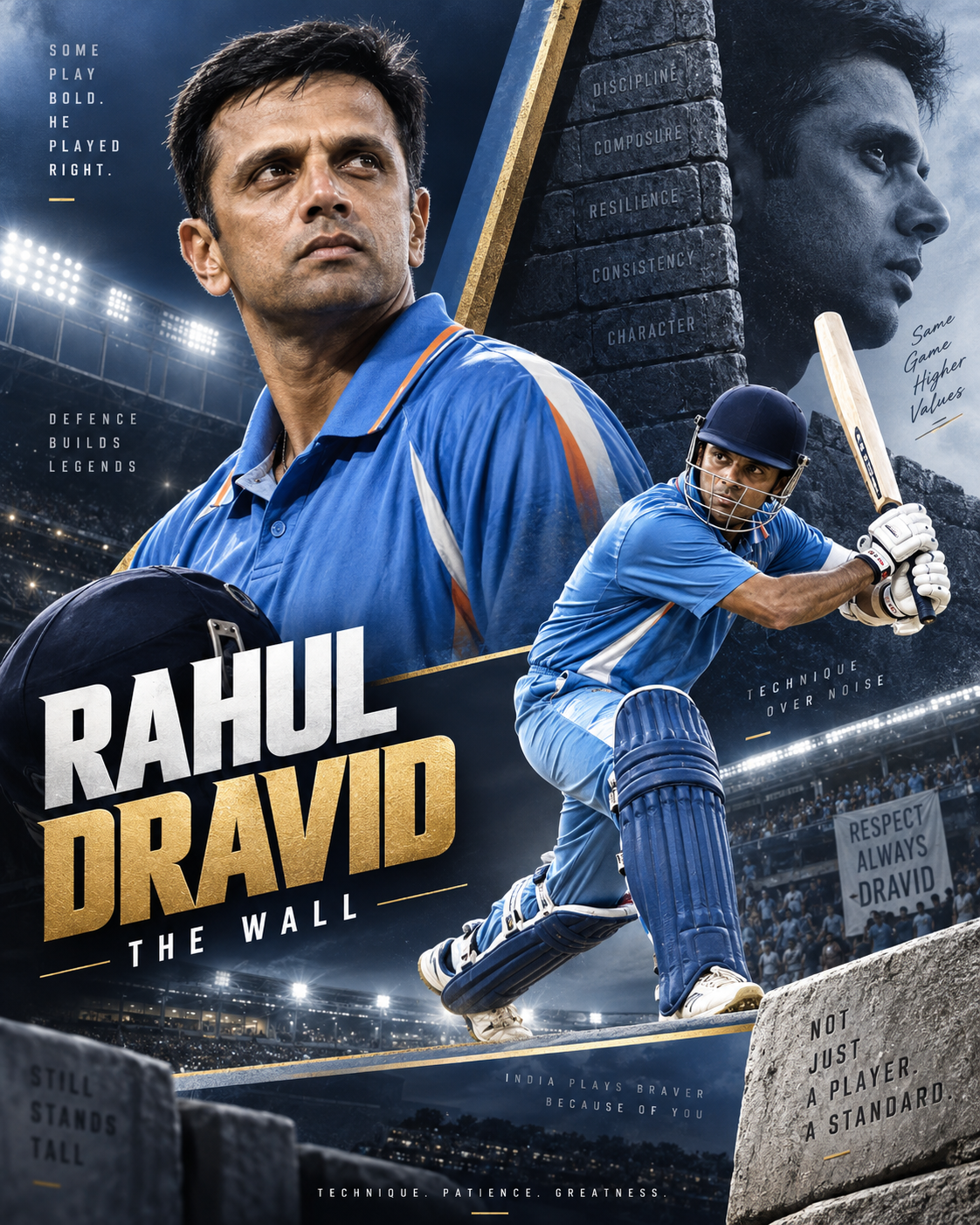
That resistance earned him the nickname that followed him for the rest of his career:
The Wall.
But reducing Dravid to defence misses half the story.
He scored 13,288 Test runs and another 10,889 in One Day Internationals. He finished with more than 24,000 international runs, played match-winning innings in Australia and Pakistan, topped the run charts at the 1999 World Cup and became one of the finest slip fielders of his generation.
When India needed someone to survive, Dravid survived.
When they needed him to win, he could do that too.
Five Runs Short at Lord’s
Rahul Sharad Dravid was born on 11 January 1973 and grew up in Bangalore.
By the time his Test opportunity arrived in 1996, he had already spent years developing through domestic cricket.
His debut came at Lord’s against England.
Another young Indian batsman, Sourav Ganguly, was making his Test debut in the same match.
Ganguly made 131.
Dravid walked in lower down the order and scored 95.
Five runs separated him from a century on debut.
In retrospect, the innings feels appropriate.
There was no dramatic hundred.
No immediate headline record.
Just hours of technically sound batting against international bowling.
The career had quietly begun.
Why “The Wall” Was Such a Good Nickname
Nicknames in sport are often exaggerated.
This one was not.
Dravid’s defence was built around balance and discipline.
He watched the ball late.
His head stayed remarkably still.
His bat came down straight.
And most importantly, he knew when not to play.
A delivery outside off stump did not need to be touched simply because it was there.
That sounds obvious.
Against a fast bowler at international level, after several hours at the crease, it becomes much harder.
Dravid could keep making the same correct decision.
Again.
And again.
And again.
Across his Test career, he faced 31,258 deliveries — an extraordinary figure that says almost as much about him as his run total.
The Wall was not built through one great innings.
It was built through thousands of correct decisions.
But He Could Score
The defensive reputation sometimes created a misleading picture of Dravid as a batsman who merely occupied the crease.
He was far better than that.
His cover drive was beautiful.
He could cut hard behind point.
He used his wrists effectively through the leg side.
Against spin, he possessed excellent footwork.
And once established, he could accelerate without abandoning his technique.
This mattered especially in ODI cricket, where many initially doubted whether his classical game could adapt.
More than 10,000 ODI runs later, that question had been answered.
Johannesburg, 1997
Dravid’s first Test century came in one of the hardest places for a young batsman to earn one.
South Africa.
Johannesburg.
A bowling attack featuring Allan Donald, Shaun Pollock, Brian McMillan and Lance Klusener.
Dravid batted for approximately nine hours and made 148.
Then he added 81 in the second innings.
The match was drawn, but the performance established something important.
His technique was not designed only for Indian pitches.
It travelled.
He could deal with pace.
Bounce.
Movement.
And pressure.
That ability would become increasingly important as India tried to improve its overseas Test record.
The 1999 World Cup Changed His ODI Reputation
Dravid entered the 1999 Cricket World Cup in England with people still questioning his place in one-day cricket.
He left as the tournament’s leading run-scorer.
In eight matches, he scored:
461 runs.
There were two centuries and three half-centuries.
He made 104 not out against Kenya.
Then 145 against Sri Lanka.
In that Sri Lanka match, Dravid and Sourav Ganguly added 318 runs, then a World Cup partnership record.
India did not reach the semi-finals.
Dravid still finished ahead of every batsman in the tournament.
The supposedly slow Test specialist had just outscored everyone at a World Cup.
Kolkata, 2001
If one match changed the psychological direction of Indian Test cricket, it was probably the 2001 Test against Australia at Eden Gardens.
Australia arrived as the dominant Test team in the world.
They had won 16 consecutive Tests.
They won the first Test of the series.
At Kolkata, they made India follow on.
The obvious outcome was another Australian victory.
Then VVS Laxman and Rahul Dravid began batting.
And kept batting.
And kept batting.
376 Runs That Changed the Match
Laxman produced the innings everyone remembers:
281.
Dravid’s contribution was 180.
Together, they added 376 runs.
For more than 100 overs, Australia could not separate them.
The partnership did more than save the Test.
It reversed it.
India declared.
Harbhajan Singh led the bowling attack.
Australia collapsed.
India won by 171 runs.
A team that had been forced to follow on had defeated one of the strongest sides cricket had seen.
Dravid’s 180 tends to live in the shadow of Laxman’s 281.
That is understandable.
It was still one of the most important innings of his career.
The Strange Thing About Dravid
He could be central to a famous victory without necessarily becoming the loudest figure in the story.
That happened often.
Laxman might produce the magical innings.
Tendulkar might attract the largest crowd.
Ganguly might provide the aggression.
Sehwag might score at impossible speed.
Dravid simply kept turning up in the middle of important matches.
His cricket rarely demanded attention.
It earned it.
Adelaide, 2003
If Kolkata showed how Dravid could help rescue a Test, Adelaide showed him taking complete ownership of one.
Australia made 556 in the first innings.
Ricky Ponting scored 242.
India needed something enormous to stay in the match.
Dravid made:
233.
He batted for close to ten hours.
VVS Laxman again provided crucial support.
India reached 523.
Then Ajit Agarkar took six wickets as Australia were bowled out for 196.
India needed 230 to win.
Dravid was not finished.
The Winning Boundary
The chase became uncomfortable.
Wickets fell.
But Dravid remained.
He scored 72 not out.
Then he cut Stuart MacGill through the off side for the winning boundary.
India had beaten Australia at Adelaide.
Dravid had scored 305 runs in the match and was there when the winning run was struck.
It is difficult to find a more complete batting performance in an overseas Test.
First innings: save the game.
Second innings: finish it.
Why Adelaide Matters
Indian cricket had produced great batsmen for decades.
Winning overseas Test matches consistently was another matter.
Conditions in Australia demanded different skills.
Bounce.
Fast bowling.
Long periods of pressure.
Dravid’s 233 and 72* represented the type of innings India needed if it wanted to become more than a dominant home side.
He did not merely score runs overseas.
He helped India believe overseas victories were achievable.
Rawalpindi, 2004
A few months later came another enormous assignment.
India were touring Pakistan.
The three-Test series was level 1–1 entering the decider at Rawalpindi.
India had never previously won a Test series in Pakistan.
Dravid batted for around twelve hours.
He faced 495 balls.
He scored:
270.
It remains his highest Test score.
India won by an innings and 131 runs.
The series belonged to India.
Another landmark overseas victory had Dravid at its centre.
233 in Australia. 270 in Pakistan.
This was Dravid at his peak.
Different country.
Different bowling attack.
Different conditions.
Same problem for the opposition.
Once he settled, removing him became exhausting.
A bowler could produce an excellent spell and still find Dravid standing there afterwards.
That was what made him so valuable.
He did not always defeat attacks by overwhelming them.
Sometimes he defeated them by outlasting them.
The No. 3 Position
Dravid spent much of his Test career at No. 3, perhaps the most demanding position in the batting order.
Sometimes the opener is dismissed in the first over.
The No. 3 effectively becomes an opener.
Sometimes the openers survive for two hours.
The No. 3 must then restart mentally after waiting.
Dravid became one of the great specialists in that role.
India could lose an early wicket and still feel reasonably calm.
The Wall was walking in.
Batting With Tendulkar
For much of Dravid’s career, Sachin Tendulkar occupied the position behind him.
That created one of the most formidable middle-order combinations international cricket had seen.
Opponents might dismiss Dravid and discover Tendulkar coming next.
Or dismiss Tendulkar and still find Dravid settled at the other end.
Their personalities and batting styles were different.
Together, they became central to India’s transformation through the late 1990s and 2000s.
Dravid and Laxman
Then there was VVS Laxman.
Some batting partnerships become famous because they produce huge numbers.
Dravid and Laxman also produced memories.
Kolkata 2001.
Adelaide 2003.
Two of India’s greatest Test victories.
The pair seemed especially comfortable batting together in difficult situations.
Laxman brought creativity.
Dravid brought structure.
One flowed.
The other anchored.
Australia learned how painful that combination could be.
More Than 13,000 Test Runs
By the end of his Test career, Dravid had accumulated:
13,288 runs from 164 matches.
His average was:
52.31.
He scored:
36 centuries
and
63 half-centuries.
His highest score was:
270.
Only a tiny group of batsmen in cricket history have crossed 13,000 Test runs.
Those numbers are not built through one extraordinary season.
They require excellence for more than a decade.
The ODI Career People Sometimes Forget
Dravid’s Test reputation became so powerful that his ODI career is occasionally treated as secondary.
It should not be.
He played:
344 ODIs.
He scored:
10,889 runs.
He made 12 centuries.
For a player once considered too slow for the format, passing 10,000 ODI runs was a remarkable response.
He adapted.
That is what great players do.
He Even Kept Wicket
India faced a selection problem during the early 2000s.
Playing a specialist wicketkeeper sometimes reduced batting flexibility in ODI cricket.
Dravid agreed to keep wicket.
It was not his natural specialist role.
He did it because the team needed it.
That decision allowed India to play an extra batsman and became particularly useful during the run towards the 2003 Cricket World Cup final.
It also says something about Dravid that statistics cannot.
He was willing to do unglamorous work if it improved the team.
The 2003 World Cup
India reached the World Cup final in South Africa after a strong tournament.
Australia proved too powerful in Johannesburg.
Ricky Ponting’s unbeaten 140 drove Australia to 359 for two.
India were bowled out for 234.
Dravid made 47.
There was no trophy.
That absence matters when looking at his playing career.
Unlike Tendulkar, Dhoni or some later Indian legends, Dravid never lifted the ODI World Cup as a player.
Great careers do not always receive perfect endings.
Captaincy
Dravid later became India’s captain.
Leadership did not fit his public personality as obviously as batting did.
He was quieter than some captains.
Less theatrical.
But his period in charge included significant overseas achievements.
India won a Test series in the West Indies in 2006.
Then came a Test series victory in England in 2007.
Winning away from home remained difficult.
Dravid helped India do it.
England, 2011: One Last Great Tour
By 2011, Dravid was 38.
There were questions about how long he could continue.
India toured England.
The series went badly.
India lost 4–0.
Dravid somehow produced one of his finest individual tours.
He made three Test centuries:
103 not out at Lord’s
117 at Edgbaston
146 not out at The Oval.
He scored 461 runs in the four-Test series.
The team around him struggled.
Dravid kept batting.
It was a familiar story.
The Oval
His 146* at The Oval feels especially appropriate as one of his final great innings.
India were under pressure.
Dravid opened the batting.
He carried his bat through the innings.
When the final wicket fell, he was still there.
Of course he was.
If someone were writing a fictional ending for “The Wall,” it might have felt too obvious.
Reality did it anyway.
The Slip Fielder
Dravid’s batting sometimes overshadows how good he was in the field.
He became one of the safest slip catchers international cricket had seen.
He finished his Test career with:
210 catches.
At the time, that was a world record for a non-wicketkeeper.
Standing at slip requires a different kind of concentration.
Long periods can pass without the ball coming near you.
Then an edge arrives at high speed.
One chance.
Take it or lose it.
Dravid’s hands were remarkably reliable.
Why Slip Suited Him
There is something almost appropriate about Dravid being an excellent slip fielder.
The qualities required were similar to those he showed while batting.
Patience.
Concentration.
Technique.
Few unnecessary movements.
Then complete commitment at the important moment.
Whether waiting for a bowler or waiting for an edge, Dravid seemed comfortable with stillness.
The 2004 Awards
Dravid’s peak years received formal recognition in 2004.
He was named both:
ICC Cricketer of the Year
and
ICC Test Player of the Year.
The awards reflected the extraordinary run he had produced across the preceding years.
Kolkata.
Adelaide.
Rawalpindi.
By then, Dravid was no longer simply regarded as one of India’s great batsmen.
He was among the finest players in world cricket.
Retirement
Dravid retired from international cricket in 2012.
His career had begun in 1996.
Sixteen years.
Different captains.
Different generations.
Different formats.
More than 24,000 international runs.
He left without great theatrics.
That too felt appropriate.
Dravid’s cricket had rarely been about noise.
The work had already been done.
The Numbers
His final international batting record was remarkable:
164 Tests — 13,288 runs
344 ODIs — 10,889 runs
1 T20I — 31 runs
Total:
24,208 international runs.
He made 48 international centuries.
And his 210 Test catches added another dimension to a career built on reliability.
The Hall of Fame
In 2018, Rahul Dravid was inducted into the ICC Cricket Hall of Fame.
It was difficult to imagine him anywhere else.
By then, an entire generation of Indian batsmen had grown up studying the qualities he represented.
Technique.
Discipline.
Patience.
Preparation.
And the belief that overseas conditions were a challenge to solve, not an excuse.
The Story Continued After Retirement
Dravid’s influence did not end when he stopped batting.
He became deeply involved in Indian cricket’s development system, working with young players and India’s Under-19 and A teams.
Eventually, he became head coach of the senior Indian men’s side.
The role produced frustration.
India lost the 2023 World Test Championship final.
Then reached the 2023 ODI World Cup final unbeaten, only to lose to Australia.
Dravid initially planned to leave.
He stayed for one more major tournament.
Barbados, 2024
India reached the final of the 2024 T20 World Cup against South Africa.
This time, India won.
The victory ended an 11-year wait for a senior ICC men’s trophy.
For Dravid, it was his final tournament as India’s head coach.
The scenes after the final were memorable precisely because they were so unlike the Rahul Dravid people were used to seeing.
The usually reserved man lifted the trophy and celebrated wildly with the players.
After years of being associated with patience and restraint, The Wall finally let go.
A Trophy, Just Not the Way People Expected
Dravid never won the World Cup as an international player.
Decades later, he stood inside another Indian dressing room and helped guide a team to a world title as coach.
Cricket has a strange way of completing circles.
His greatest legacy still belongs to his batting career.
But the coaching success added another chapter.
He had helped shape Indian cricket while playing.
Then he helped shape the generation that followed him.
Why Rahul Dravid Was Different
Dravid did not dominate cricket through intimidation like Viv Richards.
He did not redefine attacking strokeplay like AB de Villiers.
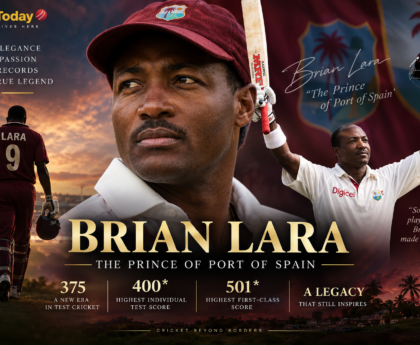
He did not possess Brian Lara’s theatrical flair.
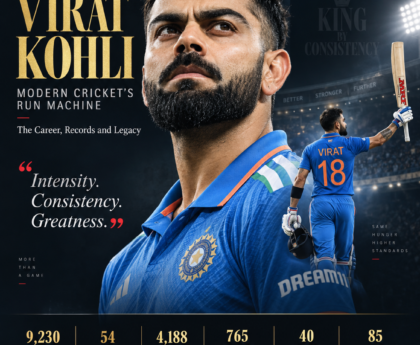
He did not attract the kind of global celebrity that followed Sachin Tendulkar.
His greatness had another character.
He made difficult things repeatable.
Leaving the right ball.
Defending the dangerous one.
Recovering after being beaten.
Starting again after lunch.
Starting again after tea.
Starting again the next morning.
Doing it in India.
Doing it in England.
Doing it in Australia.
Doing it in Pakistan.
Doing it for sixteen years.
There is nothing spectacular about repetition until you realize almost nobody can sustain it at that level.
Rahul Dravid’s Career at a Glance
Full Name: Rahul Sharad Dravid
Born: 11 January 1973
Country: India
Playing Role: Top-order batsman
Batting Style: Right-handed
International Career: 1996–2012
Test Matches: 164
Test Runs: 13,288
Test Average: 52.31
Test Centuries: 36
Test Half-Centuries: 63
Highest Test Score: 270
Test Catches: 210
ODI Matches: 344
ODI Runs: 10,889
ODI Centuries: 12
International Runs: 24,208
1999 World Cup Runs: 461 — tournament leading run-scorer
2001 Kolkata Test: 180 in a 376-run partnership with VVS Laxman
2003 Adelaide Test: 233 and 72*
2004 Rawalpindi Test: 270
ICC Cricketer of the Year: 2004
ICC Test Player of the Year: 2004
ICC Hall of Fame: 2018
2024 T20 World Cup: Champion as India head coach
Nickname: The Wall
Rahul Dravid’s Lasting Legacy
Rahul Dravid spent much of his career surrounded by louder stories.
Tendulkar was the icon.
Ganguly became the aggressive captain.
Sehwag changed opening batting.
Laxman produced miracles.
Dhoni later became the finisher and trophy-winning leader.
Dravid never seemed bothered by any of that.
He simply kept batting.
Thirteen thousand Test runs later, there was no need to shout.
The great innings were already there.
180 at Kolkata.
233 and 72 not out at Adelaide.
270 at Rawalpindi.
Three centuries in England at 38.
More than 31,000 Test deliveries faced.
Ten thousand ODI runs from a man once considered unsuitable for one-day cricket.
And 210 catches waiting quietly in the slips.
“The Wall” was a perfect nickname.
But walls simply stand still.
Rahul Dravid did more than that.
He stood his ground — and helped Indian cricket move forward.