
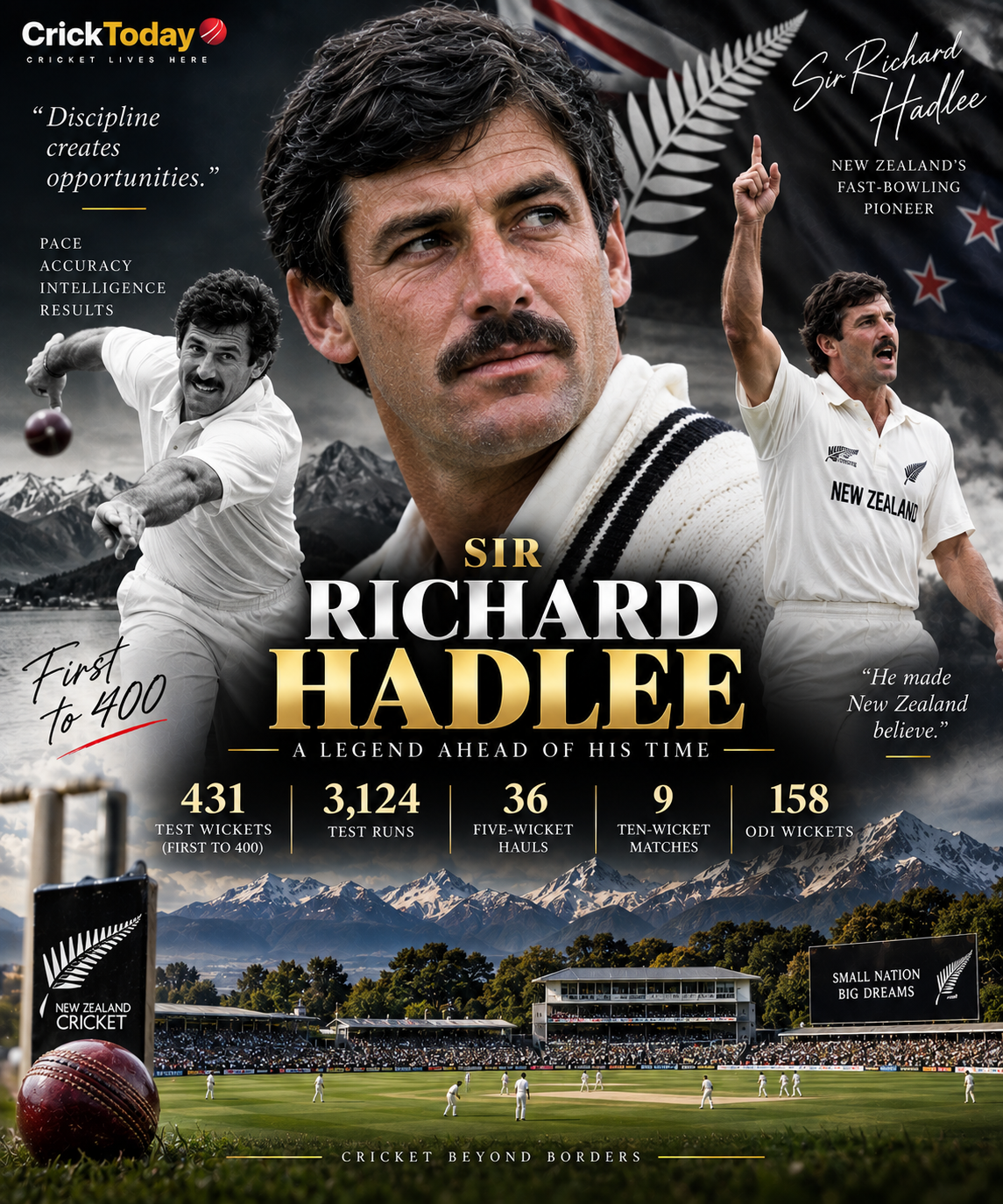

Long before New Zealand became a regular contender at the top of international cricket, one fast bowler gave the country a weapon capable of troubling almost any batting line-up in the world.
Sir Richard Hadlee was not simply New Zealand’s leading bowler.
For much of his career, he was the attack.
Accurate, intelligent and capable of moving the ball dangerously through the air and off the surface, Hadlee developed into one of the finest fast bowlers cricket has produced.
By the time he retired, he had taken 431 Test wickets, becoming the first bowler in history to reach 400.
He was also good enough with the bat to score more than 3,000 Test runs.
But statistics only explain part of his importance.
Hadlee helped change how the rest of the cricket world viewed New Zealand.
Cricket Was Already in the Family
Richard John Hadlee was born on 3 July 1951 in Christchurch, New Zealand.
Cricket was deeply rooted in the Hadlee family.
His father, Walter Hadlee, had captained New Zealand, while his brothers Dayle and Barry also played at international level.
Richard therefore grew up in an environment where the sport was more than an occasional pastime.
But his eventual achievements would exceed even the considerable cricketing tradition around him.
Hadlee made his Test debut against Pakistan in February 1973.
The early years were not instantly spectacular.
Like many fast bowlers, he needed time to understand how to turn natural ability into consistent international success.
Once he did, New Zealand had a bowler unlike any they had possessed before.
From Raw Pace to Precision
Hadlee’s early bowling relied heavily on pace.
As his career developed, his approach became more controlled.
He shortened his run-up, refined his action and concentrated increasingly on accuracy, seam movement and conventional swing.
The change made him more dangerous rather than less.
Instead of attempting to overpower every batsman, Hadlee began forcing them into mistakes.
He attacked the area around off stump relentlessly.
A batsman could never become completely comfortable leaving the ball because Hadlee possessed the ability to bring the next delivery back towards the stumps.
At the same time, deliveries moving away from the bat created catches behind the wicket.
It was fast bowling built around intelligence.
His First Major Breakthrough
Hadlee’s ninth Test produced the first clear indication of what he could become.
Against India at Christchurch in 1976, he took 11 wickets in the match.
New Zealand won by an innings and 33 runs.
For Hadlee, it was the beginning of a career filled with performances where his bowling did far more than contribute.
It decided matches.
This became especially significant for New Zealand.
Unlike some stronger cricket nations of the period, New Zealand did not always possess several world-class bowlers operating together.
When Hadlee produced a great spell, his country suddenly had the ability to defeat teams with much deeper cricketing resources.
A Historic Victory Over England
Another major moment arrived against England in Wellington during the 1977–78 season.
New Zealand had never defeated England in a Test match.
Hadlee helped change that.
He took 10 wickets in the match, including 6 for 26 in England’s second innings.
New Zealand won by 72 runs.
The result was historically significant for the country.
For Hadlee, it demonstrated something that would define his career:
When New Zealand needed a breakthrough, he was often the player expected to provide it.
Hadlee Against the West Indies
Few assignments in cricket during the late 1970s and 1980s were more intimidating than facing the West Indies.
Their batting contained some of the finest players in the world.
Their bowling attack was even more feared.
Yet Hadlee produced one of his greatest all-round performances against them in Dunedin in 1980.
He took 5 for 34 in the first innings and 6 for 68 in the second.
He also scored 51 runs.
New Zealand won the Test by just one wicket.
During the same series, Hadlee demonstrated the other side of his game by scoring 103 in Christchurch.
New Zealand eventually secured its first Test series victory over the West Indies.
For a country still establishing itself against cricket’s strongest nations, the result mattered enormously.
More Than a Fast Bowler
Hadlee is remembered primarily for his bowling, but describing him simply as a specialist fast bowler ignores a major part of his career.
He could bat.
Hadlee scored 3,124 Test runs, including two centuries and 15 half-centuries.
His batting average of 27.16 was highly valuable for a player whose main responsibility was leading the bowling attack.
He could defend when necessary but was also capable of attacking.
That placed him firmly among the exceptional group of all-rounders who defined international cricket during the 1980s.
The Great All-Rounders of the 1980s
The era produced a remarkable collection of players who could genuinely influence matches with both bat and ball.
Imran Khan represented Pakistan.
Ian Botham represented England.
Kapil Dev represented India.
And Richard Hadlee represented New Zealand.
Comparisons between the four have continued for decades.
Each had different strengths.
Botham’s aggressive personality and explosive performances made him a major figure in England.
Imran developed into an elite fast bowler, important batsman and eventually a World Cup-winning captain.
Kapil combined durable fast bowling with destructive lower-order batting.
Hadlee’s greatest strength was the relentless quality of his bowling.
Few batsmen were given easy deliveries.
Few captains could simply wait for him to lose control.
He made wickets through pressure as much as movement.
The 1985 Tour of Australia
If one series captures Hadlee at his absolute peak, it is New Zealand’s tour of Australia in 1985–86.
Australia away had traditionally been an extremely difficult challenge.
New Zealand arrived with Hadlee as the centre of their bowling attack.
In the opening Test at Brisbane, he produced one of the greatest fast-bowling performances in the history of the game.
Australia were bowled out for 179.
Hadlee took 9 for 52.
One wicket separated him from becoming only the second bowler at the time to take all ten wickets in a Test innings.
He was not finished.
Hadlee added another six wickets in Australia’s second innings.
His match figures were:
15 wickets for 123 runs.
New Zealand won by an innings and 41 runs.
Finishing the Job in Perth
Australia responded by winning the second Test in Sydney.
The series moved to Perth level at 1–1.
Once again, Hadlee became decisive.
He took another 11 wickets in the match, helping New Zealand win by six wickets.
The result gave New Zealand a 2–1 Test series victory in Australia.
It remains one of the landmark achievements in New Zealand cricket history.
For Hadlee personally, the tour confirmed what cricket already suspected.
At his best, he could dismantle even strong batting sides almost single-handedly.
Why Hadlee Was So Effective
Hadlee’s bowling did not depend on extreme pace.
As his career progressed, his greatest weapons became accuracy, movement and control.
He repeatedly pitched the ball in areas where batsmen were forced to make decisions.
Should they play?
Should they leave?
Was the ball coming into the stumps?
Would it move away?
These questions sound simple.
At international level, when a batsman has only fractions of a second to react, uncertainty becomes dangerous.
Hadlee created uncertainty almost constantly.
The Outswinger
One of Hadlee’s finest deliveries was his outswinger to the right-handed batsman.
The ball would begin on a threatening line before moving away.
If the batsman followed it, the outside edge came into play.
If he became too cautious, Hadlee could attack the stumps with a straighter delivery.
The method was not complicated.
Its execution was.
Many bowlers know where they want to put the ball.
Far fewer can put it there repeatedly.
Hadlee could.
Economy of Movement
Another distinctive feature of Hadlee’s later bowling was its efficiency.
He reduced his run-up and removed unnecessary effort from his action.
That helped him preserve energy while maintaining control.
For a fast bowler expected to deliver long spells, this mattered.
Rather than charging in with maximum effort for every ball, Hadlee developed a repeatable method.
It made him dangerous over an entire day.
It also helped extend his career into his late thirties.
The Nottinghamshire Years
Hadlee’s influence extended beyond international cricket.
He became an important player for Nottinghamshire in English county cricket.
English conditions were naturally suited to his ability to swing and seam the ball.
He became a hugely respected figure at Trent Bridge.
Hadlee’s county experience also gave him regular exposure to different batsmen and conditions, allowing him to refine his craft further.
His partnership with South African all-rounder Clive Rice became particularly important to Nottinghamshire.
Together, they helped turn the county into a powerful side.
An Extraordinary First-Class Record
Hadlee’s achievements outside international cricket reinforce just how productive his career was.
Across 342 first-class matches, he took 1,490 wickets.
His bowling average was just 18.11.
He recorded 102 five-wicket innings and 18 ten-wicket matches.
He also scored 12,052 first-class runs, including 14 centuries.
Those are the statistics of far more than a bowler who occasionally contributed with the bat.
Hadlee was a genuine first-class all-rounder.
Chasing a Historic Milestone
As Hadlee moved towards the end of his international career, another landmark came into view.
No bowler in Test history had taken 400 wickets.
Hadlee became the first.
He eventually finished with 431 Test wickets from 86 matches at an average of 22.29.
At retirement, 431 was the world record.
Later bowlers would eventually move beyond his total.
The significance of being first, however, remains.
Before Hadlee, 400 Test wickets was unknown territory.
He proved it could be reached.
The Scale of 431 Wickets
Hadlee played just 86 Tests.
That detail is important.
Modern international careers can contain considerably more matches because cricket calendars expanded over time.
Hadlee had fewer opportunities.
Yet he still accumulated 431 wickets.
He also recorded:
36 five-wicket innings
and
nine ten-wicket matches.
His strike power was therefore not based merely on longevity.
He repeatedly took large numbers of wickets within individual matches.
ODI Cricket
Hadlee was also an important player in the developing world of One Day International cricket.
He played 115 ODIs, taking 158 wickets.
With the bat, he contributed 1,751 runs.
The format required different skills from Test cricket.
Bowlers had to restrict scoring while remaining threatening.
Hadlee’s accuracy naturally translated well.
Batsmen attempting to attack him could not rely on receiving loose deliveries.
He forced them to manufacture scoring opportunities.
That usually increased risk.
A Bowler Who Carried Expectations
New Zealand cricket during Hadlee’s era differed greatly from the established powerhouse teams.
Australia, England and the West Indies possessed deeper pools of players and longer traditions of Test success.
New Zealand often entered major series as the less fancied side.
Hadlee changed the equation.
If conditions offered movement and Hadlee was bowling well, New Zealand had a genuine match-winning threat.
Opponents knew it.
Captains knew it.
Supporters knew it.
That responsibility would have been difficult for any player.
Hadlee embraced it.
The Numbers Behind His Test Career
Hadlee’s Test record remains remarkable:
86 matches
431 wickets
Bowling average: 22.29
36 five-wicket hauls
Nine ten-wicket matches
Best innings bowling: 9/52
3,124 runs
Two Test centuries
Those figures explain why he is remembered not only as New Zealand’s greatest early fast-bowling icon but as one of international cricket’s most accomplished all-rounders.
One Last Five-Wicket Haul
Hadlee’s final Test came against England in 1990.
Even at the end, he remained capable of influencing the match.
He took five wickets in his final Test innings.
Then came one of those moments that seems almost too perfect for sport.
Hadlee took a wicket with the last delivery of his Test career.
England’s Devon Malcolm became his final victim.
A career built around dismissing batsmen ended with one final wicket.
Recognition Beyond the Boundary
Hadlee’s contribution to New Zealand cricket was recognized at the highest level.
He received a knighthood for services to cricket.
In 2009, he was inducted into the ICC Cricket Hall of Fame.
The honour reflected more than the number of wickets he took.
Hadlee had helped elevate New Zealand cricket internationally.
He showed that a player from a smaller cricketing nation could dominate the biggest teams in the world.
His Influence on New Zealand Fast Bowling
New Zealand has since produced many excellent fast bowlers.
Chris Cairns added all-round ability in a later generation.
Shane Bond brought extreme pace.
Tim Southee and Trent Boult developed one of the country’s finest new-ball partnerships.
Neil Wagner created pressure through relentless short-pitched bowling.
Kyle Jamieson added height and bounce.
Matt Henry became another highly skilled seam bowler.
All are different.
But Hadlee established the benchmark.
For New Zealand fast bowlers, his career became the standard against which greatness could be measured.
More Than the First Man to 400
It would be easy to reduce Hadlee’s career to one statistic.
The first bowler to take 400 Test wickets.
It is a magnificent achievement.
But his career was much richer than that.
He helped New Zealand beat England for the first time in Test cricket.
He played a major role in their first series victory over the West Indies.
He produced 15 wickets in Brisbane.
He helped New Zealand secure a historic series triumph in Australia.
He scored Test centuries.
He dominated English county cricket.
And he remained a match-winning bowler until his final appearance.
Sir Richard Hadlee’s Lasting Legacy
Every cricket nation has players who represent turning points in its history.
For New Zealand, Richard Hadlee was one of those players.
Before his career, New Zealand had experienced relatively limited success at Test level.
During his career, they proved they could defeat the strongest teams.
Hadlee did not achieve that alone.
Cricket never works that way.
But his contribution was enormous.
He gave New Zealand something every successful Test side needs:
A bowler the opposition genuinely feared.
The record books show 431 Test wickets and 3,124 runs.
The history books show something larger.
A fast bowler from Christchurch became one of the dominant players of his generation and helped New Zealand establish itself as a serious force in international cricket.
Decades after his final delivery, Sir Richard Hadlee remains one of the defining figures in New Zealand cricket history.
Quick Facts
Full Name: Sir Richard John Hadlee
Born: 3 July 1951
Country: New Zealand
Playing Role: All-rounder
Batting Style: Left-handed
Bowling Style: Right-arm fast
International Career: 1973–1990
Test Matches: 86
Test Wickets: 431
Test Bowling Average: 22.29
Test Five-Wicket Hauls: 36
Test Ten-Wicket Matches: 9
Best Test Bowling: 9/52
Test Runs: 3,124
Test Centuries: 2
ODI Matches: 115
ODI Wickets: 158
ODI Runs: 1,751
First Bowler to 400 Test Wickets: Yes
ICC Hall of Fame: 2009