
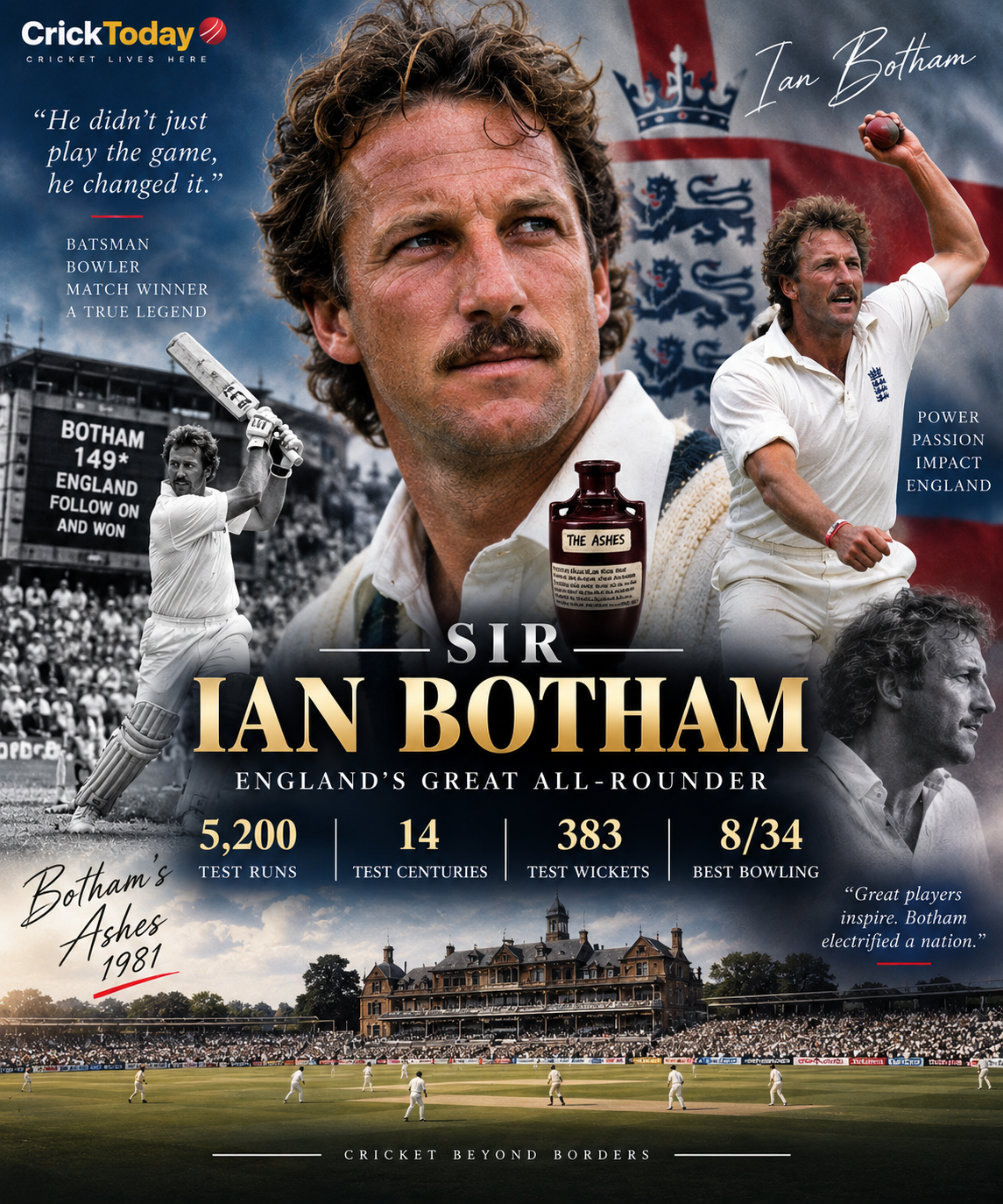

Few cricketers have influenced a match with both bat and ball as dramatically as Sir Ian Botham.
For England, Botham became the kind of player who could change a Test match in a single session. He could attack fast bowlers with fearless hitting, break partnerships with swing and seam, and lift an entire team through sheer presence.
His career was not built on one skill.
It was built on impact.
The Rise of an English All-Rounder
Ian Terence Botham was born on 24 November 1955 in Heswall, England.
He developed into a genuine all-rounder: a powerful right-handed batsman and a right-arm fast-medium bowler capable of taking wickets in almost any conditions.
Botham made his One Day International debut in 1976 and entered Test cricket against Australia in 1977.
His impact was immediate.
He did not need years to establish himself as a major international player.
Botham quickly became one of England’s most important cricketers.
More Than a Specialist
The most valuable all-rounders give their captain two genuine players in one.
Botham did exactly that.
As a batsman, he could produce long Test innings but was especially dangerous when attacking.
He played aggressively before aggressive batting became as common as it is today.
As a bowler, he attacked the stumps and used movement through the air and off the pitch.
That combination made him difficult to replace.
If his batting failed, he could still win a match with the ball.
If the bowling did not produce wickets, he could rescue England with the bat.
Botham the Batsman
Botham’s batting was powerful and direct.
He was not interested in simply occupying the crease.
When the opportunity appeared, he attacked.
His willingness to hit over the top and challenge bowlers made him exciting to watch.
Over his Test career, Botham scored 5,200 runs, including 14 centuries.
His highest Test score was 208.
Those are impressive figures for a player who also carried a major bowling workload.
Botham’s batting often became most dangerous when England were under pressure.
He seemed to enjoy difficult situations.
Botham the Bowler
With the ball, Botham was equally important.
He finished his Test career with 383 wickets.
At the time of his retirement, that made him England’s leading Test wicket-taker.
His best innings figures were 8 for 34.
He also recorded 27 five-wicket hauls in Test innings and took ten wickets in a match on four occasions.
Those numbers placed him among the leading bowlers of his generation even before his batting was considered.
That is what made his overall career so unusual.
The Great All-Rounder Era
Botham played during one of cricket’s greatest periods for all-rounders.
Around the same era, international cricket also featured Imran Khan, Kapil Dev and Richard Hadlee.
Each brought a different style.
Imran combined pace with increasingly strong batting.
Kapil Dev became the centre of India’s fast-bowling attack and a dangerous lower-order hitter.
Hadlee built a reputation through relentless accuracy and movement.
Botham stood comfortably alongside them.
His combination of runs, wickets and match-changing performances made him one of the defining all-rounders of the period.
The 1981 Ashes
No chapter of Botham’s career is more famous than the 1981 Ashes.
The series became so closely associated with him that it is still frequently remembered as “Botham’s Ashes.”
England began the series badly.
Botham had also struggled while serving as captain and stepped down from the leadership.
What followed was one of the most remarkable individual turnarounds in Ashes history.
Headingley 1981
The third Test at Headingley became the defining match.
England were forced to follow on and appeared certain to lose.
Botham came to the crease with the match slipping away.
Instead of surrendering, he attacked.
He scored an unbeaten 149, transforming England’s position and forcing Australia to bat again.
Even then, Australia remained favourites.
But England fast bowler Bob Willis produced a devastating spell, and Australia collapsed.
England won by 18 runs.
The match became one of the most famous comebacks in Test history.
Botham’s innings was the spark.
The Series Turns
Headingley was not an isolated performance.
Botham continued to influence the series.
At Edgbaston, his bowling helped England defend a small target.
At Old Trafford, he produced another powerful century.
England eventually won the Ashes.
Botham had gone from struggling captain to national sporting hero in the space of a few matches.
Few series have ever been so strongly connected with one individual player.
Playing Without Fear
Botham’s biggest strength may have been his refusal to play cautiously when a match demanded action.
He was willing to take risks.
That approach sometimes led to failure.
But it also allowed him to produce performances that more conservative players might never attempt.
Cricket matches can sometimes drift.
Botham had the ability to disrupt them.
A quick fifty, an attacking hundred or a sudden burst of wickets could transform the entire contest.
His Value in Test Cricket
Across 102 Test matches, Botham accumulated:
5,200 runs
14 centuries
22 half-centuries
383 wickets
27 five-wicket innings
120 catches
That combination explains why he remains one of England’s most important all-round cricketers.
Most players would be satisfied with either the batting record or the bowling record.
Botham built both.
One-Day Cricket
Botham also represented England extensively in One Day Internationals.
He played 116 ODIs, scoring 2,113 runs and taking 145 wickets.
Although his Test performances created most of his legend, his ODI record further demonstrated his versatility.
Limited-overs cricket suited his aggressive instincts.
He could contribute quickly with the bat and provide valuable overs with the ball.
Personality and Presence
Botham was not a quiet cricketer.
He played with confidence and emotion.
That personality made him hugely popular with supporters and occasionally controversial.
But it also added to his ability to influence matches.
Opponents knew when Botham entered the contest.
Crowds responded.
Teammates often responded too.
Some players influence cricket through technique.
Others influence it through presence.
Botham had both.
The Later Years
Like many all-rounders, Botham’s body carried the effects of years of heavy workload.
Fast bowling and aggressive batting placed enormous physical demands on him.
His performances became less consistent later in his career.
But by then, his place in English cricket history had already been established.
He continued representing England until 1992.
Life Beyond Playing
Botham remained a major public figure after his playing career ended.
He became involved in broadcasting, charitable work and other public roles.
His cricket achievements, however, remained the foundation of his reputation.
For generations of England supporters, the name Botham still immediately brings back memories of 1981.
Sir Ian Botham’s Lasting Legacy
Botham’s career cannot be understood through statistics alone.
His value came from the way he changed matches.
He scored runs when England appeared beaten.
He took wickets when partnerships looked settled.
He played aggressively at a time when Test cricket was often more conservative.
And he demonstrated what a true all-rounder could contribute.
His final Test record — more than 5,000 runs and 383 wickets — remains an extraordinary combination.
For England, he became more than a player.
He became one of the defining personalities of an era.
That is why Sir Ian Botham remains one of cricket’s great all-rounders.
Quick Facts
Full Name: Ian Terence Botham
Born: 24 November 1955
Country: England
Playing Role: All-rounder
Batting Style: Right-handed
Bowling Style: Right-arm fast-medium
Test Matches: 102
Test Runs: 5,200
Test Centuries: 14
Highest Test Score: 208
Test Wickets: 383
Best Test Bowling: 8/34
Test Five-Wicket Hauls: 27
ODI Matches: 116
ODI Runs: 2,113
ODI Wickets: 145