
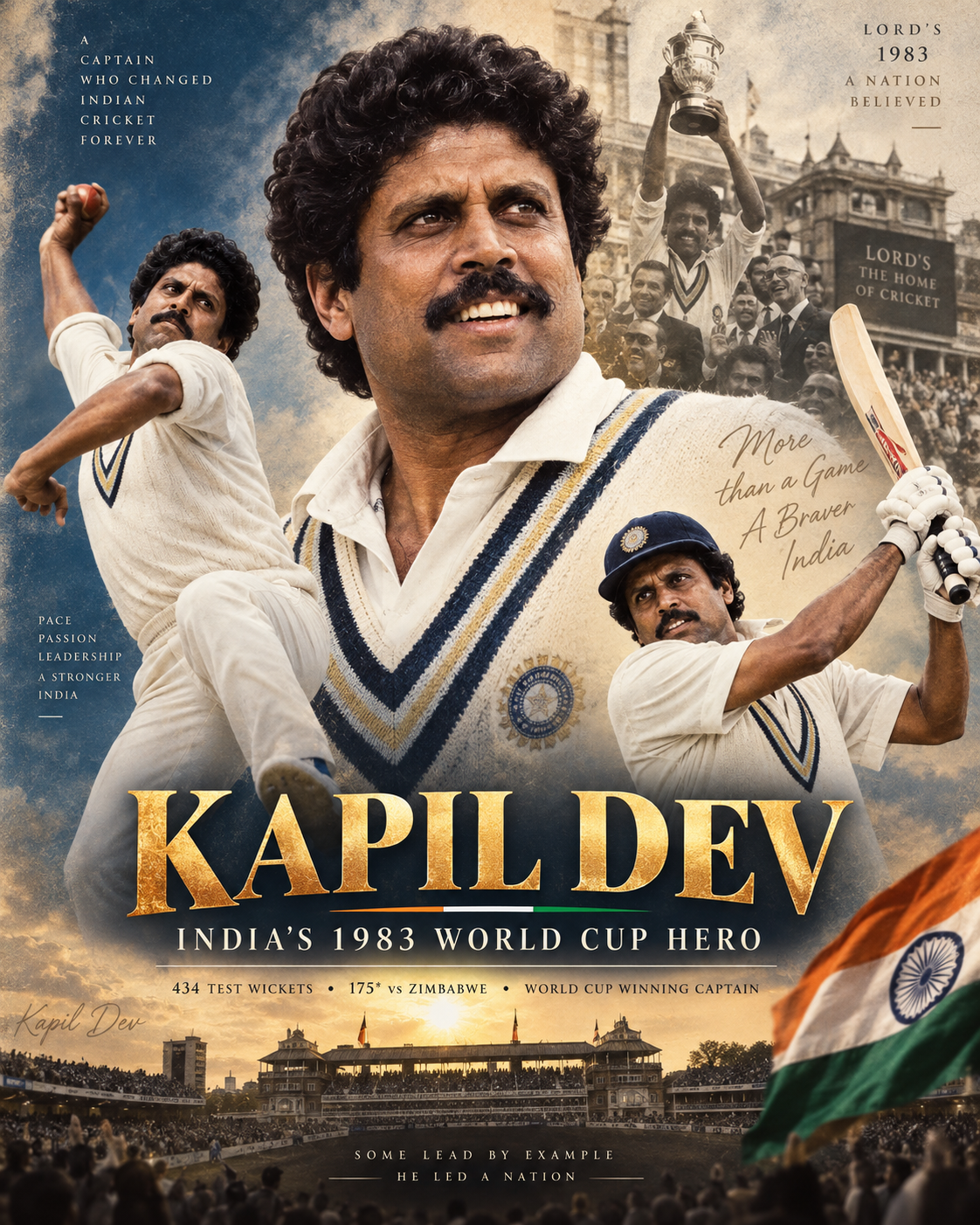

Indian cricket history can be divided into moments before and after 25 June 1983.
Before that day, India had never won the Cricket World Cup.
By the evening, Kapil Dev was standing on the Lord’s balcony holding the trophy above his head.
India had defeated the mighty West Indies.
A team few expected to become world champions had changed the direction of cricket in the country.
At the centre of that transformation stood Kapil Dev.
He was India’s captain.
Their leading fast-bowling all-rounder.
A fearless lower-middle-order batsman.
And the man responsible for one of the most famous innings in World Cup history.
Kapil finished his international career with 434 Test wickets, 5,248 Test runs, 253 ODI wickets and 3,783 ODI runs.
But his legacy is larger than the numbers.
He helped India believe it could defeat anyone.
From Chandigarh to International Cricket
Kapil Dev Nikhanj was born on 6 January 1959 in Chandigarh, India.
Indian cricket during his early years was traditionally associated with batting and spin bowling.
The country had produced elegant batsmen and world-class spinners.
Elite fast bowlers were considerably rarer.
Kapil changed that.
He developed into a genuine pace bowler capable of swinging the ball while also possessing enough natural batting ability to attack international attacks.
India selected him for its tour of Pakistan in 1978.
Kapil made his ODI debut at Quetta before making his Test debut against Pakistan at Faisalabad later that month.
A career lasting more than 16 years had begun.
India Finally Had a Fast-Bowling All-Rounder
Kapil offered India something unusually valuable.
He could open the bowling.
He could take the new ball against the world’s strongest batsmen.
Then he could return later in the innings and attack with the bat.
This gave India balance.
Selecting Kapil did not mean sacrificing batting for bowling or bowling for batting.
He could make meaningful contributions in both disciplines.
That placed him among the great all-rounders of his era.
The Golden Age of All-Rounders
Kapil’s career overlapped with an extraordinary group.
Imran Khan represented Pakistan.
Ian Botham represented England.
Richard Hadlee represented New Zealand.
And Kapil Dev represented India.
Each player was different.
Hadlee was perhaps the most precise bowler.
Botham could change matches with explosive bursts.
Imran developed into an elite fast bowler, strong batsman and outstanding captain.
Kapil combined durability, attacking batting and fast bowling over an exceptionally long career.
Together, they defined one of cricket’s greatest all-rounder eras.
Kapil the Fast Bowler
Kapil was not built around extreme speed.
His strength came from movement, rhythm, stamina and the ability to keep attacking.
His natural outswinger became one of his most important weapons.
Against right-handed batsmen, the ball could begin on a threatening line before moving away.
That brought the outside edge into play.
Kapil also developed enough variation to remain dangerous when conditions did not offer obvious assistance.
For India, he became the strike fast bowler the team had long needed.
The Action
Kapil’s bowling action became instantly recognizable.
His approach to the crease was energetic.
The final jump was athletic.
His arm came through strongly.
The action looked natural rather than mechanical.
That rhythm helped him sustain a huge workload over many years.
Fast bowling places enormous strain on the body.
Kapil continued doing it across 131 Tests.
That longevity became one of the most remarkable features of his career.
More Than a Bowler
Kapil’s batting could be unpredictable.
But when he attacked successfully, the results were spectacular.
He possessed natural power.
He could hit fast bowling.
He could attack spin.
And he rarely appeared intimidated by the situation.
His role often required him to bat with the lower order.
That meant conventional innings-building was not always possible.
Sometimes India simply needed Kapil to attack.
He was extremely comfortable doing exactly that.
Eight Test Centuries
Kapil scored 5,248 Test runs.
He made eight Test centuries and 27 half-centuries.
For a player whose primary responsibility included opening the bowling, those figures were highly significant.
His highest Test score was 163.
He became one of the rare cricketers capable of combining more than 5,000 Test runs with more than 400 wickets.
That statistical combination demonstrates his genuine all-round value.
1983 — The Tournament That Changed Everything
India travelled to England for the 1983 Cricket World Cup without carrying the expectations associated with modern Indian teams.
The West Indies had won the first two World Cups.
They possessed one of the most intimidating teams in cricket history.
India were not considered the obvious challenger.
Kapil Dev was captain.
The tournament began producing surprises almost immediately.
India defeated West Indies during the group stage.
Suddenly, belief began to grow.
But one match against Zimbabwe threatened to end the dream.
17 for Five
India faced Zimbabwe at Tunbridge Wells.
The situation became disastrous.
India were reduced to:
17 for five.
A World Cup campaign was beginning to collapse.
Kapil Dev walked into the crisis.
Another wicket fell.
Then another.
India eventually slipped to 78 for seven.
The innings required something extraordinary.
Kapil produced it.
175 Not Out
Kapil attacked.
He rebuilt.
He accelerated.
And he kept going.
When India’s innings ended, the captain was unbeaten on:
175 from 138 balls.
He had struck 16 fours and six sixes.
India recovered to 266 for eight.
Zimbabwe were eventually dismissed for 235.
India won by 31 runs.
The World Cup campaign was alive.
The Great Innings Nobody Saw Live
One of the strangest details surrounding Kapil’s 175* is that the match was not televised.
There is no complete broadcast recording of one of the most important innings in Indian cricket history.
Only those inside the ground and people following other forms of coverage experienced it live.
That absence almost adds to the mythology.
Generations of cricket supporters have heard about the innings without ever being able to watch the complete performance.
The numbers have to tell the story.
From 17 for five to 266 for eight.
Kapil 175 not out.
A World Record at the Time
Kapil’s 175* was not merely a rescue innings.
At the time, it was the highest individual score ever made in One Day International cricket.
It was also the highest score of the 1983 World Cup.
The performance represented almost everything Kapil brought to cricket.
Courage.
Aggression.
Confidence.
And an unwillingness to accept that the match was already lost.
Reaching the Final
India moved through the tournament.
In the semi-final, they defeated England at Manchester.
One match remained.
The opponent could hardly have been more intimidating.
West Indies.
The defending champions.
Winners in 1975.
Winners again in 1979.
A side containing Viv Richards and one of the greatest fast-bowling attacks cricket had seen.
India entered the final as underdogs.
Lord’s — 25 June 1983
India batted first.
The innings never really took control.
They were dismissed for only:
183.
Against West Indies, that total appeared far too small.
A third consecutive World Cup title for the Caribbean side seemed entirely realistic.
India needed early wickets.
They got them.
But then Viv Richards began attacking.
The match appeared to be moving towards West Indies again.
Then came one of the most important catches in cricket history.
The Viv Richards Catch
Richards attempted an aggressive shot from Madan Lal’s bowling.
The ball went high into the air.
Kapil turned.
He ran backwards.
For a moment, the entire final seemed suspended above him.
Kapil completed the catch.
Richards was gone.
The balance of the match shifted.
India kept taking wickets.
West Indies were eventually bowled out for:
140.
India had won by 43 runs.
World Champions
Kapil lifted the Cricket World Cup at Lord’s.
The image became iconic.
India had defeated a team many considered almost unbeatable.
It was the country’s first World Cup championship.
The victory transformed Indian cricket.
Millions of young supporters gained new heroes.
Cricket’s popularity accelerated.
And future generations grew up believing India belonged among the sport’s major powers.
Kapil became permanently associated with that transformation.
More Than the 1983 Captain
The World Cup inevitably dominates discussions about Kapil.
But reducing his career to one tournament would ignore years of elite performance.
He remained India’s leading fast bowler for much of his career.
He continued scoring valuable runs.
And his wicket tally kept growing.
Eventually, he moved towards a record that once appeared almost unreachable.
The Chase for the Test Wicket Record
New Zealand’s Richard Hadlee had retired with 431 Test wickets.
It was the world record.
Kapil approached the total near the end of his own career.
In 1994, he passed Hadlee.
Kapil eventually finished with:
434 Test wickets.
For a period, no bowler in Test cricket history had taken more.
West Indies fast bowler Courtney Walsh eventually surpassed him.
But Kapil had already established one of the great bowling careers.
434 Test Wickets
Kapil’s 434 wickets came across 131 Test matches.
The figure becomes particularly important in the context of Indian cricket.
India had traditionally relied heavily on spin.
Kapil demonstrated that an Indian fast bowler could sustain an elite career across conditions and generations.
Future Indian quicks would follow.
But Kapil was the pioneer.
A Former ODI Wicket Record Holder
Kapil also achieved major success in One Day International bowling.
He finished with:
253 ODI wickets from 225 matches.
In 1988, he became the leading wicket-taker in ODI history at the time.
He held the record until Wasim Akram eventually moved past him in 1994.
So for periods of his career, Kapil had occupied the summit of both Test and ODI wicket-taking records.
That demonstrates the scale of his bowling achievements.
687 International Wickets
Across Tests and ODIs, Kapil took:
687 international wickets.
That total becomes even more impressive when combined with his batting.
He was not a specialist bowler who occasionally swung the bat.
He scored more than:
9,000 international runs.
Very few careers contain that level of contribution in both disciplines.
ODI Batting
Kapil played 225 ODIs.
He scored:
3,783 runs.
His highest score remained the legendary:
175 not out.
His batting style was naturally suited to limited-overs cricket.
He could accelerate quickly.
He was capable of hitting boundaries from the moment he arrived.
And batting lower in the order frequently required exactly that approach.
ODI Bowling
With the ball, Kapil claimed:
253 wickets.
His best ODI figures were:
5 for 43.
Those figures came against Australia during the 1983 World Cup.
So even during the tournament remembered primarily for his captaincy and 175*, Kapil was also producing major bowling performances.
That was the benefit of a genuine all-rounder.
He could influence the same competition in several different ways.
The 1983 World Cup Numbers
Kapil scored 303 runs during the 1983 tournament.
Only four batsmen scored more.
His 175* was the highest individual score of the competition.
India’s bowling attack was led statistically by players such as Roger Binny and Madan Lal, but Kapil remained an important part of the attack.
Captain.
Fast bowler.
Middle-order hitter.
He carried several responsibilities simultaneously.
Leadership
Kapil’s captaincy style reflected the way he played.
Positive.
Instinctive.
Fearless.
India’s 1983 team was not built around the expectation of domination.
Kapil helped create belief.
That may have been his greatest leadership contribution.
Before tactics matter, players must believe victory is possible.
India began the tournament as outsiders.
They ended it holding the trophy.
Taking on the West Indies
The scale of India’s World Cup achievement is easier to appreciate when remembering the strength of the West Indies.
They had dominated international cricket.
Their fast bowlers intimidated batting orders around the world.
Their batting contained extraordinary talent.
Viv Richards was among the greatest players ever.
India defeated them in the group stage.
Then defeated them again in the final.
Those victories were not accidents.
They represented a team refusing to accept the established hierarchy.
Kapil’s Catch as a Symbol
The catch of Richards became symbolic because it represented more than one wicket.
Richards appeared capable of taking the final away from India.
Kapil’s catch removed the biggest threat.
It required athleticism, concentration and nerve.
Great tournaments are often remembered through single images.
Dhoni’s six in 2011.
Warne’s celebrations.
Gilchrist’s attacks.
Kapil running backwards beneath the Lord’s sky belongs among them.
An Aggressive Lower-Order Batsman
Kapil’s batting style helped redefine expectations for bowling all-rounders.
He did not simply protect his wicket.
He counterattacked.
A team might believe India’s recognised batsmen had been dismissed.
Then Kapil arrived.
The scoring rate could suddenly increase.
This ability to attack from the lower order gave India something particularly valuable in an era before deep batting line-ups became common.
Never Playing for Personal Numbers
Kapil’s batting record could possibly have looked different had he played more conservatively.
But personal accumulation was rarely the defining characteristic of his batting.
He often attacked because the match demanded it.
That approach occasionally cost him.
It also produced unforgettable innings.
The 175* exists precisely because Kapil was willing to change the match rather than simply survive it.
Playing Across an Era of Great Fast Bowling
Kapil’s career took place during one of cricket’s greatest fast-bowling periods.
West Indies had extraordinary pace attacks.
Pakistan had Imran Khan, Wasim Akram and Waqar Younis.
Australia produced Dennis Lillee and later other major quicks.
New Zealand had Richard Hadlee.
England had Ian Botham and others.
Kapil competed in an era where fast bowling was central to international cricket.
He still built a record of 434 Test wickets.
The All-Rounder Comparison
Comparisons between Kapil, Imran, Botham and Hadlee remain popular.
There is no simple answer because their strengths differed.
Hadlee’s bowling record was exceptional.
Imran combined elite bowling with leadership and increasingly strong batting.
Botham produced extraordinary match-winning performances.
Kapil’s longevity and balance between pace bowling and aggressive batting made him unique.
Each belongs to cricket history for different reasons.
The existence of all four during overlapping careers made their era extraordinary.
A Career Without a World Cup Repeat
India did not repeat the 1983 triumph during Kapil’s playing career.
They reached the semi-finals of the 1987 World Cup on home soil but lost to England.
Kapil remained a major figure.
But the 1983 championship stood alone.
That perhaps increased its significance.
It was not one title in a long period of dominance.
It was a breakthrough.
The moment everything changed.
Final International Years
Kapil continued playing into the early 1990s.
By then, Indian cricket was entering another era.
Sachin Tendulkar had arrived.
New players were emerging.
The sport was changing rapidly.
Kapil finally ended his international career in 1994.
He left as Test cricket’s leading wicket-taker at the time.
His career had lasted more than 16 years.
131 Tests
Kapil’s Test record included:
131 matches
5,248 runs
Eight centuries
27 half-centuries
434 wickets
His best Test match bowling figures were:
11 for 146.
These numbers place him among the most statistically complete all-rounders Test cricket has produced.
225 ODIs
His ODI career included:
225 matches
3,783 runs
253 wickets
Highest score: 175 not out
Best bowling: 5 for 43
And, most importantly:
1983 World Cup-winning captain.
The Hall of Fame
In 2010, Kapil Dev was inducted into the ICC Cricket Hall of Fame.
It was fitting recognition for a player who had influenced Indian cricket in multiple ways.
Fast bowler.
All-rounder.
Captain.
World champion.
Record-holder.
His achievements had long since secured his place in the sport’s history.
The Impact on Indian Fast Bowling
India would later produce generations of high-quality fast bowlers.
Javagal Srinath.
Zaheer Khan.
Ishant Sharma.
Mohammed Shami.
Jasprit Bumrah.
And others.
Kapil belonged to an earlier era.
He demonstrated that pace bowling could become a major Indian weapon.
For young fast bowlers in the country, he provided proof that the pathway existed.
The Impact of 1983
The larger influence of the 1983 World Cup is difficult to measure statistically.
India’s victory increased cricket’s cultural importance in the country.
The following decades saw enormous commercial growth.
Television expanded.
New generations of stars emerged.
India eventually became one of the most influential forces in global cricket.
Kapil did not create all of that alone.
But the image of him lifting the World Cup became one of the moments that helped start the transformation.
Kapil Dev’s Career Numbers
Kapil Dev finished with:
131 Test matches
5,248 Test runs
Eight Test centuries
27 Test half-centuries
Highest Test score: 163
434 Test wickets
Best Test innings bowling: 9/83
225 ODIs
3,783 ODI runs
Highest ODI score: 175*
253 ODI wickets
Best ODI bowling: 5/43
9,031 international runs
687 international wickets
1983 World Cup champion
1983 World Cup-winning captain
1983 World Cup runs: 303
Former world record holder for Test wickets
Former world record holder for ODI wickets
ICC Hall of Fame: 2010
Why Kapil Dev Was Different
Kapil arrived when India needed a player like him.
A genuine fast bowler.
A dangerous batsman.
An athletic fielder.
A leader willing to believe the impossible was possible.
He did not simply fit into Indian cricket.
He expanded it.
The team could now attack with pace.
The lower order could fight back with the bat.
And in 1983, India discovered that even the strongest team in the world could be defeated.
Kapil Dev’s Lasting Legacy
Kapil Dev’s legacy begins with a trophy.
But it does not end there.
He scored more than 5,000 Test runs.
He took 434 Test wickets.
He held the world record for Test wickets.
He held the world record for ODI wickets.
He played one of the greatest World Cup innings ever recorded.
And he captained India to its first global cricket championship.
Before 1983, India had participated in World Cups.
After 1983, future generations expected India to compete for them.
That difference matters.
Kapil Dev did not merely lead India to a famous victory.
He helped change what Indian cricket believed was possible.
Quick Facts
Full Name: Kapil Dev Nikhanj
Born: 6 January 1959
Country: India
Playing Role: All-rounder
Batting Style: Right-handed
Bowling Style: Right-arm fast-medium
International Career: 1978–1994
Test Matches: 131
Test Runs: 5,248
Test Centuries: 8
Test Half-Centuries: 27
Highest Test Score: 163
Test Wickets: 434
Best Test Bowling: 9/83
ODI Matches: 225
ODI Runs: 3,783
Highest ODI Score: 175*
ODI Wickets: 253
Best ODI Bowling: 5/43
International Runs: 9,031
International Wickets: 687
1983 World Cup: Champion Captain
1983 World Cup Runs: 303
175 vs Zimbabwe:* 138 balls, 16 fours, 6 sixes
Former Test Wicket World Record Holder: Yes
Former ODI Wicket World Record Holder: Yes
ICC Hall of Fame: 2010