
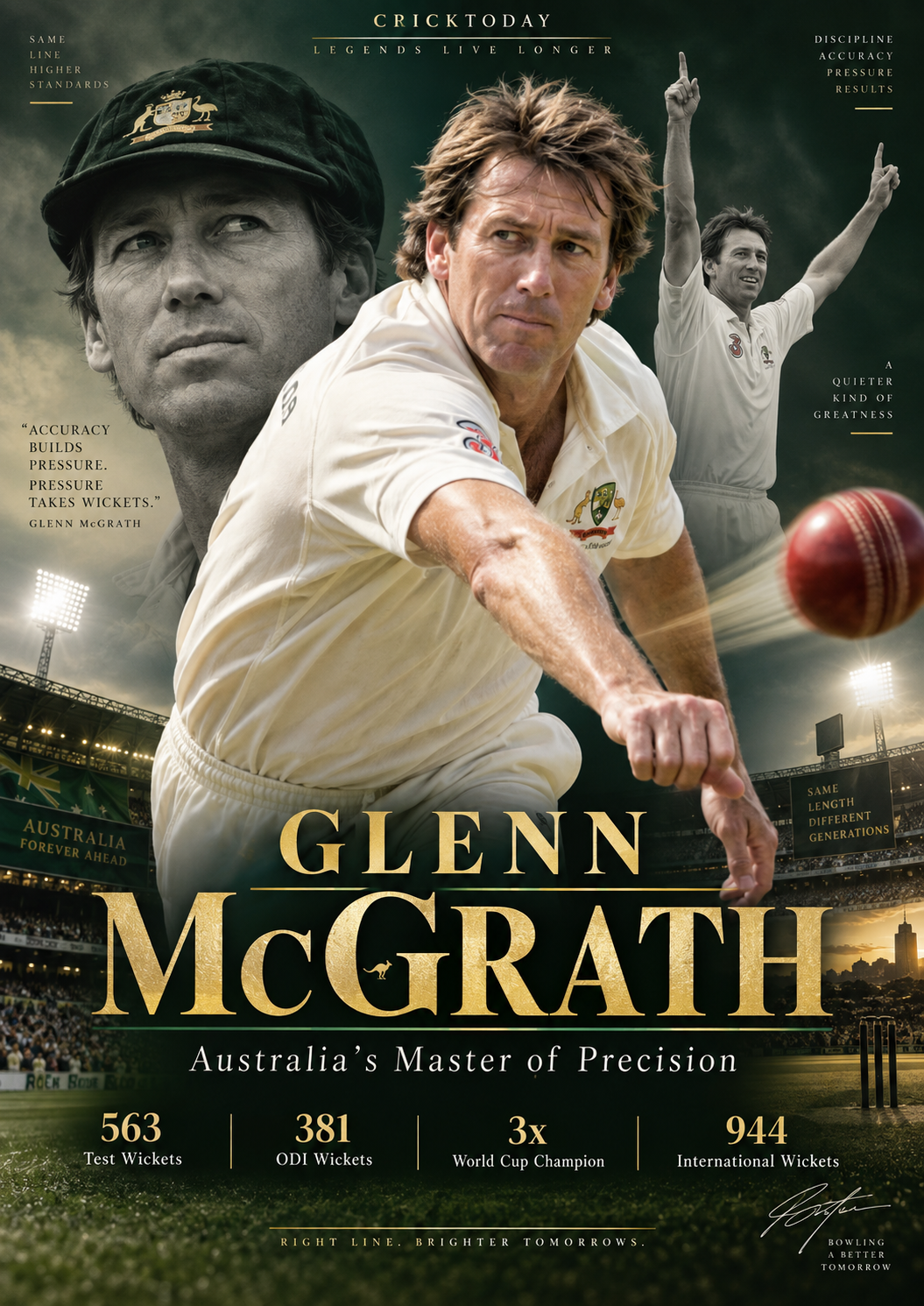

Fast bowling is often associated with extreme pace.
Glenn McGrath proved that precision could be just as destructive.
He did not regularly bowl at the speeds of the quickest men of his generation. He did not depend on extravagant swing or intimidating theatrics.
Instead, McGrath built one of cricket’s greatest bowling careers by putting the ball in almost exactly the right place, over and over again.
Off stump.
Good length.
Movement away.
Occasionally one coming back.
The batsman knew what was coming.
That rarely made it easier.
By the time McGrath retired, he had taken 563 Test wickets and 381 ODI wickets, won three Cricket World Cups and established himself as one of the defining fast bowlers of Australia’s golden era.
His method looked simple.
Executing it for more than a decade was anything but simple.
From Dubbo to International Cricket
Glenn Donald McGrath was born on 9 February 1970 in Dubbo, New South Wales, Australia.
His rise towards international cricket was not built around extraordinary raw speed.
What selectors increasingly noticed was his control.
McGrath could repeatedly hit a demanding line and length while extracting bounce from his tall frame.
That combination made him difficult to score against and even harder to survive for long periods.
He made his Test debut for Australia in 1993.
At the time, Australia were developing into a stronger international side.
Within a few years, McGrath would become one of the major reasons they became dominant.
The Simplest Plan in Fast Bowling
McGrath’s bowling philosophy could almost sound too basic.
Target the area just outside off stump.
Make the batsman play.
Create uncertainty.
Repeat.
But international batting is decided by tiny margins.
A delivery slightly too wide can be left.
A delivery slightly too full can be driven.
A delivery slightly too short can be cut or pulled.
McGrath repeatedly found the narrow zone between those options.
The batsman had to make a decision.
Play or leave?
Move forward or stay back?
Expect the ball to hold its line or move away?
McGrath asked those questions all day.
Accuracy as a Weapon
Many fast bowlers create pressure through pace.
McGrath created pressure through the absence of mistakes.
Batsmen could wait for a loose delivery.
Sometimes it never arrived.
One maiden over became two.
Then three.
The scoring rate slowed.
Patience disappeared.
A batsman eventually attempted something unnecessary.
McGrath took the edge.
That sequence occurred hundreds of times during his career.
His accuracy was not defensive.
It was attacking in a different form.
The Bounce
McGrath’s height gave his bowling another important dimension.
Even from a normal good length, he could generate uncomfortable bounce.
A delivery that another bowler might have produced at stump height could climb towards the gloves or shoulder of the bat.
That created edges.
It also made batsmen uncertain about coming forward.
McGrath therefore did not need to bowl constant bouncers to make bounce dangerous.
His natural trajectory did much of the work.
Becoming Australia’s Strike Bowler
During the 1990s, McGrath developed from a promising seamer into one of Australia’s principal attacking bowlers.
He increasingly shared responsibility with some outstanding teammates.
Craig McDermott.
Jason Gillespie.
Damien Fleming.
Brett Lee.
And, of course, Shane Warne.
Australia were building one of the strongest bowling attacks in cricket.
McGrath became the man opponents knew would give them almost nothing.
McGrath and Shane Warne
Few bowling partnerships have complemented each other as effectively as Glenn McGrath and Shane Warne.
Their methods were completely different.
McGrath attacked with pace, bounce and relentless accuracy.
Warne attacked with leg-spin, drift, turn and deception.
A batsman surviving one still had to face the other.
McGrath could build pressure from one end.
Warne could exploit it from the other.
Or the roles could reverse.
Together, they became central to Australia’s dominance.
Choosing the Opposition’s Best Batsman
McGrath developed a habit that became part of his public personality.
Before major series, he would often identify the opposition’s most important batsman as the wicket he particularly wanted.
Brian Lara.
Sachin Tendulkar.
Michael Atherton.
Others followed.
The statements created headlines.
But McGrath frequently backed them up.
He enjoyed the challenge of bowling to elite batsmen.
Great players did not make him cautious.
They gave him a target.
The Battle With Michael Atherton
One batsman became especially associated with McGrath’s success.
England captain and opener Michael Atherton.
McGrath repeatedly dismissed him during Ashes contests.
The match-up demonstrated why McGrath was so difficult for top-order batsmen.
Atherton possessed strong defensive technique.
McGrath simply kept attacking the same corridor.
Eventually, one ball did enough.
The edge followed.
It became one of the most famous bowler-batsman match-ups of the era.
The Ashes
McGrath became deeply associated with Australian Ashes success.
England understood that surviving the new ball against him was essential.
Australia understood that early McGrath wickets could transform a Test.
Throughout the 1990s and early 2000s, Australia dominated much of the rivalry.
McGrath was one of the central figures.
When conditions offered seam movement, he became dangerous.
When conditions were flat, his accuracy still created pressure.
There was no obvious surface on which batting against him became comfortable.
Lord’s 1997
One of McGrath’s most memorable performances came at Lord’s during the 1997 Ashes.
England were dismissed for just 77.
McGrath produced devastating figures of:
8 wickets for 38 runs.
The spell became one of the defining performances of his career.
Lord’s is often called the home of cricket.
McGrath had produced a masterclass there.
The performance also reinforced his reputation as one of the most dangerous bowlers in English conditions.
The 1999 Cricket World Cup
The 1999 Cricket World Cup became a major turning point in Australia’s history.
Their tournament began poorly.
Losses placed them under enormous pressure.
Australia effectively had to keep winning.
McGrath became increasingly important as the campaign progressed.
Against the West Indies, he produced figures of:
5 for 14.
Australia survived the tournament’s difficult early stages and reached the knockout rounds.
The 1999 Semi-Final
Australia faced South Africa at Edgbaston in one of the most famous World Cup matches ever played.
The match ended in a tie.
Australia advanced to the final because of their position in the previous Super Six stage.
McGrath played his role in the bowling attack.
Four days later, Australia faced Pakistan at Lord’s.
World Champion
Pakistan were bowled out for only 132 in the 1999 World Cup final.
Australia chased the target comfortably.
McGrath had his first World Cup trophy.
Nobody knew at the time that Australia were beginning one of the greatest tournament dynasties cricket would ever see.
McGrath would be there for all of it.
The 2003 Cricket World Cup
Australia entered the 2003 World Cup in South Africa as defending champions.
The team dominated the tournament.
McGrath produced one of the most devastating bowling performances in World Cup history against Namibia.
His figures were:
7 wickets for 15 runs.
At the time, they were the best bowling figures ever recorded in a men’s Cricket World Cup match.
Australia dismissed Namibia for 45.
McGrath’s accuracy against an inexperienced batting line-up was simply overwhelming.
Australia Goes Undefeated
The 2003 Australian side did not lose a match.
They defeated Sri Lanka in the semi-final.
India waited in the final.
Ricky Ponting scored an unforgettable unbeaten 140 as Australia posted 359 for two.
India needed an extraordinary chase.
McGrath struck almost immediately.
Sachin Tendulkar was dismissed in the opening over.
Australia eventually won by 125 runs.
McGrath was now a two-time World Cup champion.
The Perfect New-Ball Bowler
McGrath’s new-ball method was perfectly suited to major tournaments.
Early wickets change one-day matches.
Remove an opener and the opposition must rebuild.
Remove two and the entire batting plan can collapse.
McGrath attacked immediately.
He did not waste the new ball.
He forced the batsman to play.
His economy also created pressure from the other end.
That combination made him one of the finest ODI fast bowlers of his era.
563 Test Wickets
McGrath’s Test career eventually reached:
563 wickets from 124 matches.
His bowling average was only:
21.64.
Those figures are extraordinary.
At retirement, McGrath held the record for the most Test wickets taken by a fast bowler.
The record lasted until England’s James Anderson passed him in 2018.
For more than a decade after McGrath’s final Test, 563 remained the standard fast bowlers were chasing.
Test Bowling Average
A bowling average measures how many runs a bowler concedes for every wicket taken.
The lower the number, the better.
Maintaining an average near 21 across 124 Tests is remarkable.
McGrath played on fast pitches.
Slow pitches.
Turning pitches.
Flat surfaces.
Home and away.
Different conditions changed.
The fundamental method remained effective.
That is the sign of a truly great bowler.
29 Five-Wicket Hauls
McGrath recorded 29 five-wicket hauls in Test innings.
He also produced three ten-wicket match performances.
These figures show that his wicket total was not built only through longevity.
There were matches where he completely controlled the opposition.
Five wickets in an innings can define a Test.
McGrath did it repeatedly.
The 2005 Ashes
The 2005 Ashes became one of the greatest Test series ever played.
Australia entered as the dominant team in world cricket.
England believed they could finally challenge them.
McGrath demonstrated his importance immediately.
At Lord’s, he took five wickets as England collapsed in their first innings.
Australia won the Test comfortably.
Then everything changed.
The Edgbaston Injury
Before the second Test at Edgbaston, McGrath stepped on a cricket ball during warm-ups.
He injured his ankle.
He could not play.
England won a thrilling Test by just two runs.
The series was alive.
McGrath returned later, but the interruption mattered.
England eventually won the Ashes 2–1.
The series reinforced something Australia already understood:
McGrath’s presence changed their bowling attack dramatically.
Returning the Ashes 5–0
Australia did not forget the defeat.
England toured Australia in 2006–07.
The response was brutal.
Australia won:
5–0.
A complete Ashes whitewash.
For McGrath, it was his final Test series.
He had announced that he would retire from Test cricket after the Ashes and from international cricket after the upcoming World Cup.
His home farewell could hardly have been more dominant.
Final Test
McGrath’s final Test was played at the Sydney Cricket Ground in January 2007.
Australia completed the 5–0 Ashes victory.
Shane Warne was also retiring.
Two of the defining bowlers of Australia’s golden era were leaving together.
McGrath departed Test cricket with 563 wickets.
One tournament remained.
The 2007 World Cup
McGrath was 37 years old when Australia arrived in the Caribbean for the 2007 Cricket World Cup.
It would be his final international tournament.
Some may have expected him simply to contribute experience.
Instead, he produced the most prolific World Cup campaign of his career.
He took wickets in every match.
Australia kept winning.
McGrath kept adding to his record.
26 Wickets
Across the 2007 World Cup, McGrath took:
26 wickets in 11 matches.
At the time, it was the most wickets any bowler had ever taken in a single Cricket World Cup.
He repeatedly removed important batsmen and remained economical.
Australia reached another final without losing a match.
McGrath was ending his career at the highest possible level.
The Semi-Final Against South Africa
South Africa faced Australia in the semi-final.
Their batting collapsed.
McGrath took 3 for 18.
Shaun Tait added four wickets.
South Africa were dismissed for only 149.
Australia won by seven wickets.
One final international match remained in McGrath’s career.
A World Cup final.
The Final Match
Australia faced Sri Lanka in Barbados.
Adam Gilchrist produced a breathtaking 149.
Australia won the rain-affected final.
McGrath had completed his career with another world championship.
His final international appearance ended with him lifting the Cricket World Cup.
It was his third.
Player of the Tournament
McGrath finished the 2007 World Cup as the tournament’s leading wicket-taker.
His 26 wickets helped earn him the Player of the Tournament award.
There could hardly have been a better farewell.
A 37-year-old fast bowler had entered his final competition.
He left as:
A world champion.
The tournament’s leading wicket-taker.
And its best player.
Three World Cup Titles
McGrath was part of Australian World Cup-winning teams in:
1999
2003
and
2007.
Very few players in men’s cricket history have won three World Cups.
McGrath did it consecutively.
Those tournaments also demonstrated his longevity.
Eight years separated the first and third victories.
McGrath remained one of Australia’s major bowlers throughout.
71 World Cup Wickets
Across four Cricket World Cups, McGrath took:
71 wickets in 39 matches.
He retired as the leading wicket-taker in the history of the men’s Cricket World Cup.
His tournament record included:
18 wickets in 1999
21 wickets in 2003
and
26 wickets in 2007.
When the stakes increased, McGrath repeatedly delivered.
ODI Greatness
McGrath played 250 One Day Internationals.
He took:
381 wickets.
His bowling average was:
22.02.
Those numbers made him one of the most successful fast bowlers ODI cricket had seen.
His value came from combining wickets with control.
Opposition batsmen could not simply wait for his spell to end without consequence.
The required run rate would climb.
Pressure would increase.
Another bowler would benefit.
The 7 for 15
McGrath’s best ODI bowling figures remained the famous:
7 for 15 against Namibia in 2003.
The spell was technically simple.
Hit the right area.
Let the batsmen make mistakes.
But producing seven wickets in an international match requires ruthless execution.
McGrath gave weaker opposition almost nothing.
Against elite opposition, he usually offered very little more.
The Great Australian Attack
McGrath belonged to an extraordinary Australian bowling generation.
Shane Warne
Jason Gillespie
Brett Lee
Damien Fleming
and others.
Warne provided world-class spin.
Lee provided extreme pace.
Gillespie provided seam and control.
McGrath provided relentless precision.
The attack could challenge almost any batting line-up in almost any condition.
Bowling to Sachin Tendulkar
One of McGrath’s most fascinating challenges was bowling to Sachin Tendulkar.
Their careers overlapped for many years.
Tendulkar was among the finest batsmen the sport had seen.
McGrath was among its finest bowlers.
Their contests became must-watch cricket.
Neither dominated every encounter.
That made the rivalry compelling.
Elite batsman against elite bowler.
Patience against precision.
Small mistakes decided everything.
Bowling to Brian Lara
McGrath also faced Brian Lara, another of the era’s greatest batsmen.
Lara could destroy attacks when allowed to settle.
McGrath frequently spoke about the importance of dismissing him early.
The challenge represented exactly what McGrath enjoyed.
He wanted the opposition’s greatest player.
His career was filled with those battles.
The Mental Side of Bowling
McGrath did not need complicated tactical theatre.
His confidence came from knowing he could execute his plan.
That certainty became psychological pressure.
The batsman knew the ball would arrive near off stump.
He knew he might need to play.
He knew one small technical error could end the innings.
Facing predictability is normally supposed to make batting easier.
McGrath somehow made predictability threatening.
The Difference Between Simple and Easy
This distinction explains McGrath better than almost anything else.
His bowling plan was simple.
That did not make it easy.
Anyone can say:
“Bowl just outside off stump.”
Very few fast bowlers can do it six times an over.
For hours.
Across five days.
Across 124 Test matches.
Against the best batsmen in the world.
McGrath could.
His Partnership With Adam Gilchrist
Behind the stumps, Australia had another great player:
Adam Gilchrist.
McGrath’s ability to find outside edges combined perfectly with an attacking wicketkeeper.
Many dismissals followed the same pattern.
McGrath lands the ball in the corridor.
The batsman plays.
The edge comes.
Gilchrist takes the catch.
Simple.
Clinical.
Australian cricket repeated it for years.
McGrath the Batsman
Nobody selected Glenn McGrath for his batting.
That became part of his charm.
His lower-order appearances often produced enormous crowd reactions.
Every run felt like an event.
His highest Test score was 61.
When he reached his only Test half-century against New Zealand in 2004, teammates and spectators celebrated as though a major batting record had fallen.
McGrath himself clearly enjoyed the moment.
For once, the great bowler had become the batting story.
Retirement at the Perfect Moment
Many athletes struggle to choose when to leave.
McGrath’s final year unfolded almost perfectly.
A 5–0 Ashes victory.
His final Test at home.
Then the 2007 World Cup.
Twenty-six wickets.
Player of the Tournament.
Another championship.
Final international match: World Cup victory.
There was nowhere higher to go.
Life After Cricket
McGrath remained connected to cricket after retirement.
He became involved in coaching and mentoring fast bowlers.
His understanding of line, length, control and tactical planning made him a natural source of advice for younger players.
But another part of his post-playing life became even more significant.
The McGrath Foundation
Glenn McGrath and his late wife Jane became closely associated with breast cancer support and awareness.
After Jane’s diagnosis, their experience eventually contributed to the creation of the McGrath Foundation.
The organization became widely recognized in Australia.
Cricket also became strongly connected with its work.
The annual Sydney Test developed a prominent pink theme supporting the cause.
McGrath’s legacy therefore extended far beyond wickets.
The Pink Test
The Sydney Test’s connection with the McGrath Foundation became one of Australian cricket’s most recognizable charitable traditions.
Crowds wear pink.
The ground incorporates pink branding.
Funds and awareness support breast cancer care.
It transformed part of McGrath’s personal story into a national cricket tradition with meaning far beyond sport.
Few players leave behind that kind of legacy.
Hall of Fame
In 2012, Glenn McGrath was inducted into the ICC Cricket Hall of Fame.
The honour recognized a career containing:
More than 500 Test wickets.
More than 300 ODI wickets.
Three World Cups.
An extraordinary World Cup record.
And a place at the centre of one of cricket’s greatest teams.
His statistics made the decision straightforward.
Glenn McGrath’s Career Numbers
McGrath’s international record includes:
124 Test matches
563 Test wickets
Test bowling average: 21.64
29 Test five-wicket hauls
Three Test ten-wicket matches
Best Test bowling: 8/24
250 ODIs
381 ODI wickets
ODI bowling average: 22.02
Best ODI bowling: 7/15
944 international wickets
1999 Cricket World Cup: Champion
2003 Cricket World Cup: Champion
2007 Cricket World Cup: Champion
2007 World Cup wickets: 26
2007 World Cup: Player of the Tournament
Career World Cup wickets: 71
ICC Hall of Fame: 2012
Why Glenn McGrath Was Different
McGrath’s greatness contained a contradiction.
Everyone knew what he wanted to do.
Almost nobody could consistently stop him doing it.
He did not need mystery.
He did not need extreme pace.
He did not need twenty variations.
He needed control.
A ball near off stump.
A little bounce.
A tiny amount of movement.
Then another.
Then another.
And eventually, the batsman made the mistake.
Glenn McGrath’s Lasting Legacy
Some bowlers are remembered for frightening pace.
Others for devastating swing.
Others for spectacular deliveries.
Glenn McGrath became legendary through precision.
He took 563 Test wickets.
He took 381 ODI wickets.
He won three consecutive World Cups.
He retired with 71 World Cup wickets.
And in his final tournament, at 37 years old, he took 26 wickets and was named Player of the Tournament.
McGrath made elite fast bowling appear almost uncomplicated.
Run in.
Hit the right area.
Force the batsman to make a decision.
Repeat.
The simplicity was deceptive.
Behind it was one of the greatest levels of control cricket has ever seen.
For more than a decade, the world’s finest batsmen knew exactly where Glenn McGrath was going to bowl.
Knowing rarely saved them.
Quick Facts
Full Name: Glenn Donald McGrath
Born: 9 February 1970
Country: Australia
Playing Role: Bowler
Batting Style: Right-handed
Bowling Style: Right-arm fast-medium
International Career: 1993–2007
Test Matches: 124
Test Wickets: 563
Test Bowling Average: 21.64
Test Five-Wicket Hauls: 29
Test Ten-Wicket Matches: 3
Best Test Bowling: 8/24
ODI Matches: 250
ODI Wickets: 381
ODI Bowling Average: 22.02
Best ODI Bowling: 7/15
International Wickets: 944
1999 World Cup: Champion
2003 World Cup: Champion
2007 World Cup: Champion
2007 World Cup Wickets: 26
2007 World Cup: Player of the Tournament
Career World Cup Wickets: 71
ICC Hall of Fame: 2012