
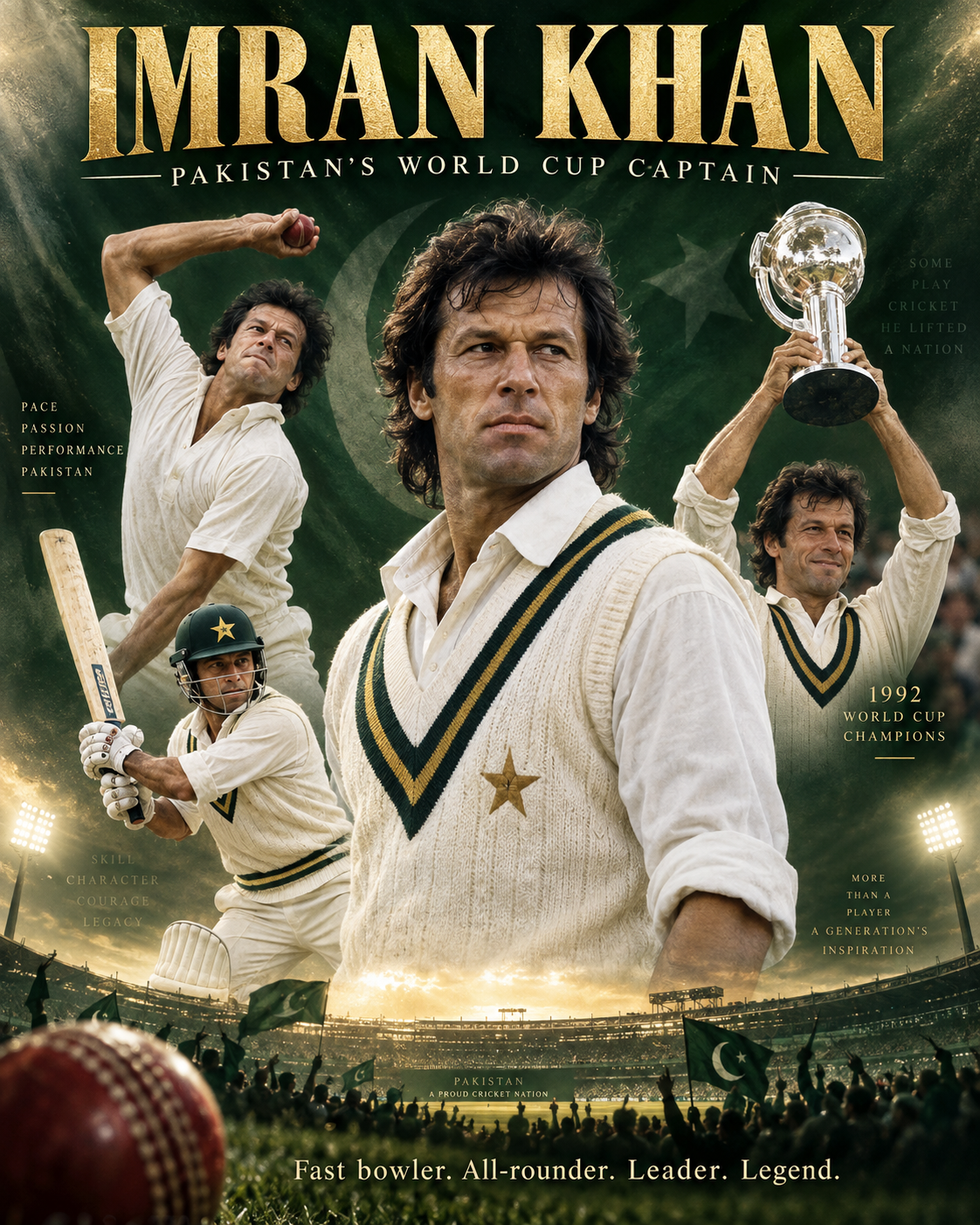

Few cricketers have influenced Pakistan cricket as deeply as Imran Khan.
He began as a talented fast bowler.
He developed into one of the finest all-rounders of his generation.
Then he became the captain who led Pakistan to its first Cricket World Cup title.
Across a 21-year international career, Imran scored 3,807 Test runs, took 362 Test wickets, added another 3,709 runs and 182 wickets in ODIs, and built a reputation as one of the most complete cricketers of the 1980s.
But his legacy is not defined by statistics alone.
It is defined by transformation.
Imran helped turn Pakistan into a team that believed it could defeat the strongest sides in world cricket.
And in 1992, that belief produced the greatest triumph in the country’s cricket history.
From Lahore to International Cricket
Imran Khan was born on 5 October 1952 in Lahore, Pakistan.
He entered international cricket as a teenager, making his Test debut against England in 1971.
The beginning was modest.
At that stage, Imran was still developing physically and technically.
He possessed natural pace, but the bowler who first appeared for Pakistan was very different from the one who would later terrorize batting line-ups around the world.
Over the following years, he transformed himself.
He became stronger.
Faster.
More disciplined.
And far more dangerous.
Building Himself Into a Fast Bowler
Imran’s development as a fast bowler became one of the defining stories of his career.
He increased his pace significantly.
His run-up became more explosive.
His action generated steep bounce and late movement.
He could swing the new ball.
He could reverse the old ball.
And he could attack both edges of the bat.
At his peak, Imran was not simply Pakistan’s best bowler.
He was one of the finest fast bowlers in world cricket.
The Sydney Breakthrough
One of the major turning points came against Australia at Sydney in 1977.
Imran took six wickets in each innings.
Pakistan won the Test.
The performance announced that Pakistan had developed a genuinely world-class fast bowler.
Australia had produced some of the greatest quicks in cricket history.
For a Pakistani fast bowler to dominate there carried enormous significance.
Imran’s international reputation began to rise quickly.
The Great All-Rounder Era
The 1980s produced one of cricket’s greatest collections of all-rounders.
Ian Botham represented England.
Richard Hadlee represented New Zealand.
Kapil Dev represented India.
And Imran Khan represented Pakistan.
All four could win matches with both bat and ball.
Their styles, however, were different.
Hadlee was exceptionally precise.
Botham was explosive.
Kapil combined durability with attacking batting.
Imran evolved into perhaps the most complete fast-bowling all-rounder of the group.
His bowling was elite.
His batting became increasingly reliable.
And his leadership eventually added another dimension.
362 Test Wickets
Imran finished his Test career with:
362 wickets in 88 matches.
His bowling average was:
22.81.
Those numbers are outstanding.
A Test bowling average near 22 over more than 350 wickets places a bowler among the elite of any era.
Imran also took 23 five-wicket hauls and six ten-wicket match hauls.
His best innings figures were:
8 for 58.
At his peak, few batsmen were comfortable facing him.
The 1982–83 Series Against India
One of Imran’s greatest periods came during Pakistan’s home series against India in 1982–83.
India possessed some of the finest batsmen in world cricket.
Sunil Gavaskar.
Mohinder Amarnath.
Dilip Vengsarkar.
And others.
Imran produced devastating fast bowling throughout the series.
His movement, pace and control repeatedly broke India’s batting line-up.
Pakistan won the series convincingly.
The contest helped establish Imran as one of the most feared fast bowlers in international cricket.
Eight for 60 in Karachi
During that series, Imran produced one of the great spells of his career.
Against India in Karachi, he took:
8 wickets for 60 runs.
It was fast bowling of the highest level.
He attacked the stumps.
He moved the ball late.
He forced experienced batsmen into mistakes.
The spell remains one of the clearest examples of Imran at his bowling peak.
Reverse Swing
Pakistan became closely associated with the development and mastery of reverse swing.
Imran was one of the major early practitioners.
As the ball became older, conventional swing often disappeared.
But a skilled fast bowler could use the worn ball differently.
The movement became late.
Sometimes dramatic.
And extremely difficult to play.
Imran understood how to use the old ball as a weapon.
Later Pakistani greats such as Wasim Akram and Waqar Younis would take reverse swing to even greater levels.
Imran helped lay the foundation.
Mentoring the Next Generation
One of Imran’s greatest contributions to Pakistan cricket was his influence on younger fast bowlers.
He recognized talent.
He encouraged aggression.
And he pushed younger players to believe they could dominate international cricket.
Wasim Akram emerged during Imran’s captaincy.
Waqar Younis followed.
Together, they helped create Pakistan’s long tradition of world-class fast bowling.
Imran’s impact therefore extended beyond the wickets he personally took.
He helped shape the attack that would carry Pakistan into the 1990s.
The Batsman
Imran’s batting improved dramatically as his career progressed.
He was never simply a bowler who could occasionally score runs.
By the later years of his career, he had developed into a genuine top-level all-rounder.
He finished Test cricket with:
3,807 runs
at an average of:
37.69.
He scored:
Six Test centuries
and
18 half-centuries.
His highest Test score was:
136.
Those numbers demonstrate how complete his game became.
Better With Age
One of the remarkable features of Imran’s career was that his batting became stronger while he was also carrying captaincy responsibilities.
Many fast bowlers decline with age.
Imran adapted.
His bowling became more intelligent.
His batting became more disciplined.
He became increasingly valuable as a leader.
Rather than relying only on athleticism, he developed the tactical side of his cricket.
That allowed him to remain influential deep into his career.
Captain of Pakistan
Imran became Pakistan captain during the 1980s.
It was not an easy team to lead.
Pakistan cricket contained extraordinary talent but also strong personalities and intense public expectations.
Imran demanded high standards.
Fitness mattered.
Confidence mattered.
Fast bowling mattered.
Most importantly, he wanted Pakistan to stop thinking like underdogs.
His captaincy changed the mentality of the team.
Taking on the West Indies
During the 1980s, the West Indies were the most dominant team in world cricket.
Their fast bowling attack was legendary.
Their batting was powerful.
Most teams struggled simply to remain competitive.
Pakistan under Imran did something different.
They challenged them.
Pakistan drew three Test series against the West Indies during Imran’s leadership.
That achievement carried enormous weight because the West Indies were defeating almost everyone else.
Pakistan had shown it could stand against the strongest team in the world.
The 1987 Series in England
Another important captaincy achievement came in 1987.
Pakistan toured England.
The first four Tests were drawn.
At Headingley, Imran produced a major bowling performance.
He took 10 wickets for 77 runs in the match.
Pakistan won the Test.
That victory secured Pakistan’s first Test series triumph in England.
For Imran, it combined everything that defined his career.
Bowling.
Leadership.
Pressure.
And historic success.
The 1987 World Cup
Pakistan co-hosted the 1987 Cricket World Cup and entered the tournament with major expectations.
The team reached the semi-final.
Australia defeated them in Lahore.
For Imran, the loss was painful.
He initially moved towards retirement.
It appeared that his opportunity to win a World Cup had disappeared.
But the story was not finished.
The Return
Pakistan cricket still needed him.
Imran returned.
By the time the 1992 Cricket World Cup arrived in Australia and New Zealand, he was approaching 40.
His bowling workload had reduced.
But his leadership remained central.
Pakistan entered the tournament with talent.
Wasim Akram.
Javed Miandad.
Inzamam-ul-Haq.
Mushtaq Ahmed.
Aaqib Javed.
Ramiz Raja.
And others.
What followed became one of cricket’s greatest comeback stories.
A Terrible Start
Pakistan’s 1992 World Cup began badly.
They lost matches.
Their batting struggled.
At one stage, elimination looked almost certain.
Against England, Pakistan were bowled out for only 74.
Rain saved them from likely defeat and gave them a crucial point.
The tournament could easily have ended there.
Instead, Pakistan began recovering.
The Cornered Tigers
Imran encouraged his players to fight like cornered tigers.
The phrase became inseparable from Pakistan’s 1992 campaign.
It reflected the situation perfectly.
The team had little room left for error.
They had to keep winning.
And they did.
Pakistan began building momentum.
The bowling improved.
The batting settled.
Belief returned.
Beating Australia
One of the key victories came against hosts Australia.
Pakistan defended their total successfully and kept their tournament alive.
From that point, their confidence grew.
Victories followed.
Suddenly, the team that had appeared almost eliminated was moving towards the semi-finals.
Momentum in tournament cricket can change rapidly.
Pakistan had found it at exactly the right time.
The Semi-Final Against New Zealand
New Zealand had been one of the strongest teams in the tournament.
They hosted Pakistan in the semi-final at Auckland.
New Zealand scored 262 for seven.
Pakistan needed a difficult chase.
Imran contributed 44.
Javed Miandad played an important innings.
Then a young Inzamam-ul-Haq changed the match.
He smashed 60 from 37 balls.
Pakistan reached the target.
For the first time in their history, they were heading to a Cricket World Cup final.
Melbourne — 25 March 1992
Pakistan faced England at the Melbourne Cricket Ground.
More than 80,000 spectators filled the stadium.
Pakistan’s start was poor.
They fell to:
24 for two.
The final could have escaped quickly.
Imran promoted himself in the batting order.
He joined Javed Miandad.
The captain decided to take responsibility.
The 139-Run Partnership
Imran and Miandad rebuilt the innings carefully.
They added:
139 runs together.
The partnership changed the final.
Miandad scored 58.
Imran went further.
He top-scored for Pakistan with:
72.
Late attacking contributions from Inzamam-ul-Haq and Wasim Akram pushed Pakistan to:
249 for six.
They now had something to defend.
Wasim Akram Changes the Final
England’s chase remained alive deep into the innings.
Then Wasim Akram produced one of the most famous spells in World Cup history.
He dismissed Allan Lamb.
Then Chris Lewis with the next delivery.
The match swung towards Pakistan.
Wasim finished with 3 for 49.
England were eventually bowled out for 227.
Pakistan had won by:
22 runs.
The Final Wicket
There was a fitting detail to the victory.
Imran had opened the final with a captain’s innings of 72.
He also took the final wicket.
Richard Illingworth was caught by Ramiz Raja.
The match was over.
Pakistan were world champions.
Imran’s final ODI had ended with him lifting the Cricket World Cup.
Few international careers have received such a dramatic ending.
Pakistan’s First World Cup
The 1992 victory changed Pakistan cricket permanently.
The country had produced great players before.
Hanif Mohammad.
Fazal Mahmood.
Zaheer Abbas.
Javed Miandad.
Others.
But a World Cup title brought a different level of sporting immortality.
Imran became forever associated with the trophy.
For Pakistan supporters, the image of him lifting it at Melbourne remains one of the most important images in the country’s cricket history.
The ODI Career
Imran played:
175 One Day Internationals.
He scored:
3,709 runs
at an average of:
33.41.
He also took:
182 ODI wickets
at an average of:
26.61.
Those numbers again demonstrate his all-round quality.
He was not merely a captain who contributed occasionally.
He was a serious player in both disciplines.
The Test Captain
Imran captained Pakistan in:
48 Test matches.
His leadership period included landmark achievements.
Series success in England.
Highly competitive contests against West Indies.
The development of world-class fast bowlers.
And the building of a stronger winning mentality.
His Test captaincy helped establish Pakistan as one of the most dangerous teams of the era.
544 International Wickets
Across Tests and ODIs, Imran finished with:
544 international wickets.
His breakdown was:
362 Test wickets
and
182 ODI wickets.
Those totals alone would make him one of Pakistan’s great bowlers.
But he also scored more than 7,500 international runs.
That combination made him much more.
More Than 7,500 International Runs
Imran scored:
3,807 Test runs
and
3,709 ODI runs.
Together:
7,516 international runs.
For a frontline fast bowler, that is an extraordinary batting contribution.
His value to Pakistan therefore extended across virtually every part of the game.
Bowling.
Batting.
Captaincy.
And development of younger players.
The 300-Wicket, 3,000-Run Club
Imran became part of an elite group of Test all-rounders to achieve the double of:
3,000 Test runs
and
300 Test wickets.
Very few players have managed both.
The achievement captures his career better than almost any single statistic.
He was genuinely world-class in more than one discipline.
Imran and Wasim Akram
Wasim Akram’s career became closely linked with Imran’s leadership.
Imran recognized his talent early.
Wasim possessed extraordinary natural ability.
Left-arm pace.
Swing.
Reverse swing.
Imran helped provide an environment where that talent could develop.
By 1992, Wasim had become one of Pakistan’s greatest match-winners.
His performance in the World Cup final was the perfect example.
Imran helped build the player who helped deliver his greatest captaincy achievement.
Imran and Javed Miandad
Another key relationship in Pakistan cricket involved Imran and Javed Miandad.
Both were enormous personalities.
Both were elite cricketers.
Their styles were very different.
Miandad was a street-smart batting genius.
Imran brought fast bowling, all-round ability and leadership.
In the 1992 World Cup final, they produced the partnership that rescued Pakistan from 24 for two.
Whatever differences existed between great players, their contributions together became part of cricket history.
The Physical Transformation
Imran’s career also became an example of what professional preparation could achieve.
The young bowler who debuted in 1971 was talented but incomplete.
The mature Imran was powerful, athletic and technically refined.
He understood conditioning long before modern cricket developed the fitness structures common today.
That commitment extended his career and improved his pace bowling dramatically.
It also influenced the standards he expected from teammates.
Fast Bowling Leadership
Pakistan’s future reputation for producing great fast bowlers was not created by one person.
The country has always possessed extraordinary natural talent.
But Imran became a crucial figure in turning pace bowling into part of Pakistan’s cricket identity.
After him came:
Wasim Akram.
Waqar Younis.
Shoaib Akhtar.
And later generations of fast bowlers.
Imran became one of the earliest global symbols of Pakistan pace.
His Place Among the Great All-Rounders
Comparing all-rounders from different eras is difficult.
Conditions change.
Schedules change.
Equipment changes.
Roles change.
But Imran’s record remains exceptional.
A Test bowling average of 22.81.
A batting average of 37.69.
More than 350 Test wickets.
Nearly 4,000 Test runs.
World Cup-winning captain.
That combination guarantees him a place in any serious discussion of cricket’s greatest all-rounders.
ICC Hall of Fame
Imran Khan was inducted into the ICC Cricket Hall of Fame in 2009.
The honour recognized a career lasting from 1971 to 1992.
By that stage, his place in Pakistan cricket history had long been secure.
The Hall of Fame simply placed him formally alongside the other giants of the game.
Imran Khan’s Career Numbers
Imran’s international cricket record includes:
88 Test matches
3,807 Test runs
Test batting average: 37.69
Six Test centuries
Highest Test score: 136
362 Test wickets
Test bowling average: 22.81
23 Test five-wicket hauls
Six Test ten-wicket matches
Best Test bowling: 8/58
175 ODIs
3,709 ODI runs
ODI batting average: 33.41
182 ODI wickets
ODI bowling average: 26.61
7,516 international runs
544 international wickets
48 Tests as captain
139 ODIs as captain
1987 Test series victory in England
1992 Cricket World Cup champion
1992 World Cup-winning captain
1992 World Cup Final: 72 runs
ICC Hall of Fame: 2009
Why Imran Khan Was Different
Imran’s cricket career developed in stages.
First came the raw fast bowler.
Then the world-class quick.
Then the genuine all-rounder.
Then the captain.
And finally, the World Cup winner.
Few players have evolved so dramatically during one international career.
He did not simply maintain his original talent.
He kept adding to it.
That development turned him from a promising player into one of the most complete cricketers of his generation.
Imran Khan’s Lasting Cricket Legacy
Pakistan cricket has produced some extraordinary names.
Wasim Akram.
Waqar Younis.
Javed Miandad.
Zaheer Abbas.
Inzamam-ul-Haq.
Shoaib Akhtar.
Babar Azam.
And many others.
But Imran Khan occupies a distinctive place.
He took 362 Test wickets.
He scored nearly 4,000 Test runs.
He challenged the dominant West Indies.
He led Pakistan to its first Test series victory in England.
He helped develop a generation of fast bowlers.
And, above everything else, he captained Pakistan to the 1992 Cricket World Cup.
His final ODI ended with a trophy in his hands.
For Pakistan cricket, that image became immortal.
From fast bowler to all-rounder, from captain to world champion — Imran Khan’s cricket career became one of the defining stories in Pakistan’s sporting history.
Quick Facts
Full Name: Imran Khan
Born: 5 October 1952
Country: Pakistan
Playing Role: All-rounder
Batting Style: Right-handed
Bowling Style: Right-arm fast
International Career: 1971–1992
Test Matches: 88
Test Runs: 3,807
Test Average: 37.69
Test Centuries: 6
Highest Test Score: 136
Test Wickets: 362
Test Bowling Average: 22.81
Test Five-Wicket Hauls: 23
Test Ten-Wicket Matches: 6
Best Test Bowling: 8/58
ODI Matches: 175
ODI Runs: 3,709
ODI Average: 33.41
ODI Wickets: 182
ODI Bowling Average: 26.61
International Runs: 7,516
International Wickets: 544
Tests as Captain: 48
ODIs as Captain: 139
1992 World Cup: Champion Captain
1992 World Cup Final: 72 runs
ICC Hall of Fame: 2009