

Every cricket nation has moments that change the way the world sees them.
For Ireland, one of those moments arrived in Bengaluru on 2 March 2011.
England had scored 327.
Ireland were five wickets down and appeared to be heading towards defeat.
Then Kevin O’Brien began hitting.
What followed became one of the most famous innings in Cricket World Cup history.
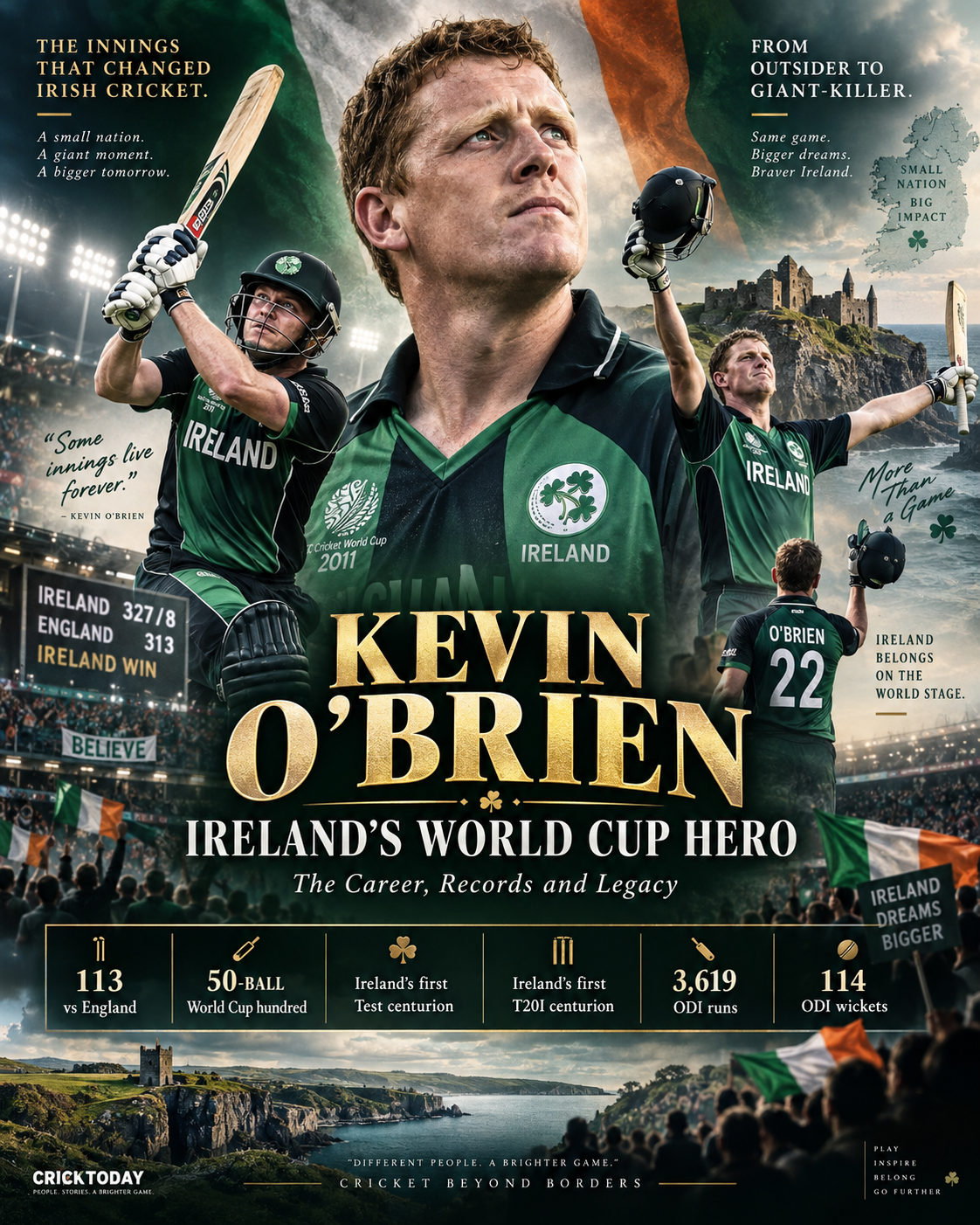
O’Brien reached his century from only 50 balls, eventually scoring 113 and helping Ireland complete a remarkable run chase.
That innings made him internationally famous.
But Kevin O’Brien’s career was far bigger than one afternoon in India.
He represented Ireland through their rise from Associate cricket to Full Membership, played in several global tournaments, became Ireland’s first Test centurion and finished as one of the most productive all-rounders the country has produced.
Growing Up in an Irish Cricket Family
Kevin Joseph O’Brien was born on 4 March 1984 in Dublin, Ireland.
Cricket already had an important place in his family.
His older brother, Niall O’Brien, also became a long-serving Ireland international and one of the country’s leading wicketkeepers.
Their father, Brendan O’Brien, had represented Ireland as well.
For Kevin, international cricket therefore did not feel completely distant.
But the Ireland team he eventually joined was very different from the one future generations would inherit.
Ireland were not yet a Test-playing nation.
Most of their international opportunities came through Associate competitions and major ICC qualification tournaments.
Players had to earn global attention through performances against stronger, better-funded cricket nations.
O’Brien became one of the players who helped change that situation.
International Debut
O’Brien made his One Day International debut against England in Belfast in 2006.
His first ODI produced an unusual piece of history.
When brought on to bowl, O’Brien dismissed England opener Andrew Strauss with his first delivery in ODI cricket.
It was an impressive introduction for a player who would later become far better known for his batting.
O’Brien developed into a useful right-arm medium-fast bowler while also becoming one of Ireland’s most destructive middle-order batsmen.
That combination gave the team valuable flexibility.
The 2007 World Cup
Ireland entered the 2007 Cricket World Cup in the Caribbean as an Associate nation with limited expectations from the wider cricket world.
They quickly changed that.
Their opening match against Zimbabwe ended in a tie.
Then came Pakistan.
The match took place on St Patrick’s Day, adding even more significance for Irish supporters.
Ireland bowled Pakistan out for only 132.
Niall O’Brien led much of the chase with 72.
When Ireland eventually completed the victory, Kevin O’Brien was there near the end alongside captain Trent Johnston.
The result became one of the great early shocks in World Cup history.
Ireland had defeated a major Test nation.
From Surprise Package to Serious Competitor
Ireland’s 2007 campaign did more than provide one upset.
The team progressed to the Super Eight stage.
Suddenly, Irish cricket was receiving attention from audiences that had rarely watched them before.
Players such as Trent Johnston, William Porterfield, Niall O’Brien, Boyd Rankin and Kevin O’Brien became increasingly familiar names.
Kevin’s aggressive batting style was especially useful.
He was comfortable arriving in difficult situations and immediately looking for boundaries.
That approach would later produce the innings that defined his international reputation.
Bengaluru, 2011
Ireland faced England at the M. Chinnaswamy Stadium in Bengaluru during the 2011 Cricket World Cup.
England batted first and scored 327 for eight.
A chase of 328 was enormous by the standards of World Cup cricket at the time.
Ireland’s reply began badly.
Captain William Porterfield was dismissed from the first ball.
Ireland then lost more wickets.
At 111 for five, the match appeared almost finished.
Kevin O’Brien had other ideas.
The Innings That Changed Irish Cricket
O’Brien began attacking England’s bowlers with extraordinary confidence.
He targeted the boundaries.
He punished anything short.
Full deliveries disappeared down the ground.
Suddenly, England were under pressure.
O’Brien reached fifty quickly.
Then he accelerated further.
His century arrived from only 50 balls.
At the time, it was the fastest hundred ever scored in a Cricket World Cup.
The record stood for more than twelve years.
O’Brien eventually made 113 from 63 deliveries, striking 13 fours and six sixes.
He and Alex Cusack added a crucial 162-run partnership.
Ireland completed the chase with five balls remaining.
Final score:
Ireland 329 for seven.
They had beaten England by three wickets.
Why the Innings Mattered
The importance of O’Brien’s 113 went beyond the scoreboard.
Ireland were still an Associate cricket nation.
They did not have the financial resources, domestic structure or playing opportunities available to many Test nations.
Yet here they were defeating England in a World Cup.
And they had done it by successfully chasing 328.
At the time, it was the highest successful run chase in Cricket World Cup history.
For Irish cricket, the victory strengthened the argument that the team belonged at the highest level.
For O’Brien, it ensured that his name would always be connected with one of the tournament’s greatest upsets.
The World Cup Century Record
O’Brien’s 50-ball hundred remained the fastest Cricket World Cup century until 2023.
During that tournament, South Africa’s Aiden Markram reached a century from 49 balls.
Only weeks later, Australia’s Glenn Maxwell went even further and reached a hundred from just 40 deliveries.
The record eventually changed hands.
The significance of O’Brien’s innings did not.
It remained the century that helped Ireland defeat England from a seemingly impossible position.
Records can be broken.
Context cannot.
More Than One World Cup Innings
Because the 2011 performance became so famous, O’Brien’s broader career is sometimes overlooked.
He represented Ireland across several international tournaments and formats.
He could change games with aggressive batting.
He contributed wickets with medium pace.
He fielded strongly.
And he became one of the experienced players guiding Ireland through a period of enormous development.
By the end of his career, he had played for his country for roughly a decade and a half.
Ireland’s Rise Through International Cricket
During O’Brien’s early career, Ireland had to qualify for many of the world events in which they competed.
There was no guarantee of regular matches against leading nations.
That gradually changed.
Ireland produced strong results in global tournaments and developed increasingly professional structures.
Then came one of the biggest milestones in the history of Irish cricket.
In 2017, Ireland was awarded Full Member status by the International Cricket Council.
That meant Test cricket.
The same player who had represented Ireland as an Associate would soon walk out for the country’s first Test team.
Ireland’s First Test Match
Ireland played their inaugural Test against Pakistan at Malahide in Dublin in May 2018.
The occasion carried enormous historical significance.
Decades of Irish cricket development had led to this moment.
O’Brien was selected in the first Test XI.
Pakistan scored 310 for nine declared.
Ireland struggled in reply and were bowled out for 130.
They were asked to follow on.
A heavy defeat appeared possible.
Then O’Brien produced another historic innings.
Ireland’s First Test Century
Batting in Ireland’s second innings, O’Brien showed a very different side of his game from the explosive hitter seen in Bengaluru.
This innings required patience.
Pakistan possessed an attack containing high-quality pace and swing bowling.
Ireland needed someone to stay at the crease.
O’Brien did.
He reached 100, becoming the first Irish player ever to score a Test century.
He eventually made 118.
Ireland recovered sufficiently to force Pakistan to bat again.
Pakistan eventually won the match by five wickets, but O’Brien was named Player of the Match.
Ireland had lost.
Yet their first Test had still produced an unforgettable national milestone.
Kevin O’Brien had become the country’s first Test centurion.
From World Cup Hero to Test Pioneer
The contrast between O’Brien’s two most famous innings tells the story of his versatility.
Against England in 2011:
Attack immediately.
Take risks.
Hit boundaries.
Score a hundred from 50 balls.
Against Pakistan in 2018:
Absorb pressure.
Defend.
Build partnerships.
Keep Ireland in the match.
Both innings required completely different skills.
O’Brien produced both.
Another First in T20 Cricket
O’Brien added another national record in 2019.
Against Hong Kong, he scored 124 from 62 balls in a T20 International.
It was Ireland’s first T20I century.
That achievement gave O’Brien a unique distinction.
He had now scored an international century in:
Test cricket
One Day Internationals
and
T20 Internationals
He became the first Irish player to complete that three-format century set.
The T20 Player
Twenty20 cricket suited O’Brien naturally.
He was strong.
He was aggressive.
He could attack spin and pace.
And he was comfortable attempting boundary shots early in an innings.
Later in his career, Ireland moved him higher up the order in T20 cricket.
The change allowed him more deliveries to influence the match.
His 124 against Hong Kong showed how destructive he could be with that opportunity.
ODI Career
O’Brien’s ODI career lasted from 2006 until 2021.
He played 153 One Day Internationals.
He scored 3,619 runs for Ireland in the format.
His batting included two ODI centuries.
With the ball, he took 114 wickets.
At the time he retired from ODI cricket, those 114 wickets made him Ireland’s leading wicket-taker in the format.
For a player remembered mainly as a powerful batsman, that bowling contribution is easy to underestimate.
An All-Round Contribution
O’Brien’s bowling was not built around extreme pace.
He relied on control, changes of pace and the ability to make batsmen take risks.
Across his career, he often provided useful overs when captains needed another bowling option.
That versatility mattered enormously for Ireland.
Smaller cricket nations often have less depth than the traditional powers.
A player who can bat seriously and also bowl meaningful overs gives the team far greater balance.
O’Brien did that for years.
114 ODI Wickets
O’Brien’s 114 ODI wickets underline how significant his second skill became.
He was not simply an occasional bowler.
He dismissed international batsmen repeatedly over a long career.
That made his overall contribution substantially larger than his famous batting highlights alone suggest.
His first ODI wicket came with his first ball.
More than a hundred followed.
T20I Career
O’Brien also became one of Ireland’s most experienced T20 internationals.
He finished with 1,973 T20I runs.
With the ball, he took 58 T20I wickets.
His ability to contribute in both departments made him useful throughout the different stages of T20 cricket.
Earlier in his career, he often appeared as a middle-order finisher.
Later, he demonstrated that he could also open the batting.
International Totals
Across the three official international formats, O’Brien finished with approximately:
5,820 international runs
and
172 international wickets.
Those totals provide a clearer picture of the complete player.
A single spectacular century made him famous.
Years of runs and wickets made him one of Ireland’s most important cricketers.
Four World Cups
O’Brien represented Ireland at several major global tournaments.
His Cricket World Cup appearances came during a period when Ireland were gradually moving from outsiders to respected competitors.
The 2007 victory over Pakistan showed what Ireland could do.
The 2011 victory over England became iconic.
Later tournaments gave the team further opportunities to challenge major nations.
O’Brien belonged to the generation that built much of Ireland’s modern international reputation.
Playing With Niall O’Brien
Kevin’s career was closely connected with his brother Niall.
The brothers spent years together in the Ireland team.
Niall was a left-handed wicketkeeper-batsman.
Kevin was a right-handed all-rounder.
Both played major roles in Ireland’s rise.
For Irish supporters, seeing two brothers representing their country across World Cups became one of the recognizable features of that generation.
Ireland’s Golden Generation
O’Brien was part of an important group of players that changed Irish cricket.
The generation included names such as:
William Porterfield
Niall O’Brien
Trent Johnston
Ed Joyce
Boyd Rankin
Paul Stirling
George Dockrell
and others.
Together, they helped Ireland move from Associate cricket towards Full Membership.
Some produced more runs.
Some produced more wickets.
But few generated a single moment as globally memorable as Kevin O’Brien’s 2011 century.
The Importance of Associate Cricket
O’Brien’s career also represents the importance of opportunities for developing cricket nations.
Players cannot prove themselves against elite opposition if they are rarely allowed to face them.
World Cups gave Ireland those opportunities.
Ireland used them.
The victories over Pakistan and England changed international perceptions of the team.
They showed that strong cricketers existed beyond the traditional Test-playing countries.
O’Brien became one of the clearest examples.
A Career Across Changing Eras
When O’Brien made his international debut in 2006, Ireland were an Associate nation.
When his international career ended, Ireland were playing Test cricket.
That change is enormous.
He experienced:
World Cup qualification battles.
Historic upset victories.
Ireland’s rise through ODI cricket.
Full Membership.
The country’s first Test.
Ireland’s first Test century.
And the continued expansion of T20 cricket.
Few Irish players have witnessed such a dramatic transformation from inside the team.
Retirement From ODI Cricket
O’Brien retired from One Day International cricket in June 2021.
He finished the format with 153 appearances, 3,619 runs and 114 wickets.
The retirement closed the chapter in which most of his famous international moments had occurred.
But his association with Ireland cricket was not finished immediately.
He continued to remain involved in the shorter format.
International Retirement
In August 2022, O’Brien announced his retirement from international cricket.
His last Ireland appearance had come in 2021.
His international playing career was over.
The timing brought an end to one of the most significant careers produced during Ireland’s transition into a Full Member nation.
He later began moving into coaching and cricket development roles.
The Number 113
Some players become permanently associated with one number.
For O’Brien, that number is 113.
It was his score against England in Bengaluru.
But the innings should not be remembered only because of the runs.
Ireland were 111 for five.
They needed 328.
Their opponent was an established Test nation.
The World Cup stage magnified everything.
O’Brien attacked anyway.
That willingness to believe a match could still be won became part of the innings’ lasting appeal.
Why Kevin O’Brien Matters to Irish Cricket
Irish cricket existed long before Kevin O’Brien.
Many important players and administrators built the foundations he later benefited from.
But his generation helped bring Irish cricket into a new era.
They created moments that attracted global attention.
They proved Ireland could defeat major international teams.
They helped create the momentum that eventually led to Full Membership and Test status.
O’Brien’s contribution to that journey was substantial.
Beyond the Records
O’Brien never built the statistical record of players such as Sachin Tendulkar or Jacques Kallis.
That was not his role in cricket history.
His importance comes from context.
He played for a developing cricket nation.
He produced major performances on global stages.
He helped Ireland defeat stronger teams.
He became the first Irish Test centurion.
He became Ireland’s first T20I centurion.
And he spent years contributing with both bat and ball while Irish cricket moved into a new era.
That is a different kind of greatness.
Kevin O’Brien’s Lasting Legacy
Cricket history is not made only by the players who finish with the largest totals.
Sometimes it is made by the player who produces the right performance on the right day.
Kevin O’Brien did that in Bengaluru.
His 50-ball century against England stood as the Cricket World Cup record for more than twelve years.
More importantly, the innings gave Ireland one of the most famous victories in the tournament’s history.
Seven years later, when Ireland finally entered Test cricket, O’Brien created another piece of history by scoring the country’s first Test century.
Those two innings bookend much of what his career represented.
One came when Ireland were still fighting to prove they belonged.
The other came after they had earned Test status.
Kevin O’Brien helped travel that entire journey.
For Ireland, he will always be more than the man who scored 113 against England.
He was one of the players who helped change the status of Irish cricket itself.
Quick Facts
Full Name: Kevin Joseph O’Brien
Born: 4 March 1984
Country: Ireland
Playing Role: All-rounder
Batting Style: Right-handed
Bowling Style: Right-arm medium-fast
International Debut: 2006
Final International Appearance: 2021
International Retirement: 2022
Test Matches: 3
Highest Test Score: 118
Ireland’s First Test Centurion: Yes
ODI Matches: 153
ODI Runs: 3,619
ODI Wickets: 114
Highest ODI Score: 142
2011 World Cup vs England: 113 from 63 balls
2011 World Cup Century: 50 balls
T20I Runs: 1,973
T20I Wickets: 58
Highest T20I Score: 124
Ireland’s First T20I Centurion: Yes
International Runs: 5,820
International Wickets: 172
ICC Associate Cricketer of the Year: 2013
Tags: Kevin O’Brien, Ireland Cricket, Cricket Legends, Irish Cricketers, 2011 Cricket World Cup, Ireland vs England, Cricket Records, Cricket History