
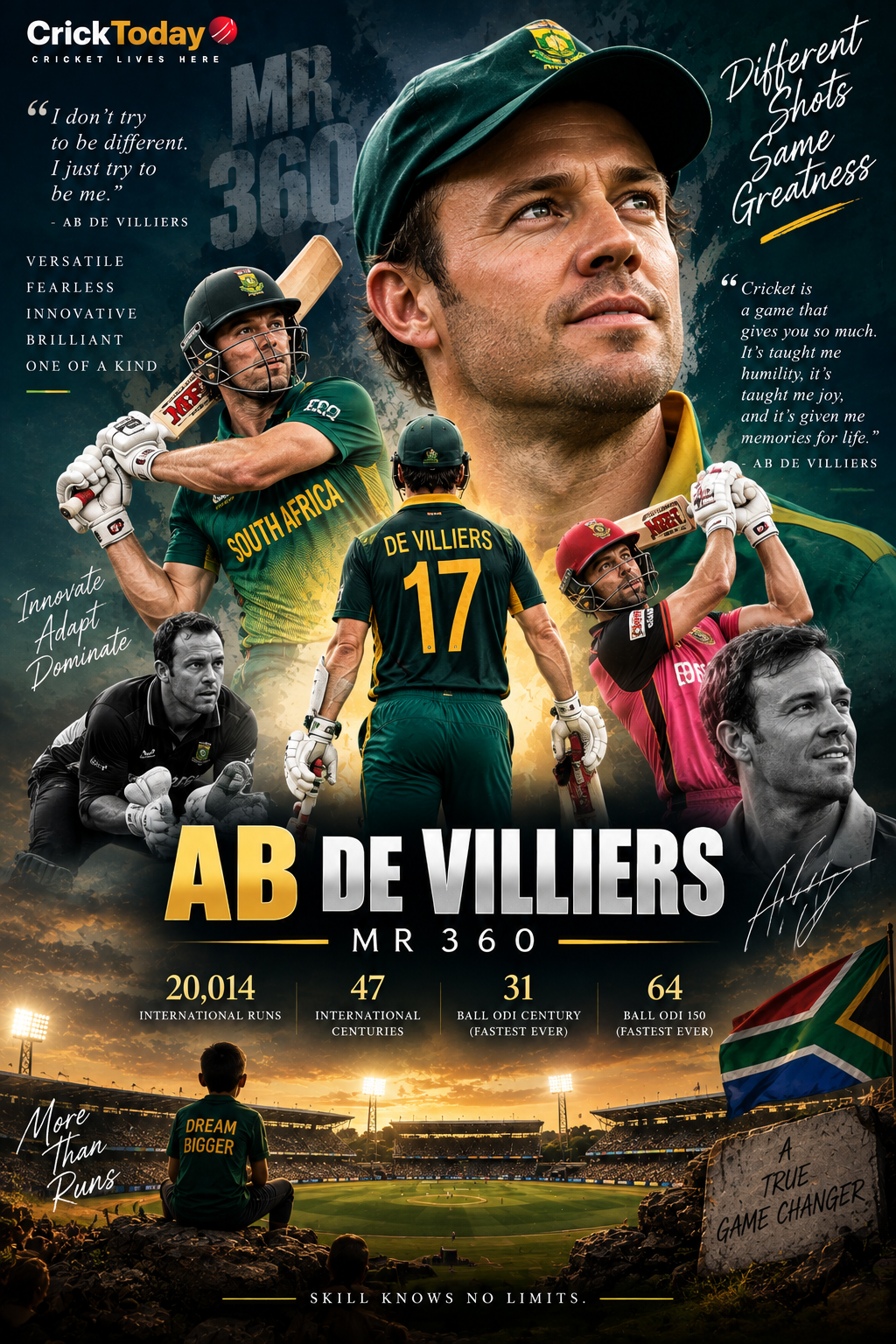

Some batsmen become famous because of how many runs they score.
Others become famous because they make spectators wonder how the shot they just played was even possible.
AB de Villiers did both.
He could play a perfectly straight Test-match defence for hours.
Then, in another format, he could move across his stumps, scoop a fast bowler over fine leg, reverse-sweep the next delivery and launch the following ball straight into the stands.
There seemed to be no part of a cricket ground he could not reach.
That extraordinary range eventually gave him one of modern cricket’s most recognizable nicknames:
Mr 360.
Across a 14-year international career, de Villiers scored more than 20,000 international runs, averaged above 50 in both Tests and ODIs and produced some of the fastest innings international cricket has ever seen.
He was also an exceptional fielder, a wicketkeeper when South Africa needed him and a captain during one of the country’s strongest ODI periods.
AB de Villiers did not simply score runs.
He expanded what people believed batting could look like.
From Pretoria to International Cricket
Abraham Benjamin de Villiers was born on 17 February 1984 in Pretoria, South Africa.
He developed as an exceptionally talented sportsman and eventually concentrated on cricket.
De Villiers entered international cricket in December 2004, making his Test debut against England at Port Elizabeth.
He began his Test career as an opening batsman.
That would not remain his permanent position.
Over the years, South Africa used him almost everywhere in the batting order.
He opened.
He batted in the middle order.
He kept wicket.
He fielded in some of the most demanding positions on the ground.
Whatever the team needed, de Villiers seemed capable of adapting.
That versatility would become one of the defining features of his career.
More Than an Entertainer
The spectacular shots eventually made de Villiers a global star.
But it is important not to mistake innovation for recklessness.
At his best, de Villiers possessed an outstanding conventional technique.
He could defend.
He could leave the ball outside off stump.
He could bat for hours.
He could handle fast bowling.
He could play spin.
His unusual shots worked because there was an extremely strong technical foundation underneath them.
Before there was Mr 360, there was an elite Test batsman.
Developing Into a Test Star
De Villiers’ early Test career contained both promise and inconsistency.
International bowlers quickly discovered weaknesses.
As they do with every talented young batsman, they tested him repeatedly.
De Villiers adjusted.
By the late 2000s, he had developed into one of the central figures in South Africa’s batting line-up.
A particularly important performance came against England at Headingley in 2008.
De Villiers scored 174 from 381 balls.
The innings lasted close to nine hours.
It was hardly the frantic batting style that would later dominate highlight reels.
That was precisely why it mattered.
It proved de Villiers could play almost any kind of innings.
The Two Versions of AB
Few batsmen have possessed such contrasting gears.
One version of de Villiers could absorb pressure for an entire day.
The other could destroy a bowling attack in a few overs.
Both were genuine.
He did not have to choose between being technically correct and innovative.
He could be both.
That made preparing for him particularly difficult.
A bowler might spend hours trying to force de Villiers into a mistake.
Then suddenly he would change the tempo and attack deliveries that had previously looked safe.
A Century in the 414 Chase
South Africa toured Australia in 2008–09.
At Perth, Australia set South Africa a target of 414 runs to win the first Test.
It was a huge chase.
De Villiers played one of the defining innings of his Test career.
He scored an unbeaten 106.
South Africa reached the target.
It became one of the great successful fourth-innings chases in Test history.
For de Villiers, it reinforced something important.
His greatest quality was not simply attacking.
It was adapting to whatever the match demanded.
278 Not Out
Against Pakistan in Abu Dhabi in 2010, de Villiers produced the highest Test score of his international career.
He made:
278 not out.
At the time, it was the highest individual Test score ever made by a South African.
The innings demonstrated the concentration behind the innovation.
Scoring 278 requires far more than a collection of spectacular shots.
It requires patience.
Discipline.
Fitness.
And the ability to maintain concentration for hours.
De Villiers possessed all four.
The Wicketkeeper-Batsman
South Africa also used de Villiers as a wicketkeeper during significant periods of his career.
That placed even greater demands on him physically.
Keeping wicket for an entire innings and then batting in the top or middle order is exhausting.
De Villiers still produced elite performances.
Against Pakistan in Johannesburg in 2013, he scored an unbeaten century and completed 11 wicketkeeping dismissals in the same Test.
It was an extraordinary combination of batting and keeping.
He was not merely filling in behind the stumps.
He was performing at international level in two demanding roles.
The Rise of Mr 360
As limited-overs cricket became more aggressive, de Villiers began displaying the full range of his imagination.
Traditional field placements became increasingly useless.
A captain might protect cover.
De Villiers could scoop over fine leg.
Move a fielder behind square.
He could hit straight.
Protect the leg side.
He could open the face and find third man.
The entire field became available to him.
That is where the nickname Mr 360 came from.
He could score virtually anywhere.
Why Bowlers Struggled
Most bowlers build plans around predictable scoring areas.
A batsman who likes driving through cover can be denied width.
A strong leg-side player can be crowded differently.
But how do you set a field for a batsman who might hit the same delivery in three different directions?
That was the de Villiers problem.
His movements also disrupted length.
A yorker designed for middle stump could become a scoop.
A wide ball could become a boundary through point.
A slower delivery could disappear straight down the ground.
The bowler’s margin for error became incredibly small.
The 31-Ball Century
On 18 January 2015, South Africa faced the West Indies at Johannesburg.
What happened became one of the most famous displays of batting in ODI history.
Hashim Amla and Rilee Rossouw had already scored centuries.
De Villiers arrived with only a limited number of overs remaining.
He immediately attacked.
His fifty came from 16 balls.
Then came the hundred.
Only 31 deliveries.
It was the fastest century in men’s ODI history.
The record still stands.
149 From 44 Balls
De Villiers did not stop at the hundred.
He eventually scored:
149 from 44 balls.
His innings included:
Nine fours
and
16 sixes.
Think about that for a moment.
He was one run short of 150 after facing only 44 deliveries.
South Africa finished on 439 for two.
The innings became one of the clearest demonstrations of what elite modern batting could become.
The Fastest ODI Fifty
During the same innings, de Villiers reached 50 from just 16 balls.
That set another record at the time.
The acceleration was astonishing.
He had barely arrived at the crease before the match had been transformed.
For opposition bowlers, there was no settling-in period.
De Villiers could begin attacking immediately.
The Fastest ODI 150
His record-breaking year continued at the 2015 Cricket World Cup.
South Africa faced the West Indies at the Sydney Cricket Ground.
De Villiers produced another astonishing innings.
He scored:
162 not out from 66 balls.
He reached 150 from only 64 deliveries.
It was the fastest 150 ever recorded in ODI cricket.
Within weeks, de Villiers had demonstrated three extraordinary levels of acceleration:
A 16-ball fifty.
A 31-ball hundred.
A 64-ball 150.
Few batsmen have ever compressed so much scoring into so little time.
The 2015 Cricket World Cup
The 2015 World Cup represented perhaps South Africa’s strongest opportunity to win the tournament during de Villiers’ career.
He was captain.
The team contained major names:
Hashim Amla
Faf du Plessis
Quinton de Kock
David Miller
Dale Steyn
Morne Morkel
Imran Tahir
and others.
De Villiers was in exceptional form.
Across the tournament, he scored 482 runs.
South Africa reached the quarter-final against Sri Lanka.
Breaking the Knockout Barrier
South Africa’s World Cup history had contained several painful knockout defeats.
Against Sri Lanka in Sydney, that changed.
South Africa dismissed Sri Lanka for 133.
They chased the target comfortably.
It was South Africa’s first victory in a Cricket World Cup knockout match.
For de Villiers and his teammates, it appeared that a major psychological barrier had finally been crossed.
New Zealand waited in the semi-final.
The Auckland Heartbreak
The semi-final became one of the most emotional matches in World Cup history.
Rain reduced South Africa’s innings.
De Villiers finished unbeaten on 65 from 45 balls.
New Zealand were given a revised target.
The match went to the final over.
Grant Elliott faced Dale Steyn.
New Zealand needed five runs from two deliveries.
Elliott hit the ball for six.
The match was over.
New Zealand reached the final.
South Africa’s players were devastated.
Images of de Villiers and his teammates after the defeat became some of the lasting images of the tournament.
It was the closest de Villiers came to playing in a World Cup final.
Greatness Without a World Cup
Cricket sometimes creates uncomfortable truths.
Some extraordinary players never win the trophy most associated with international greatness.
Brian Lara never won an ODI World Cup.
Jacques Kallis never did either.
Neither did AB de Villiers.
That does not diminish their individual careers.
It simply reminds us that cricket is a team sport.
One batsman, no matter how brilliant, cannot control every aspect of a tournament.
De Villiers’ World Cup career still contained extraordinary performances.
His World Cup Record
Across World Cup cricket, de Villiers scored more than 1,200 runs.
He produced several of the tournament’s most memorable innings.
His World Cup batting average exceeded 60.
His unbeaten 162 against the West Indies remains among the greatest displays of attacking batting the tournament has seen.
But the trophy remained absent.
That became one of the few gaps in an otherwise extraordinary international résumé.
Captaincy
De Villiers took over South Africa’s ODI captaincy in 2011.
Leadership added another responsibility to an already demanding role.
He had to manage bowlers.
Set fields.
Handle pressure.
And remain South Africa’s most dangerous batsman.
At the 2015 World Cup, he led the country into its first successful World Cup knockout match and then to within one dramatic finish of the final.
Captaincy did not always bring trophies.
But it added another important chapter to his career.
A Different Kind of Captain
De Villiers did not possess the outward aggression of every international captain.
His style often appeared more expressive and emotional.
He clearly felt defeats deeply.
The 2015 semi-final was a perfect example.
But he also led a powerful team capable of beating almost anyone.
His captaincy period reflected both South Africa’s enormous talent and the frustration of repeatedly falling short in global tournaments.
176 Against Bangladesh
Even late in his international career, de Villiers remained capable of producing devastating innings.
Against Bangladesh in 2017, he scored 176 from 104 deliveries in an ODI.
It was his highest ODI score.
The innings showed that the extraordinary hand speed and innovation had not disappeared.
De Villiers was still among the most dangerous batsmen in cricket.
Within a year, however, his international career would be over.
His Test Record
De Villiers played 114 Test matches.
He scored:
8,765 runs
at an average of:
50.66.
He made:
22 centuries
and
46 half-centuries.
His highest score was:
278 not out.
Those numbers would be enough to establish an outstanding career even if he had never played limited-overs cricket.
The Importance of the Test Average
A career Test average above 50 remains one of cricket’s traditional benchmarks for elite batting.
De Villiers achieved it across more than 100 matches.
That matters because his reputation later became so closely connected with extraordinary white-ball shots.
He was not simply a T20-style entertainer.
He was a world-class Test batsman.
His ability to survive and score in the longest format made the innovation in shorter formats even more impressive.
His ODI Record
One Day International cricket may have been de Villiers’ greatest format.
Across 228 ODIs, he scored:
9,577 runs.
His batting average was:
53.50.
His strike rate was above:
101.
He scored:
25 ODI centuries
and
53 half-centuries.
His highest score was:
176.
A career average above 50 combined with a strike rate above 100 is an extraordinary combination.
It means de Villiers did not have to choose between consistency and aggression.
He delivered both.
The ODI Player of the Year
De Villiers’ dominance was repeatedly recognized by the ICC.
He won the ICC Men’s ODI Player of the Year award three times:
2010
2014
2015
That period represented the peak of his white-ball influence.
Opposition captains knew exactly who South Africa’s greatest batting threat was.
Knowing did not necessarily help them stop him.
T20 International Cricket
De Villiers also played 78 T20 Internationals.
He scored:
1,672 runs.
His career T20I strike rate was above 135.
His international T20 numbers were not as dominant as his Test and ODI records.
But franchise cricket later provided an even larger stage for his short-format brilliance.
It was there that the Mr 360 identity became global.
Royal Challengers Bangalore
De Villiers became one of the most beloved overseas players in Indian Premier League history.
His association with Royal Challengers Bangalore made him enormously popular in India.
Alongside Virat Kohli and other major stars, de Villiers produced repeated displays of extraordinary hitting.
Bengaluru became almost a second cricketing home.
Crowds chanted his name.
Opposition supporters often admired him even while hoping he would get out.
That level of cross-team popularity is rare.
The Partnership With Virat Kohli
One of the most famous batting partnerships in IPL history involved de Villiers and Virat Kohli.
Both possessed very different personalities and batting methods.
Kohli often built an innings through timing, placement and relentless running.
De Villiers could distort the field with improvisation.
Together, they became one of franchise cricket’s most recognizable batting combinations.
For a generation of IPL supporters, seeing Kohli and de Villiers together at the crease became an event in itself.
Fielding Excellence
Batting sometimes overshadows how extraordinary de Villiers was in the field.
He was athletic.
Fast.
Explosive.
And capable of spectacular catches.
He could field in the slips.
Inside the circle.
On the boundary.
Or keep wicket.
South Africa could place him almost anywhere.
That versatility increased his value beyond his batting.
A ball hit near de Villiers was rarely an automatic run.
The Wicketkeeper
De Villiers’ ability behind the stumps further demonstrated the unusual breadth of his talent.
Across international cricket, he completed hundreds of catches and several stumpings.
He was not simply an emergency keeper used for a few matches.
For periods, South Africa relied on him regularly.
Combining wicketkeeping with elite batting placed enormous physical demands on him.
Yet he continued scoring heavily.
20,014 International Runs
Across Tests, ODIs and T20 Internationals, de Villiers finished with:
20,014 international runs.
Only Jacques Kallis scored more for South Africa.
His breakdown was:
8,765 Test runs
9,577 ODI runs
1,672 T20I runs.
He also scored:
47 international centuries.
Twenty-two in Tests.
Twenty-five in ODIs.
The numbers confirm what the highlight reels suggest.
Mr 360 was not only spectacular.
He was remarkably productive.
The Ability to Defend
One of the most underrated chapters of de Villiers’ career involved innings where he almost stopped scoring completely.
Against India in Delhi in 2015, South Africa were attempting to save a Test.
De Villiers batted for more than four hours.
He faced 297 balls for only 43 runs.
This was the same player who had scored a 31-ball ODI hundred earlier that year.
That contrast may be the best explanation of his greatness.
Few batsmen could operate at both extremes.
De Villiers could.
31 Balls or 297 Balls
Think about those two numbers:
31 balls to score an ODI century.
And:
297 balls to score 43 in a Test survival effort.
The same batsman.
The same year.
Completely different requirements.
Completely different mindset.
That is adaptability.
De Villiers was not great because he had one extraordinary style.
He was great because he could change styles almost completely without losing his identity.
Retirement Shock
On 23 May 2018, de Villiers announced his retirement from international cricket.
He was only 34.
The announcement surprised the cricket world because he was still performing at an extremely high level.
South Africa had recently beaten India and Australia in Test series.
De Villiers explained that he was tired and felt the time was right to step away.
For South African supporters, the decision was difficult.
One of the country’s greatest batsmen was leaving while apparently still capable of dominating international attacks.
Why He Left While Still Great
Some players continue until their performances decline sharply.
De Villiers chose another path.
He left international cricket while still capable of producing match-winning innings.
That created years of speculation about possible comebacks, particularly around major tournaments.
But his official international career remained finished.
His final record therefore captures a player who retired before an obvious statistical decline.
Life After International Cricket
De Villiers continued appearing in franchise competitions after leaving international cricket.
His popularity remained enormous.
Crowds still came to watch the unusual shots.
Bowlers still faced the same problem.
Where do you bowl to him?
Eventually, he stepped away from professional cricket entirely.
By then, his influence on modern batting was already secure.
ICC Hall of Fame
In 2024, AB de Villiers was inducted into the ICC Cricket Hall of Fame.
The honour formally placed him among the game’s celebrated legends.
His Hall of Fame profile described him as an embodiment of the modern game.
It was an appropriate description.
Few players connected traditional Test batting and modern white-ball innovation as naturally as de Villiers.
The Player Who Changed Field Placements
Perhaps de Villiers’ greatest tactical legacy is visible every time a modern batsman moves across the crease.
Scoops.
Ramp shots.
Reverse strokes.
Unusual angles.
None were completely invented by de Villiers.
Cricket had innovators before him.
But few used such a wide range of unconventional shots so consistently against elite international bowling.
He made captains reconsider what a defensive field even looked like.
Influence on Modern Batting
Modern white-ball batting increasingly demands a 360-degree scoring range.
Batsmen practice ramps.
They rehearse reverse sweeps.
They manipulate their stance.
They intentionally move outside the crease to disrupt bowling plans.
De Villiers helped normalize that thinking.
He demonstrated that innovation did not have to be a desperate last-over gamble.
It could become a permanent part of a world-class batting method.
Why AB de Villiers Was Different
Power alone does not explain him.
Plenty of players hit harder.
Technique alone does not explain him.
Plenty of players looked more classical.
Innovation alone does not explain him either.
Others played unusual shots.
De Villiers combined all three.
Technique.
Power.
Imagination.
That combination allowed him to play innings other batsmen could not easily reproduce.
The Numbers Behind Mr 360
AB de Villiers finished international cricket with:
114 Test matches
8,765 Test runs
Test average: 50.66
22 Test centuries
46 Test half-centuries
Highest Test score: 278*
228 ODIs
9,577 ODI runs
ODI average: 53.50
ODI strike rate: 101.09
25 ODI centuries
53 ODI half-centuries
Highest ODI score: 176
78 T20 Internationals
1,672 T20I runs
20,014 international runs
47 international centuries
Fastest ODI hundred: 31 balls
Fastest ODI 150: 64 balls
2015 World Cup: 482 runs
ICC ODI Player of the Year: 2010, 2014, 2015
ICC Hall of Fame: 2024
AB de Villiers’ Lasting Legacy
There may never be another batsman exactly like AB de Villiers.
Cricket will continue producing innovators.
Modern players will score faster.
Records will eventually fall.
The 31-ball ODI hundred may one day disappear from the record books.
But records are only part of the story.
De Villiers changed how people imagined batting.
He showed that a batsman could possess a Test average above 50 while simultaneously playing some of the most unconventional shots international cricket had ever seen.
He could survive nearly 300 deliveries when his team needed resistance.
Or score a hundred in 31 balls when the match demanded destruction.
He could keep wicket.
He could take spectacular catches.
He could captain.
He could improvise against the fastest bowlers in the world.
There was no single version of AB de Villiers.
That was the point.
A captain could set nine fielders.
Mr 360 kept finding the spaces between them.
Quick Facts
Full Name: Abraham Benjamin de Villiers
Born: 17 February 1984
Country: South Africa
Playing Role: Batsman / wicketkeeper-batsman
Batting Style: Right-handed
International Career: 2004–2018
Test Matches: 114
Test Runs: 8,765
Test Average: 50.66
Test Centuries: 22
Highest Test Score: 278*
ODI Matches: 228
ODI Runs: 9,577
ODI Average: 53.50
ODI Strike Rate: 101.09
ODI Centuries: 25
Highest ODI Score: 176
T20I Matches: 78
T20I Runs: 1,672
International Runs: 20,014
International Centuries: 47
Fastest ODI Century: 31 balls
Fastest ODI 150: 64 balls
2015 World Cup Runs: 482
ICC ODI Player of the Year: 2010, 2014, 2015
ICC Hall of Fame: 2024
Nickname: Mr 360