

Some batsmen are remembered for consistency. Others are remembered for records.
Brian Lara is remembered for both, but neither fully explains what made him special.
At his best, Lara could take control of a match almost single-handedly. His high backlift, flowing stroke play and ability to score enormous innings made him one of the most distinctive batsmen cricket has produced.
He played during a difficult period for West Indies cricket, when the dominance of previous generations was beginning to fade.
Yet Lara continued to produce innings that stood alongside anything achieved during the great West Indian eras before him.
From Trinidad to International Cricket
Brian Charles Lara was born on 2 May 1969 in Trinidad and Tobago.
His batting talent became evident early.
Lara was naturally left-handed, elegant at the crease and unusually confident against both pace and spin.
He developed through Trinidad and Tobago cricket before earning his opportunity with the West Indies.
His Test debut came against Pakistan in 1990.
The young Lara entered a West Indies side that still carried the reputation built by legendary players such as Clive Lloyd, Viv Richards, Gordon Greenidge and Desmond Haynes.
Following that generation was never going to be easy.
Lara, however, did not try to copy them.
He developed his own style.
The Backlift That Became Famous
Lara’s batting technique was instantly recognisable.
His bat rose high behind him before the bowler delivered, giving his stroke play a dramatic appearance.
For another batsman, such a large backlift might have created problems.
For Lara, it became part of his strength.
He generated exceptional bat speed and could drive the ball through the covers with remarkable timing.
His footwork against spin was equally impressive.
He was willing to use his feet, attack slow bowlers and change the length they wanted to bowl.
Against fast bowling, Lara could cut, pull and drive with equal confidence.
When he was in rhythm, bowlers often found there was no obvious safe area to target.
The Innings That Announced Brian Lara
One of Lara’s earliest great Test innings came in Sydney in 1993.
Australia had built a powerful first-innings total, and the West Indies were under pressure when Lara arrived at the crease.
What followed was his first Test century.
He did not stop at 100.
Lara scored 277, producing an innings filled with timing, placement and attacking stroke play.
It immediately changed the way the cricket world viewed him.
This was no longer simply a talented young batsman.
A major international star had arrived.
The innings also helped turn the series in West Indies’ favour.
Breaking Sir Garfield Sobers’ Record
Just one year later, Lara produced an even more extraordinary performance.
In 1994, playing England in Antigua, he began an innings that would enter cricket history.
At the time, the record for the highest individual score in Test cricket belonged to another West Indian legend, Sir Garfield Sobers.
Sobers had scored an unbeaten 365 in 1958.
The record had survived for 36 years.
Lara passed it.
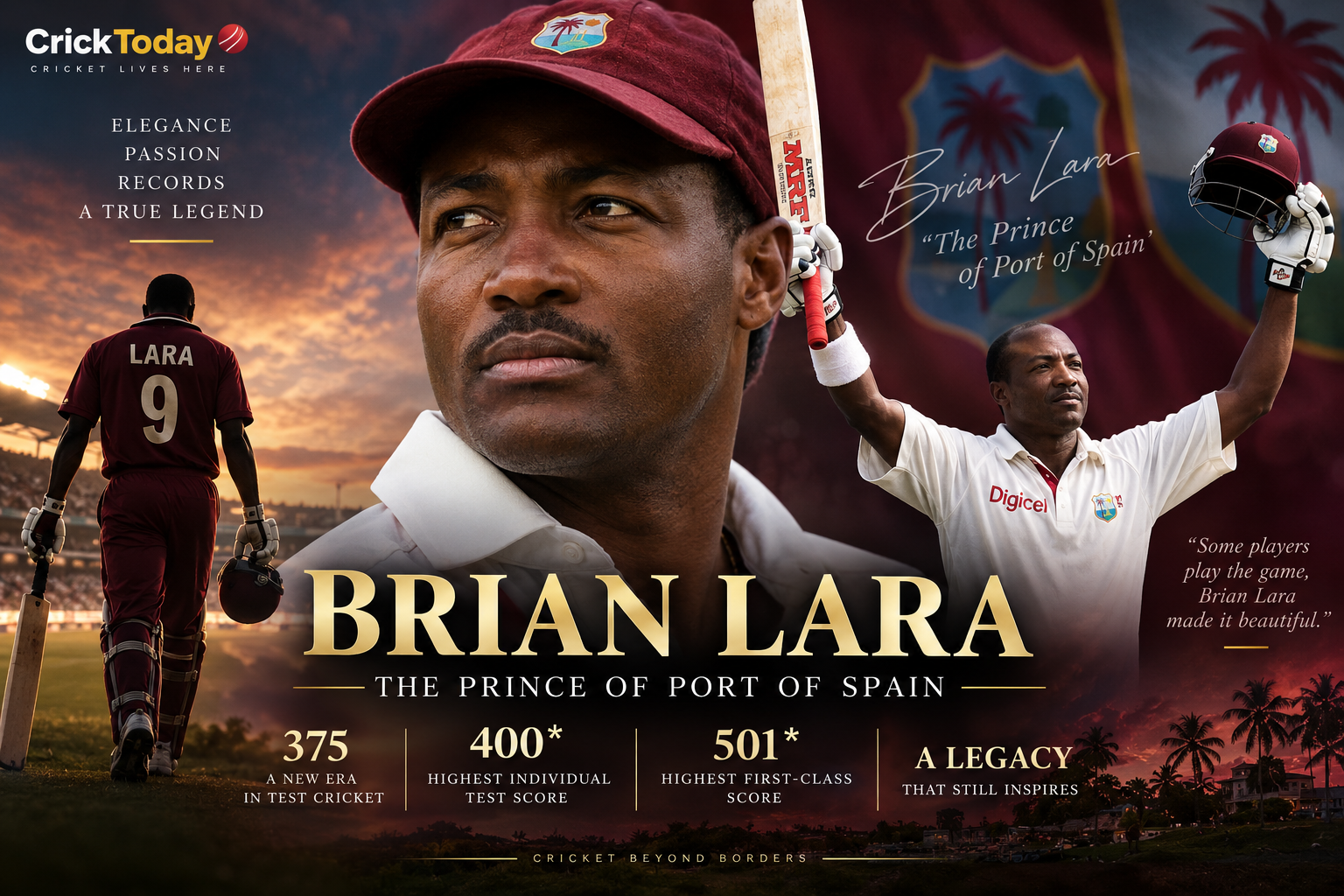
He eventually scored 375, setting a new world record for the highest individual Test innings.
For a young batsman to surpass one of West Indies cricket’s most respected figures was an extraordinary achievement.
Yet Lara’s appetite for enormous scores was only beginning.
501 Not Out
Only weeks after making 375 in Test cricket, Lara produced another astonishing innings.
Playing county cricket for Warwickshire against Durham in 1994, he scored 501 not out.
It remains the highest individual score in first-class cricket.
Scoring 500 runs in a single innings requires more than natural talent.
It requires concentration over an enormous period of time.
A batsman must repeatedly reset mentally, continue finding motivation and resist the temptation to relax after reaching major milestones.
Lara possessed that ability.
When he reached 100, he could continue.
When he reached 200, he could continue.
Even after 300 or 400, he remained capable of building something larger.
Few batsmen in cricket history have possessed the same capacity for monumental innings.
Carrying West Indies Through a Changing Era
Lara’s career arrived at an important point in West Indies cricket history.
For much of the 1970s and 1980s, the West Indies had been the dominant force in international cricket.
They possessed legendary fast bowlers and a batting line-up filled with world-class players.
By the 1990s, that dominance was beginning to weaken.
Australia was emerging as a major force, while other international teams were becoming stronger.
Lara therefore played much of his career in a West Indies side that could no longer simply overwhelm opponents.
That often placed enormous responsibility on his batting.
There were matches where West Indies needed Lara not just to score runs, but to produce something exceptional.
On several occasions, he did exactly that.
The 1999 Series Against Australia
One of the greatest examples came against Australia in 1999.
West Indies entered the series under heavy pressure.
Australia possessed an outstanding team featuring world-class players and a powerful bowling attack.
In the second Test at Kingston, Lara responded with 213, helping West Indies secure a convincing victory.
Then came Barbados.
West Indies were chasing 308 to win.
The match became increasingly tense as wickets fell around Lara.
At 248 for eight, Australia appeared close to victory.
Lara continued.
Batting with the lower order, he guided West Indies closer and closer to the target.
He finished unbeaten on 153 as West Indies won by just one wicket.
It remains one of Lara’s most celebrated innings because of the pressure surrounding every run.
There was almost no room for error.
One mistake could have ended the match.
Instead, Lara carried his team across the line.
Losing the Record — Then Taking It Back
Lara’s 375 remained the highest individual Test score until Matthew Hayden of Australia scored 380 against Zimbabwe in 2003.
For most players, once such a record is lost, it is gone forever.
Lara responded differently.
In 2004, England returned to Antigua.
Ten years after his original record-breaking innings, Lara built another enormous score at the same ground.
This time, he went even further.
He finished on 400 not out.
Lara had become the first batsman to regain the record for the highest individual Test score after losing it.
The 400 remains one of cricket’s most famous landmarks and, decades later, continues to stand as the highest individual score in men’s Test cricket.
Why Lara Could Score So Big
Lara’s ability to produce huge innings came from several qualities working together.
His concentration was exceptional once he became settled.
His scoring range was wide enough to prevent bowlers from controlling him easily.
He was also willing to attack.
That mattered because enormous innings cannot always be built through defence alone.
Lara could accelerate without appearing reckless.
When bowlers became tired or defensive, he punished them.
Spin bowlers could be attacked down the pitch.
Fast bowlers could disappear through point, cover or midwicket.
His ability to keep scoring meant that even very long innings rarely became completely stagnant.
Lara Against the Best Bowlers of His Era
Lara competed during a period filled with outstanding bowlers.
He faced players such as Glenn McGrath, Shane Warne, Wasim Akram, Waqar Younis, Allan Donald, Shaun Pollock, Muttiah Muralitharan, Anil Kumble and Curtly Ambrose.
Different bowlers asked completely different questions.
McGrath attacked relentlessly accurate areas.
Warne challenged batsmen with leg-spin and tactical pressure.
Muralitharan possessed extraordinary variation.
Wasim and Waqar could use pace and reverse swing.
Lara’s record against elite opposition helped establish his reputation far beyond the Caribbean.
Some of his most memorable innings came precisely when the bowling attack was strongest.
A Special Player of Spin
Lara’s ability against spin deserves particular attention.
Many batsmen become more defensive when facing a world-class spinner.
Lara often did the opposite.
He used his feet aggressively and refused to allow the bowler complete control over the contest.
His encounters with players such as Shane Warne and Muttiah Muralitharan became fascinating battles.
Lara could defend when necessary, but he also understood that attacking a great spinner could disrupt their rhythm.
That willingness to take calculated risks made him especially dangerous.
Captaincy and Responsibility
Lara also captained the West Indies during different periods of his career.
The role brought additional pressure.
Leading a team while also being expected to produce the majority of its runs is an enormous responsibility.
West Indies cricket was going through a transitional period, and Lara often found himself carrying expectations that extended beyond his own batting.
Captaincy did not always produce easy results, but some of his finest individual performances came while he was responsible for leading the team.
That says a great deal about his ability to perform under pressure.
Brian Lara’s Career Numbers
By the time his international career ended, Lara had built one of the strongest batting records in cricket.
He played 131 Test matches and scored 11,953 runs.
Those runs included 34 Test centuries.
In One Day Internationals, he played 299 matches and scored 10,405 runs.
Across both formats, he accumulated more than 22,000 international runs.
His highest Test score was 400 not out.
His highest first-class score was 501 not out.
Both numbers became permanent parts of cricket history.
More Than Numbers
It is easy to focus on Lara’s records because they are so unusual.
But statistics do not explain why so many people enjoyed watching him bat.
There was movement in his batting.
There was personality.
The high backlift, the rapid footwork and the flowing follow-through made his stroke play visually distinctive.
Even a defensive shot could look elegant.
When he attacked, the effect was even more dramatic.
Lara did not look manufactured.
He looked natural.
That is one reason his batting remains so memorable even for supporters who watched him play decades ago.
The Prince of Port of Spain
Lara eventually became known as the Prince of Port of Spain.
The nickname reflected both his Trinidadian roots and the graceful nature of his batting.
For cricket supporters across the Caribbean, he became one of the major symbols of West Indies cricket during the 1990s and early 2000s.
He belonged to a region with an extraordinary cricket tradition.
Before him came players such as Sobers, Richards, Lloyd, Greenidge and many others.
Lara did not replace that history.
He added another chapter to it.
Retirement
Brian Lara’s international career came to an end in 2007.
He had spent approximately 17 years representing the West Indies.
His retirement removed one of international cricket’s most recognisable batsmen from the game.
There would be other great West Indian players, but Lara’s particular combination of style, record-breaking ability and responsibility within the team made his career difficult to reproduce.
In 2012, he was inducted into the ICC Cricket Hall of Fame.
It was a fitting recognition for a player whose achievements had already secured his place in cricket history.
Brian Lara’s Lasting Legacy
Every generation has batsmen who score heavily.
Very few become permanently associated with numbers such as 375, 400 and 501.
Lara did.
But reducing his career to those numbers would miss the larger story.
He was a batsman capable of rescuing matches when his team was struggling.
He could dominate the strongest attacks of his generation.
He produced some of his greatest performances while carrying the pressure of captaincy and the expectations of West Indies supporters.
And he maintained an attacking, elegant style that made people want to watch.
The records matter.
The runs matter.
But Brian Lara’s true legacy lies in the feeling that, whenever he settled at the crease, something extraordinary might happen.
Quite often, it did.
Quick Facts
Full Name: Brian Charles Lara
Born: 2 May 1969
Country: West Indies / Trinidad and Tobago
Playing Role: Batsman
Batting Style: Left-handed
Test Matches: 131
Test Runs: 11,953
Test Centuries: 34
Highest Test Score: 400*
ODI Matches: 299
ODI Runs: 10,405
Highest First-Class Score: 501*
International Career: 1990–2007
ICC Hall of Fame: 2012