

Cricket has produced extraordinary batsmen in every generation, but one number still stands apart from almost everything else in the sport:
99.94.
That was Sir Donald Bradman’s batting average when his Test career ended in 1948.
More than seven decades later, the figure remains one of cricket’s most famous statistics.
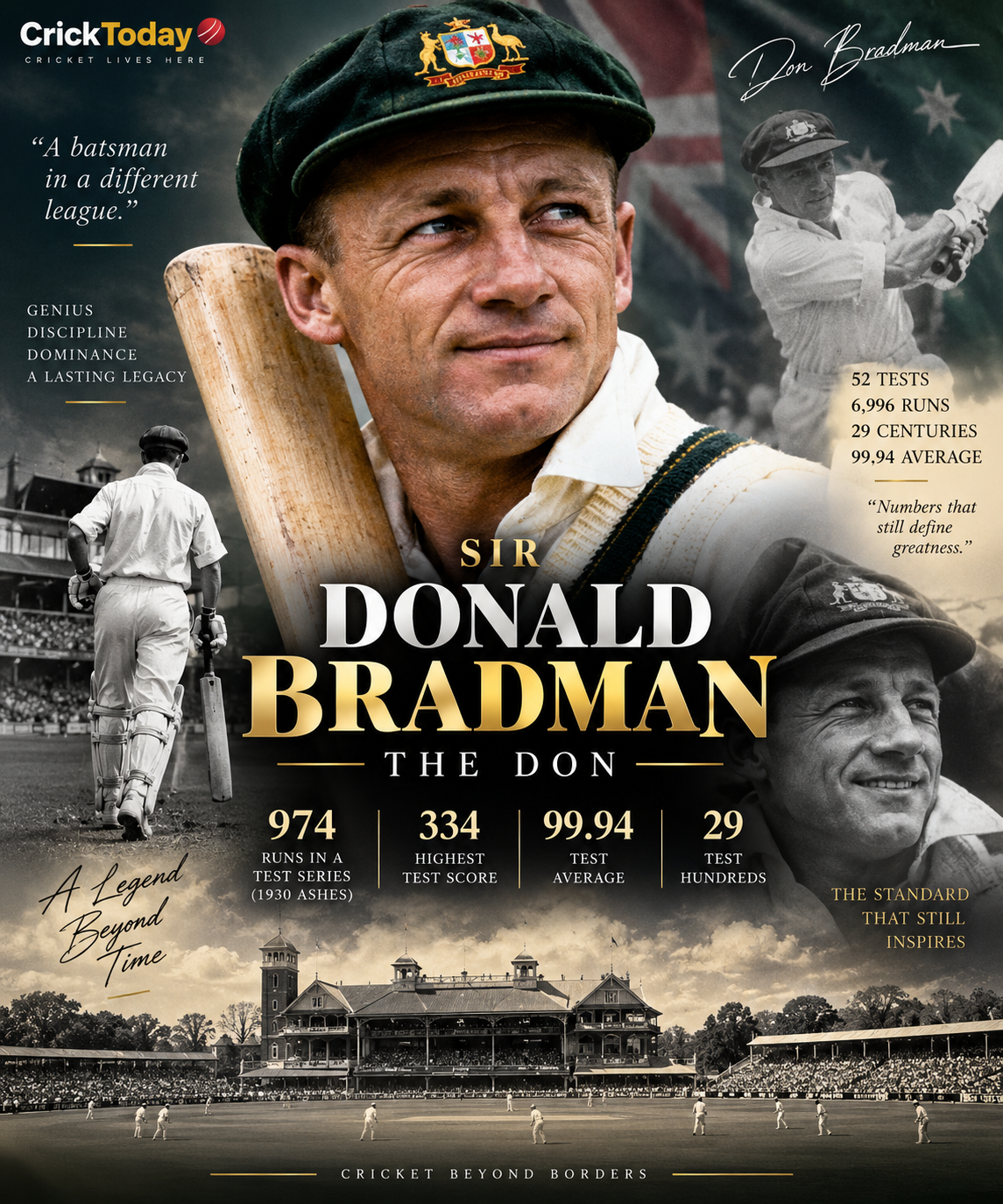
Bradman played only 52 Tests, yet he scored 6,996 runs, made 29 centuries and built a reputation so powerful that his name became shorthand for batting excellence.
But the story of “The Don” is bigger than a batting average.
It is a story of dominance, adaptation, pressure, rivalry and a career that became deeply connected with Australian sporting identity.
From Bowral to Australian Cricket
Donald George Bradman was born on 27 August 1908 in Cootamundra, New South Wales, Australia.
He grew up in Bowral, where stories of his unusual hand-eye coordination became part of cricket folklore.
As a youngster, Bradman famously developed his reflexes by hitting a golf ball against a curved surface with a cricket stump.
Whether viewed as simple childhood practice or an early sign of exceptional ability, it reflected something that would later define his batting: extraordinary control of the bat.
Bradman progressed rapidly through Australian cricket.
By the late 1920s, his domestic performances had made him impossible for national selectors to ignore.
He made his Test debut against England on 30 November 1928.
His international career had begun.
An Early Setback
Bradman’s first Test did not immediately suggest that cricket had discovered one of its greatest run-scorers.
After a modest debut, he was left out of the next Test.
For many players, being dropped so early could have damaged confidence.
Bradman responded by scoring runs.
When he returned to the side, his place quickly became far more secure.
It was an early example of a pattern that would follow him throughout his career.
When opponents challenged him, he usually found an answer.
The 1930 Ashes Tour
If Bradman had already shown his talent in Australia, the 1930 Ashes tour of England transformed his reputation internationally.
He produced one of the greatest series performances in Test history.
Across the five Tests, Bradman scored 974 runs.
That total remains the record for the most runs scored by a batsman in a single Test series.
During the series, he produced innings of enormous scale.
At Headingley, he scored 334.
Even more remarkably, he reached 309 runs in a single day.
England had faced talented Australian batsmen before.
Bradman presented a different problem entirely.
He did not simply survive long periods.
He accumulated runs at a speed that placed enormous pressure on the opposition.
Australia won the series 2–1, and Bradman had become the central figure in world cricket.
Why Bradman Was So Difficult to Bowl To
Bradman’s technique did not look exactly like the textbook batting style traditionally taught to young players.
His method was his own.
He had exceptional footwork, remarkable balance and an ability to judge length extremely early.
Most importantly, he seemed to possess more time than other batsmen.
That extra fraction of a second allowed him to adjust his stroke after the ball had been released.
He could attack deliveries other batsmen might simply defend.
He also possessed an extraordinary ability to convert starts into huge scores.
For Bradman, reaching 50 was often only the beginning.
Once settled, he could bat for hours and continue increasing the pressure on the bowling side.
England Searches for an Answer
Bradman’s dominance created a unique problem for England.
How do you stop a batsman who keeps scoring enormous totals?
Ahead of the 1932–33 Ashes series in Australia, England captain Douglas Jardine developed a highly controversial strategy.
It became known as Bodyline.
England’s fast bowlers, particularly Harold Larwood and Bill Voce, delivered short-pitched balls towards the batsman’s body while several fielders waited close on the leg side.
The tactic was designed largely to restrict Bradman and prevent him from playing freely.
It worked better than most previous plans against him.
Bradman still averaged 56.57 during the series — an outstanding figure for almost any other batsman — but far below his usual standards.
England won the series 4–1.
The Bodyline Controversy
Bodyline became much more than a cricket tactic.
Australian players were struck by short-pitched deliveries, crowds reacted angrily and relations between the Australian and English cricket authorities became extremely tense.
The controversy even reached diplomatic levels.
Bradman remained the central target because his earlier performances had forced England to search for an extreme tactical solution.
That fact alone says something about his impact.
Opponents were not simply trying to dismiss him.
They were redesigning their entire bowling strategy around stopping him.
Eventually, changes to cricket’s laws and fielding restrictions made sustained Bodyline-style tactics far more difficult to use.
Bradman had survived one of the most unusual challenges of his career.
Returning to Dominance
Bodyline slowed Bradman.
It did not stop him.
When Australia returned to England for the 1934 Ashes, Bradman again produced massive innings.
One of the most memorable came at The Oval, where he scored 244.
Australia reclaimed the Ashes.
Bradman continued building a record that seemed increasingly unusual even by the standards of the finest batsmen of his era.
Centuries became double centuries.
Double centuries sometimes became triple centuries.
Across his Test career, Bradman twice exceeded 300.
His highest Test score remained 334.
A Different Kind of Consistency
Most great batsmen experience long periods where their form declines.
Bradman’s career contained disappointments, but his overall level remained extraordinarily high.
He reached a Test century 29 times in only 52 matches.
That meant he scored a hundred more frequently than almost any other major batsman in cricket history.
His concentration was a major part of that success.
Many batsmen relax after reaching a century.
Bradman often appeared to become even more dangerous.
Once he understood the conditions and the bowlers, removing him became increasingly difficult.
That ability to transform good starts into enormous scores separated him from many of his contemporaries.
Cricket Interrupted by War
Bradman’s international career was interrupted by the Second World War.
Test cricket largely disappeared during some of the years that could have been among the most productive of his career.
The interruption is important when examining his final statistics.
Bradman’s Test career stretched from 1928 to 1948, but several prime years contained no international cricket.
When top-level cricket returned after the war, Bradman was already well into his thirties.
Yet he continued to score heavily.
Bradman the Captain
Bradman was not only Australia’s leading batsman.
He eventually became captain.
Leadership added another layer of responsibility.
A captain must think about bowling changes, field placements, team selection, match situations and the confidence of teammates.
Bradman had to manage those duties while still being expected to produce enormous scores himself.
His most famous captaincy achievement came near the very end of his career.
The Invincibles of 1948
In 1948, Bradman captained Australia on a tour of England that became legendary.
The Australian squad included outstanding cricketers such as Arthur Morris, Keith Miller, Ray Lindwall and Neil Harvey.
The team became known as The Invincibles.
Across 31 first-class matches on the tour, Australia did not lose once.
In the five-Test Ashes series, Australia defeated England 4–0.
It was an extraordinary achievement, particularly on a long overseas tour involving repeated travel and constant cricket.
Bradman was approaching 40 years of age.
Yet he remained the captain and symbolic leader of one of the strongest Australian teams ever assembled.
The Final Innings
Bradman’s final Test appearance came at The Oval in London in 1948.
The mathematics were simple.
He needed just four runs in his final innings to finish his Test career with a batting average of exactly 100.
The crowd understood the significance.
So did his teammates.
So did England.
Bradman walked to the crease for the final time.
England spinner Eric Hollies bowled.
Bradman was dismissed without scoring.
A duck.
His Test batting average therefore finished not at 100, but at:
99.94.
Ironically, that failure helped make the number even more famous.
A career filled with enormous innings ended with zero.
Yet the average still remained almost twice that of many excellent international batsmen.
Understanding the 99.94 Average
Batting average measures how many runs a batsman scores for each dismissal.
Across 80 Test innings, Bradman was dismissed 70 times and scored 6,996 runs.
That produced the famous average of 99.94.
To understand how unusual it is, consider that a Test batting average above 50 has traditionally been regarded as exceptional.
A career average near 60 places a batsman among the elite.
Bradman finished just short of 100.
This statistical gap is one of the strongest reasons his career remains so difficult to compare directly with anyone else.
Bradman’s Test Record
By retirement, Bradman’s international record included:
52 Test matches
6,996 Test runs
29 Test centuries
13 Test half-centuries
Highest Test score of 334
Career batting average of 99.94
Those numbers came in only 80 Test innings.
His achievements become even more striking when compared with the limited amount of international cricket played during his era.
Modern players often have far more Test matches available to them.
Bradman did not.
First-Class Cricket
Bradman was equally dominant outside Test cricket.
Across 234 first-class matches, he scored 28,067 runs.
He made 117 first-class centuries.
His first-class batting average was 95.14.
That matters because it demonstrates that his Test performances were not isolated achievements.
Bradman dominated cricket across a much larger sample of matches.
Wherever he played, runs followed.
More Than an Ashes Player
Because Bradman’s career is so closely associated with England and the Ashes, it is easy to think of him only through that rivalry.
England was certainly his most frequent Test opponent.
But his importance extended far beyond one series.
He became a symbol of Australian cricket during a period when sport played a major cultural role.
At a time when Australia was still developing its national identity, Bradman gave people a sporting figure they could celebrate internationally.
His performances were followed through newspapers, radio broadcasts and packed cricket grounds.
He became more than a successful player.
He became a national figure.
The Impact of His Scoring
Great batsmen do more than improve their own statistics.
They change matches.
Bradman regularly forced opponents to alter their plans.
Captains adjusted fields.
Bowlers changed their lines.
England eventually developed an entire controversial system of bowling partly because conventional methods had failed.
That is perhaps one of the strongest indicators of his influence.
The opposition knew exactly who the major threat was.
Stopping him remained extraordinarily difficult.
Life After Playing
Bradman retired from Test cricket in 1948, but his involvement with the sport continued.
He later served Australian cricket in administrative and selection roles.
His understanding of the game therefore extended beyond batting.
He remained an important voice in Australian cricket for decades after his final innings.
Bradman was eventually inducted into the ICC Cricket Hall of Fame in 2009.
By then, his status had long since moved beyond ordinary cricket statistics.
A Record That Still Looks Unusual
Cricket has changed enormously since Bradman played.
Protective equipment improved.
Batting techniques evolved.
Limited-overs cricket emerged.
Training became more scientific.
Video analysis transformed preparation.
Professional players began competing year-round.
Yet Bradman’s Test average still looks almost unreal beside the records of other elite batsmen.
That does not mean players from different eras can be compared perfectly.
Conditions, schedules, equipment, opponents and rules all change.
What can be said with certainty is that Bradman dominated the cricket available to him at a level rarely seen in the sport.
Sir Donald Bradman’s Lasting Legacy
Every generation produces new cricket heroes.
Australia has had Allan Border, Steve Waugh, Ricky Ponting, Steve Smith and many other outstanding batsmen.
The wider cricket world has produced Sachin Tendulkar, Brian Lara, Jacques Kallis, Kumar Sangakkara and countless other great players.
But Bradman’s name continues to occupy a distinctive place in cricket history.
Part of that comes from the numbers.
Part comes from the era.
Part comes from the stories.
The 974-run Ashes series.
The Bodyline battle.
The triple centuries.
The Invincibles.
And finally, the last innings where four runs separated him from an average of exactly 100.
His career ended in 1948.
His statistics still attract attention generations later.
That is the lasting power of Sir Donald Bradman — The Don.
Quick Facts
Full Name: Sir Donald George Bradman
Born: 27 August 1908
Country: Australia
Playing Role: Batsman
Batting Style: Right-handed
Test Career: 1928–1948
Test Matches: 52
Test Runs: 6,996
Test Centuries: 29
Test Half-Centuries: 13
Highest Test Score: 334
Test Batting Average: 99.94
First-Class Runs: 28,067
First-Class Centuries: 117
1930 Ashes Runs: 974
ICC Hall of Fame: 2009