
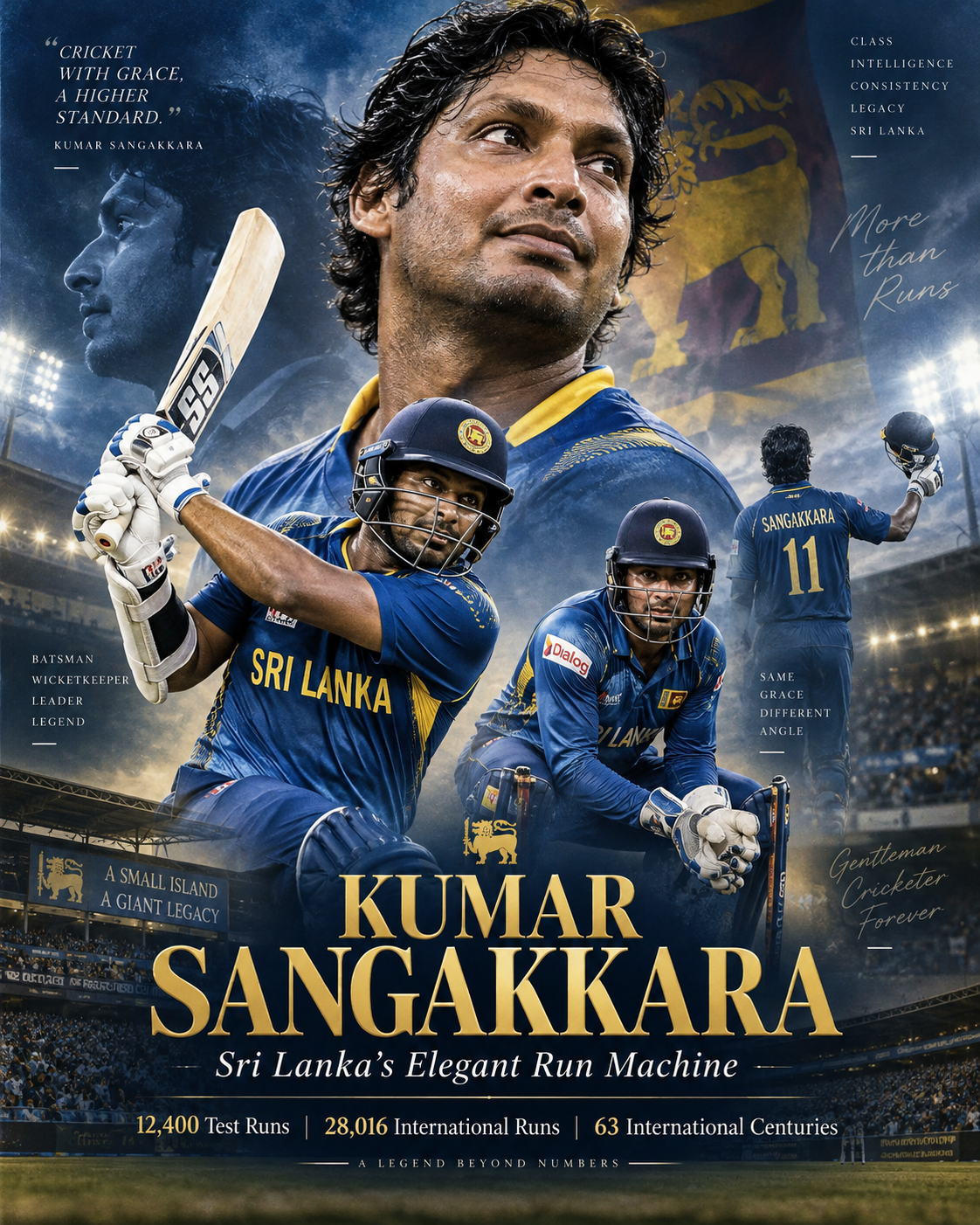

Cricket has produced many great left-handed batsmen.
Few combined elegance, consistency, intelligence and longevity quite like Kumar Sangakkara.
For 15 years, the Sri Lankan great became one of the most reliable run-scorers in world cricket.
He could bat for an entire day in a Test.
He could control a One Day International chase.
He could keep wicket at the highest level.
And when Sri Lanka needed something extraordinary, Sangakkara repeatedly delivered.
By the time he retired, he had scored more than 28,000 international runs, including 63 international centuries.
He finished with 12,400 Test runs at an average above 57 and another 14,234 runs in ODIs.
But Sangakkara’s career was not built only on accumulation.
It was built on class.
From Matale to International Cricket
Kumar Chokshanada Sangakkara was born on 27 October 1977 in Matale, Sri Lanka.
He developed his cricket at Trinity College in Kandy before progressing through Sri Lanka’s domestic system.
By 2000, national selectors believed he was ready.
Sangakkara made his One Day International debut against Pakistan in July 2000.
His Test debut followed later that month against South Africa at Galle.
Sri Lanka already possessed major stars.
Sanath Jayasuriya.
Aravinda de Silva.
Muttiah Muralitharan.
Chaminda Vaas.
Mahela Jayawardene.
Sangakkara entered a team that had already won a World Cup.
He eventually became one of the greatest players that team ever produced.
Beginning as a Wicketkeeper
Sangakkara’s early international role was demanding.
He was expected to bat in the top order and keep wicket.
Either job alone requires enormous concentration.
Doing both at international level is exhausting.
A wicketkeeper may spend an entire day crouching behind the stumps.
Then he has to remove the gloves, pick up a bat and face world-class bowling.
Sangakkara did this for years.
And he still became one of the finest batsmen in Test history.
A Left-Hander Built on Timing
Sangakkara’s batting rarely looked violent.
It looked controlled.
His cover drive was one of the most elegant strokes of his era.
The front foot moved towards the ball.
The head remained still.
The bat followed through smoothly.
There was very little wasted movement.
But elegance should not be confused with softness.
Sangakkara could attack.
He simply did it without appearing rushed.
A Strong Player of Pace and Spin
One reason Sangakkara succeeded for so long was his ability to handle very different bowling attacks.
Against fast bowling, he played late and used the pace of the ball.
Against spin, his footwork was excellent.
He could move forward.
He could go deep into the crease.
He could sweep.
He could rotate the strike.
There was rarely one obvious method to contain him.
That adaptability allowed him to score across Asia, Australia, England, South Africa, New Zealand and the Caribbean.
The Sangakkara-Jayawardene Partnership
No discussion of Sangakkara’s career is complete without Mahela Jayawardene.
The pair became two of the defining figures of Sri Lankan cricket.
They were close friends.
They were teammates for years.
They captained the country at different times.
And together, they created one of the greatest partnerships cricket has ever seen.
The most famous example came against South Africa in Colombo in 2006.
The 624-Run Partnership
Sri Lanka lost two early wickets.
Sangakkara joined Jayawardene.
What followed was extraordinary.
The pair added:
624 runs for the third wicket.
It remains the highest partnership for any wicket in Test cricket.
Sangakkara scored:
287.
Jayawardene scored:
374.
South Africa’s attack included bowlers such as Dale Steyn and Makhaya Ntini.
Yet Sri Lanka completely dominated the match.
The partnership became one of the defining statistical landmarks in cricket history.
The Appetite for Big Scores
Sangakkara did not simply score hundreds.
He often turned them into enormous innings.
During his Test career, he scored 11 double centuries.
Only Don Bradman made more scores of 200 or higher in Test cricket.
That tells us something important about Sangakkara’s concentration.
A hundred was not enough.
Once settled, he wanted more.
Two hundred.
Sometimes three hundred.
Few batsmen possessed such a consistent appetite for huge innings.
319 Against Bangladesh
Sangakkara’s highest Test score came against Bangladesh in Chattogram in 2014.
He scored:
319.
It was his first Test triple century.
Remarkably, he followed that enormous innings with another hundred in the second innings.
Across the match, Sangakkara scored more than 400 runs.
By this stage, he was already in his mid-thirties.
Instead of declining, he was producing some of the finest cricket of his career.
The 192 at Hobart
One of Sangakkara’s most admired Test innings came in Australia.
Sri Lanka were chasing a huge target at Hobart in 2007.
Australia possessed one of the strongest attacks in world cricket.
Sangakkara scored 192.
Sri Lanka eventually lost the match, but the innings became one of the clearest demonstrations of his ability outside Asia.
Sangakkara himself later identified it as one of the innings he valued most.
It showed he could dominate in conditions traditionally considered difficult for visiting batsmen.
Reaching No. 1
Sangakkara’s consistency eventually took him to the top of world cricket.
He reached No. 1 in the ICC Test batting rankings.
And he did not reach it only once.
Across his career, he spent long periods at the top.
His career-best rating reached 938 points, the highest ever achieved by a Sri Lankan batsman.
For several years, Sangakkara existed in the same elite conversation as players such as Sachin Tendulkar, Ricky Ponting, Jacques Kallis and later AB de Villiers.
12,400 Test Runs
Sangakkara finished his Test career with:
12,400 runs from 134 matches.
His batting average was:
57.40.
He scored:
38 centuries
and
52 half-centuries.
His highest score was:
319.
At retirement, he was among the highest run-scorers Test cricket had ever seen.
He also finished as the highest-scoring left-handed batsman in Test history at the time.
The Importance of 57.40
Test batting averages carry enormous weight because the format exposes every weakness.
Fast bowlers can attack for hours.
Spinners can build pressure.
Pitches deteriorate.
Weather changes.
Matches last five days.
Maintaining an average above 50 over a long career is exceptional.
Sangakkara finished above 57.
Among players who passed 10,000 Test runs, his average was extraordinary.
It reflected not only talent but remarkable consistency.
The Wicketkeeping Question
Sangakkara’s batting numbers became even stronger after he gradually moved away from regular wicketkeeping duties in Test cricket.
Without the physical workload of keeping, he could focus more completely on batting.
The results were dramatic.
He became an even more dominant Test batsman.
This created an interesting truth about his career.
Sangakkara was good enough to be an elite wicketkeeper-batsman.
But when allowed to concentrate almost entirely on batting, he became one of the greatest run-scorers in history.
More Than 14,000 ODI Runs
Sangakkara’s ODI career was equally remarkable.
Across 404 One Day Internationals, he scored:
14,234 runs.
He averaged:
41.98.
He scored:
25 ODI centuries
and
93 half-centuries.
His highest ODI score was:
169.
Only a very small number of players have scored more ODI runs.
For years, Sangakkara sat near the very top of the format’s all-time run charts.
A Different ODI Batsman
Sangakkara was not built around raw power.
His ODI success came through manipulation.
Singles.
Twos.
Placement.
Timing.
Then acceleration.
He could build an innings without allowing the required run rate to escape.
This made him particularly valuable at No. 3.
He could stabilize Sri Lanka after an early wicket or accelerate after a strong opening partnership.
Few situations made him uncomfortable.
The World Cup Journey
Sangakkara represented Sri Lanka at several Cricket World Cups.
The trophy repeatedly came close.
In 2007, Sri Lanka reached the final against Australia.
Adam Gilchrist produced one of the greatest World Cup final innings ever played.
Australia won.
Four years later, Sri Lanka reached another final.
This time, India waited in Mumbai.
Again, the trophy escaped.
Captain at the 2011 World Cup
Sangakkara captained Sri Lanka during the 2011 Cricket World Cup.
The team contained enormous experience.
Tillakaratne Dilshan.
Mahela Jayawardene.
Lasith Malinga.
Muttiah Muralitharan.
Sangakkara himself.
Sri Lanka reached the final against India at the Wankhede Stadium.
Jayawardene scored a magnificent century.
Sri Lanka posted 274 for six.
India chased the target successfully.
MS Dhoni finished the match with the famous six over long-on.
For Sangakkara, it was another painful World Cup final defeat.
Leadership
Captaincy added another dimension to his career.
Sangakkara was thoughtful and articulate.
He understood tactics deeply.
But leadership in Sri Lankan cricket carried enormous pressure.
After the 2011 World Cup, he stepped down from the captaincy.
He wanted to focus more fully on his batting.
The decision worked.
Some of the greatest seasons of his career followed.
The 2014 T20 World Cup
By 2014, Sangakkara and Mahela Jayawardene had announced that the ICC World Twenty20 would be their final T20 International tournament.
Sri Lanka had already suffered heartbreak in major finals.
They had lost the 2007 ODI World Cup final.
The 2009 T20 World Cup final.
The 2011 ODI World Cup final.
The 2012 T20 World Cup final.
One more opportunity remained.
India were waiting.
The Final Against India
India scored 130 for four.
Virat Kohli made 77.
Sri Lanka began the chase carefully.
Sangakkara arrived knowing this would be his final T20 International appearance.
The situation demanded calm.
He delivered exactly that.
Sangakkara scored:
52 not out.
Sri Lanka won by six wickets.
After years of final defeats, the trophy finally belonged to them.
A Perfect T20 Farewell
Sangakkara was named Player of the Match in the final.
The moment carried enormous emotional weight.
His T20I career ended with:
A championship.
An unbeaten half-century.
And the trophy Sri Lanka had chased for years.
For Sangakkara and Jayawardene, it was a perfect farewell to the format.
2014 — An Extraordinary Year
Sangakkara’s 2014 season was remarkable even by his standards.
He accumulated runs across international formats at an extraordinary rate.
According to the ICC, he set a record for the most international runs in a calendar year.
He was 36 and 37 years old during that season.
Most players are declining by that stage.
Sangakkara was producing one of the greatest years of his career.
The 2015 World Cup
Sangakkara entered the 2015 Cricket World Cup knowing it would be his final ODI tournament.
He was already a legend.
Then he produced something nobody had ever done before.
One century.
Then another.
Then another.
Then another.
Four ODI hundreds in four consecutive innings.
105 Not Out Against Bangladesh
The sequence began against Bangladesh in Melbourne.
Sangakkara scored:
105 not out.
Sri Lanka won comfortably.
It was his 400th ODI.
A major personal milestone became the beginning of an even larger record.
117 Not Out Against England
Next came England.
Sangakkara scored:
117 not out.
Sri Lanka chased 310 without losing control.
Two consecutive World Cup centuries.
Then came Australia.
104 Against Australia
At the Sydney Cricket Ground, Sangakkara made:
104.
Sri Lanka lost the match.
But Sangakkara had now scored three consecutive ODI centuries.
That alone was extraordinary.
He was not finished.
124 Against Scotland
Against Scotland, Sangakkara scored:
124.
Four consecutive ODI hundreds.
No batsman in the history of ODI cricket had ever done it before.
And Sangakkara achieved the record at a World Cup.
He finished the tournament with:
541 runs
at an average above 100.
At 37 years old.
Finishing at the Top
There was something particularly striking about Sangakkara’s final year.
He did not leave because he could no longer compete.
He left while still dominating international bowling.
His final World Cup included four consecutive centuries.
His Test career still contained major scores.
Sangakkara chose his ending rather than waiting for the game to choose it for him.
That is rare.
The 14,000-Run Club
Sangakkara’s 14,234 ODI runs placed him among the absolute elite of limited-overs batting.
For years, only Sachin Tendulkar had scored more.
Later generations began challenging those totals.
But Sangakkara’s position in the format’s history remained secure.
Few batsmen combined such longevity with wicketkeeping responsibilities and consistent top-order production.
More Than 28,000 International Runs
Across all three international formats, Sangakkara finished with:
12,400 Test runs
14,234 ODI runs
1,382 T20I runs
Combined:
28,016 international runs.
He scored:
63 international centuries.
Thirty-eight in Tests.
Twenty-five in ODIs.
Those figures place him among the most prolific batsmen the international game has ever seen.
The Wicketkeeper
Batting greatness sometimes causes people to forget that Sangakkara spent a major part of his career behind the stumps.
He was an elite wicketkeeper.
In One Day Internationals, Sangakkara completed 482 dismissals as wicketkeeper, a world record.
His quick hands were particularly valuable against Sri Lanka’s spin attack.
Keeping to Muttiah Muralitharan was not easy.
The ball turned sharply.
Variations were difficult to read.
Sangakkara handled that challenge for years.
Sangakkara and Muralitharan
The relationship between wicketkeeper and spinner is crucial.
Sangakkara spent years standing behind the stumps to one of the greatest bowlers cricket has ever seen.
Muralitharan could turn the ball enormous distances.
His doosra moved the opposite way.
The bounce could vary.
Sangakkara had to read all of it instantly.
The partnership became one of Sri Lanka’s most important combinations.
One created chances.
The other completed them.
Sangakkara and Jayawardene
If Muralitharan defined one part of Sangakkara’s career, Mahela Jayawardene defined another.
The two were central to Sri Lanka’s batting for more than a decade.
Their careers overlapped almost completely.
They shared enormous partnerships.
They played World Cup finals together.
They experienced defeats together.
And finally, in 2014, they won the T20 World Cup together.
Few international teammates have been linked as closely.
The MCC Spirit of Cricket Lecture
Sangakkara’s influence extended beyond batting.
In 2011, he delivered the MCC Spirit of Cricket Cowdrey Lecture at Lord’s.
He became the first active international cricketer and the youngest person at the time to deliver the prestigious address.
His speech examined Sri Lankan cricket, administration and the wider meaning of the sport.
It strengthened his reputation as one of cricket’s most articulate thinkers.
Sangakkara was not simply a great player.
He became an important voice within the game.
Life After International Cricket
After leaving international cricket, Sangakkara continued playing domestic and county cricket.
He remained highly productive.
Later, he moved into commentary, administration and cricket leadership.
He became associated with the Marylebone Cricket Club and remained one of the sport’s respected global figures.
The transition suited him.
Sangakkara had always seemed capable of thinking beyond the immediate scorecard.
Hall of Fame
In 2021, Kumar Sangakkara was inducted into the ICC Cricket Hall of Fame.
The recognition confirmed his place among the game’s greatest players.
By then, there was little debate about his stature.
More than 28,000 international runs.
More than 60 international centuries.
A Test average above 57.
Eleven Test double hundreds.
A T20 World Cup title.
And one of the finest World Cup batting sequences ever produced.
Why Sangakkara Was Different
Sangakkara’s greatness was not built around one dramatic personality trait.
He was not intimidating in the way Viv Richards was.
He did not possess AB de Villiers’ extreme improvisation.
He did not bat with Virat Kohli’s visible aggression.
His greatness was quieter.
It came from control.
Balance.
Judgment.
Concentration.
And the ability to repeat excellence year after year.
The game rarely looked rushed when Sangakkara was batting.
Even when he was scoring quickly, there was an order to everything.
Kumar Sangakkara’s Career Numbers
Sangakkara’s international record includes:
134 Test matches
12,400 Test runs
Test average: 57.40
38 Test centuries
52 Test half-centuries
11 Test double centuries
Highest Test score: 319
404 ODIs
14,234 ODI runs
ODI average: 41.98
25 ODI centuries
93 ODI half-centuries
Highest ODI score: 169
56 T20 Internationals
1,382 T20I runs
28,016 international runs
63 international centuries
482 ODI wicketkeeping dismissals
2007 Cricket World Cup runner-up
2011 Cricket World Cup runner-up
2014 T20 World Cup champion
2014 T20 World Cup Final: 52*
2015 World Cup runs: 541
Four consecutive ODI centuries in 2015
ICC Cricketer of the Year: 2012
ICC Test Player of the Year: 2012
ICC ODI Player of the Year: 2011 and 2013
ICC Hall of Fame: 2021
Kumar Sangakkara’s Lasting Legacy
Sri Lankan cricket has produced extraordinary players.
Muttiah Muralitharan.
Sanath Jayasuriya.
Aravinda de Silva.
Mahela Jayawardene.
Lasith Malinga.
Chaminda Vaas.
Sangakkara belongs comfortably among them.
His career combined numbers and beauty.
He scored more than 28,000 international runs.
He made 11 Test double centuries.
He became one of the leading ODI run-scorers of all time.
He kept wicket at world-class level.
He reached No. 1 in the Test rankings.
He won a T20 World Cup.
And in his final ODI World Cup, he scored four consecutive hundreds.
Many great players leave behind one defining record.
Sangakkara left dozens.
But perhaps his greatest legacy is simpler.
For 15 years, whenever Sri Lanka needed runs, Kumar Sangakkara was one of the safest names they could see walking towards the crease.
Elegant.
Intelligent.
Relentless.
And almost always capable of something bigger.
Quick Facts
Full Name: Kumar Chokshanada Sangakkara
Born: 27 October 1977
Country: Sri Lanka
Playing Role: Wicketkeeper-batsman
Batting Style: Left-handed
International Career: 2000–2015
Test Matches: 134
Test Runs: 12,400
Test Average: 57.40
Test Centuries: 38
Test Half-Centuries: 52
Test Double Centuries: 11
Highest Test Score: 319
ODI Matches: 404
ODI Runs: 14,234
ODI Average: 41.98
ODI Centuries: 25
ODI Half-Centuries: 93
Highest ODI Score: 169
T20I Matches: 56
T20I Runs: 1,382
International Runs: 28,016
International Centuries: 63
ODI Wicketkeeping Dismissals: 482
2014 T20 World Cup: Champion
2014 T20 World Cup Final: 52*
2015 World Cup Runs: 541
Consecutive ODI Centuries: 4
ICC Cricketer of the Year: 2012
ICC Hall of Fame: 2021