

Some cricketers are remembered for the runs they scored.
Some for trophies.
Some for leadership.
Some for the moments when an entire stadium seemed to stop breathing.
MS Dhoni belongs to all of those categories.
The long hair of his early career, the lightning-fast stumpings, the helicopter shot, the calm expression under enormous pressure and the famous six that won India the 2011 Cricket World Cup all became part of modern cricket history.
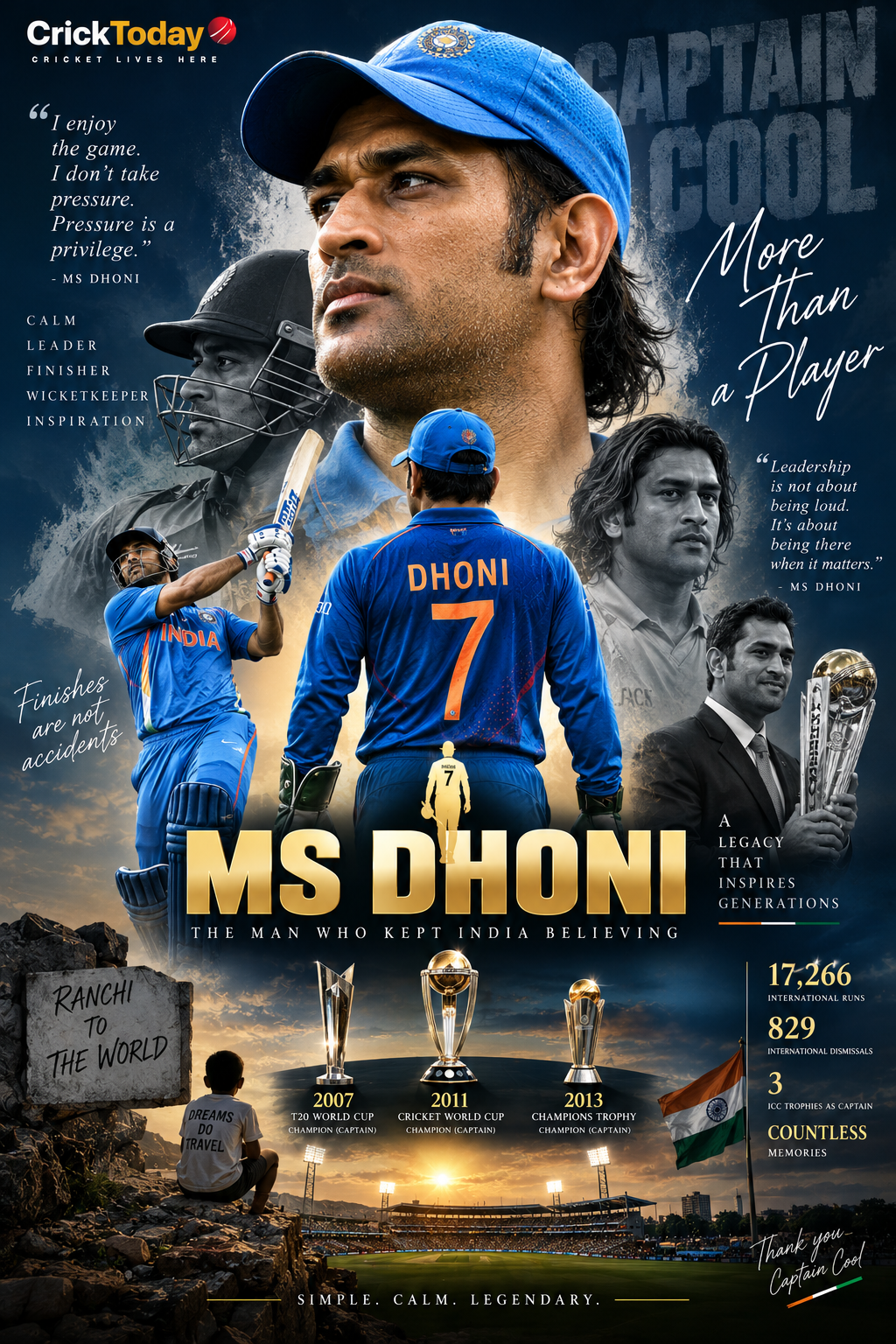
Dhoni finished his international career with 17,266 runs, more than 800 dismissals as a wicketkeeper and three major ICC trophies as captain.
But numbers alone do not explain his reputation.
Dhoni became famous because when a match became chaotic, he often appeared completely calm.
That quality earned him one of cricket’s most recognizable nicknames:
Captain Cool.
From Ranchi to International Cricket
Mahendra Singh Dhoni was born on 7 July 1981 in Ranchi, India.
His path to international cricket was unusual.
Ranchi was not traditionally considered one of the major centres of Indian cricket, and Dhoni did not emerge from the same system that had produced many of the country’s established stars.
Before his cricket career fully developed, he even worked as a ticket collector with Indian Railways.
But his ability with both the bat and wicketkeeping gloves eventually became impossible to ignore.
Dhoni made his One Day International debut against Bangladesh on 23 December 2004.
The beginning could hardly have been less dramatic.
He was run out for a duck.
A player who would later become one of ODI cricket’s most recognizable figures had begun his career without scoring a run.
The 148 That Announced Dhoni
India soon gave Dhoni another opportunity.
Against Pakistan in Visakhapatnam in 2005, he was promoted up the batting order.
The move worked spectacularly.
Dhoni smashed 148 from 123 balls.
The innings was powerful, aggressive and completely different from the traditional image of an Indian wicketkeeper-batsman.
Dhoni did not simply occupy the crease.
He attacked.
His strength through the leg side immediately attracted attention.
The long hair, unconventional technique and fearless stroke play gave Indian cricket a new personality.
A few months later, he produced something even bigger.
183 Not Out
Against Sri Lanka in Jaipur in 2005, India were chasing 299.
Dhoni was promoted to No. 3.
He produced the finest ODI innings of his career.
183 not out from 145 balls.
The innings included 15 fours and 10 sixes.
India completed the chase comfortably.
The 183* became the highest individual score by a wicketkeeper in men’s ODI cricket, a record that still stands.
Dhoni was no longer merely an exciting young player.
He had become one of international cricket’s most dangerous limited-overs batsmen.
Becoming the World’s No. 1 ODI Batsman
Dhoni’s rise was remarkably fast.
In only his 40th ODI, he reached No. 1 in the ICC Men’s ODI Batting Rankings.
According to the ICC, he became the fastest player to reach the top position in the ranking.
The achievement demonstrated how quickly he had moved from unknown prospect to international star.
But another transformation was coming.
Dhoni would soon become a captain.
The 2007 T20 World Cup
India entered the inaugural ICC Men’s T20 World Cup in 2007 with a relatively young squad.
Many senior players were absent.
Dhoni was appointed captain.
It was a major responsibility for a player still early in his leadership career.
India progressed through the tournament.
They defeated England.
They defeated hosts South Africa.
They beat Australia in the semi-final.
Then came the final against Pakistan.
India vs Pakistan — The Final
The 2007 T20 World Cup final became one of the most dramatic matches in the early history of the format.
India scored 157 for five.
Pakistan’s chase went down to the final over.
Misbah-ul-Haq threatened to take Pakistan across the line.
Dhoni made an unconventional decision.
He gave the final over to Joginder Sharma.
Pakistan needed 13.
Misbah hit a six.
Then he attempted a scoop.
Sreesanth took the catch.
India were world champions.
Dhoni had captained India to victory in the first-ever T20 World Cup.
The result changed his career.
It also helped change Indian cricket’s relationship with Twenty20.
A New Generation of Leadership
Dhoni’s captaincy was very different from the emotional style often associated with international cricket.
He rarely looked panicked.
When a bowler was being attacked, Dhoni might simply adjust the field.
When a match went to the final over, his facial expression often barely changed.
That calmness did not mean he lacked aggression.
His aggression was tactical.
He backed unusual bowling changes.
He placed fielders in unexpected positions.
He trusted young players.
And he was willing to make decisions that would attract criticism if they failed.
Many of them worked.
Becoming India’s ODI Captain
Dhoni soon took over India’s ODI leadership as well.
The team began building towards the next major objective:
The 2011 Cricket World Cup.
Unlike the 2007 T20 tournament, expectations were enormous.
India were co-hosting the competition.
Sachin Tendulkar was approaching the final years of his career.
Millions of supporters wanted a World Cup victory on home soil.
India had not won the ODI World Cup since 1983.
Dhoni would have to lead them through that pressure.
The 2011 World Cup Campaign
India progressed through the group stage and into the knockout rounds.
They defeated Australia in the quarter-final.
Then came Pakistan in the semi-final at Mohali.
India won.
The final would be played at Mumbai’s Wankhede Stadium against Sri Lanka.
The stage could hardly have been bigger.
Sri Lanka scored 274 for six.
India needed 275 to become world champions.
The chase began badly.
Virender Sehwag was dismissed without scoring.
Sachin Tendulkar followed for 18.
India were under pressure.
The Decision to Promote Himself
Gautam Gambhir and Virat Kohli began rebuilding.
When Kohli was dismissed, many expected the in-form Yuvraj Singh to walk out.
Instead, Dhoni came to the crease.
He promoted himself.
It was a huge decision.
Dhoni had not enjoyed a particularly strong World Cup with the bat.
Yet he believed he was the right player for the situation.
He had experience facing Sri Lanka’s Muttiah Muralitharan and understood the match-up.
Dhoni joined Gambhir.
The chase began changing.
91 Not Out
Dhoni produced one of the most important innings ever played by an Indian captain.
He controlled the chase.
Gambhir made 97.
Dhoni remained.
As India moved closer to the target, the entire country seemed to wait for the final moment.
Nuwan Kulasekara ran in.
Dhoni swung.
The ball travelled over long-on.
Six.
India had won the World Cup.
Dhoni finished unbeaten on 91.
He was named Player of the Match.
The image of Dhoni holding his follow-through as the ball disappeared into the Mumbai night became one of the most recognizable images in cricket history.
Ending a 28-Year Wait
India’s victory ended a 28-year wait for another ODI World Cup title.
Kapil Dev had led India to the 1983 championship.
Dhoni became the second Indian captain to lift the trophy.
For Sachin Tendulkar, it was the World Cup triumph that had been missing from his career.
For Dhoni, it established him permanently among India’s most significant captains.
But he was not finished.
India Reaches No. 1 in Test Cricket
Dhoni’s leadership achievements were not restricted to limited-overs cricket.
Under his captaincy, India reached No. 1 in the ICC Test Team Rankings in 2009.
It was the first time India had reached the top position since the ICC’s official Test ranking system had been introduced.
Dhoni therefore led India during an important period across every major format.
His Test captaincy did not always produce the same success away from home, particularly during difficult tours of England and Australia.
But India became extremely strong at home and reached the summit of Test cricket during his tenure.
Dhoni the Test Batsman
Dhoni’s Test batting was often overshadowed by his white-ball achievements.
But he still produced a substantial career.
Across 90 Tests, he scored 4,876 runs.
He made six Test centuries.
His highest Test score was 224 against Australia in Chennai in 2013.
That innings came against a strong Australian attack and demonstrated the destructive potential of Dhoni’s batting even in the longest format.
The 2013 Champions Trophy
Two years after winning the World Cup, Dhoni led India into the 2013 ICC Champions Trophy in England.
India reached the final unbeaten.
England were the opponents.
Rain reduced the match to only 20 overs per side.
India made 129 for seven.
England appeared well positioned during the chase.
Then the match changed.
Dhoni used his bowlers and field placements aggressively.
India won by just five runs.
Another ICC trophy belonged to India.
A Unique Captaincy Record
The Champions Trophy victory completed an extraordinary set.
Under Dhoni, India had won:
2007 ICC Men’s T20 World Cup
2011 ICC Men’s Cricket World Cup
2013 ICC Champions Trophy
Dhoni became the only captain to win all three major ICC men’s white-ball tournaments.
That remains one of the defining achievements of his career.
It combines success across different formats, different teams and different stages of his captaincy.
The Finisher
Captaincy was only one side of Dhoni’s reputation.
The other was finishing matches.
A run chase looks different near the end.
The equation becomes specific.
42 from 30.
27 from 18.
15 from 8.
Pressure rises with every dot ball.
Dhoni became extraordinarily comfortable in these situations.
He often appeared willing to take a chase deep into the final overs.
Supporters sometimes became nervous.
Dhoni seemed to know exactly how many runs were required and which bowler he planned to attack.
Why Dhoni Took Matches Deep
Dhoni understood that pressure affected bowlers too.
A bowler defending ten runs in the final over knows one mistake can decide the match.
Dhoni often waited for that mistake.
A full toss.
A missed yorker.
A slower ball picked early.
Then came the boundary.
His approach did not always work.
No finishing method can.
But it succeeded often enough to make opposition teams uncomfortable whenever Dhoni remained at the crease.
The Helicopter Shot
One shot became permanently associated with him.
The helicopter shot.
Dhoni could attack full deliveries — including yorkers — with an extraordinary whip of the wrists.
His bat would continue around his body in a distinctive follow-through.
The shot allowed him to generate tremendous power from deliveries other batsmen might only defend.
Young players around the world began trying to imitate it.
Few could reproduce Dhoni’s combination of strength, wrists and timing.
The helicopter shot became more than a cricket stroke.
It became part of his identity.
Lightning Behind the Stumps
Dhoni was equally distinctive as a wicketkeeper.
Traditional wicketkeeping often emphasizes collecting the ball cleanly before removing the bails.
Dhoni sometimes appeared to eliminate unnecessary movement entirely.
His hands were extraordinarily quick.
Against spin, a batsman’s foot could leave the crease for a fraction of a second.
That was sometimes enough.
By the time the player tried to recover, the bails were already gone.
123 ODI Stumpings
Dhoni finished his ODI career with 123 stumpings.
That remains the most in men’s ODI cricket.
Across 350 ODIs, he completed 444 wicketkeeping dismissals.
His unconventional technique sometimes attracted debate.
But effectiveness was difficult to question.
Dhoni understood the angles behind the stumps and possessed exceptional reflexes.
His keeping was particularly valuable to India’s spinners.
The Dhoni-Spinners Partnership
India frequently relied on spin during Dhoni’s career.
Harbhajan Singh.
Ravichandran Ashwin.
Ravindra Jadeja.
Yuzvendra Chahal.
Kuldeep Yadav.
Dhoni’s wicketkeeping and tactical understanding made him an important partner for them.
From behind the stumps, he could observe a batsman’s movement closely.
He regularly communicated with bowlers.
He adjusted fields.
He anticipated scoring options.
Wicketkeeping gave him one of the best tactical viewpoints on the ground.
Dhoni used it.
10,773 ODI Runs
Dhoni finished his ODI career with 10,773 runs.
His batting average was 50.57.
Those figures are particularly impressive because he spent much of his career batting in the middle and lower-middle order rather than opening the innings.
He regularly arrived when fewer overs remained.
That meant fewer opportunities to accumulate large hundreds.
His job was often to finish the innings rather than build it from the beginning.
Despite that role, he crossed 10,000 ODI runs.
The 183* Record
His unbeaten 183 against Sri Lanka remains especially significant.
According to the ICC, it remains the highest individual ODI score by a wicketkeeper.
The innings came early in his career, before Dhoni became known primarily as a calculated finisher.
It reminds people just how destructive his natural batting could be.
Young Dhoni attacked from the start.
The older Dhoni learned when to wait.
Both versions were dangerous.
Captaincy by Instinct
Dhoni was often described as an instinctive captain.
That does not mean his decisions lacked thought.
Instead, he appeared willing to respond to what was happening rather than simply following conventional plans.
He might keep a surprising fielder in place.
He might delay a particular bowler.
He might give the final over to someone unexpected.
Some decisions looked strange until they worked.
His captaincy helped create the image of Dhoni as a player who saw the game differently.
Backing Young Players
Another important part of Dhoni’s leadership was his willingness to back younger cricketers.
Several players developed important roles during his captaincy.
Some later became major figures in Indian cricket themselves.
Leadership in international sport is not only about making tactical decisions.
It is also about creating confidence.
Dhoni generally avoided publicly criticizing players after failures.
His calm approach gave many younger teammates room to develop.
Leaving Test Cricket
Dhoni retired from Test cricket during India’s tour of Australia in December 2014.
The decision came suddenly.
He finished with:
90 Tests
4,876 runs
Six centuries
and
294 wicketkeeping dismissals.
Virat Kohli took over the Test captaincy.
Dhoni continued playing ODI and T20 International cricket.
His white-ball career still had several years remaining.
Handing Over the Captaincy
Dhoni eventually stepped down as India’s limited-overs captain before the 2017 season.
Virat Kohli took over.
Dhoni remained in the team as wicketkeeper-batsman.
The transition was important.
One of the qualities of successful leadership is knowing when another generation should take control.
Dhoni moved away from formal captaincy but continued offering experience from behind the stumps.
The 2019 World Cup
Dhoni’s final international tournament was the 2019 Cricket World Cup in England and Wales.
India finished the league stage strongly and reached the semi-final against New Zealand.
The match went badly early.
India lost major wickets.
Dhoni and Ravindra Jadeja began rebuilding.
The chase came alive again.
Then came one of the most painful moments for Indian supporters.
The Final Run-Out
India needed a difficult finish.
Dhoni attempted a second run.
New Zealand’s Martin Guptill threw at the stumps.
Dhoni was short.
Run out.
India eventually lost by 18 runs.
Nobody knew for certain at that moment that it would be Dhoni’s final international innings.
It was.
His international playing career effectively ended with that World Cup semi-final.
Retirement
On 15 August 2020, MS Dhoni announced his retirement from international cricket.
The announcement was characteristically understated.
There was no elaborate farewell match.
No long press conference.
He simply announced that his international journey was over.
A career that began with a run-out in 2004 had ended after another run-out in 2019.
Between those moments lay one of Indian cricket’s most remarkable careers.
The Career Numbers
Dhoni represented India across all three international formats.
He played:
90 Tests
350 ODIs
98 T20 Internationals
That gave him 538 international appearances.
With the bat, he scored:
4,876 Test runs
10,773 ODI runs
1,617 T20I runs
Total:
17,266 international runs.
Behind the Stumps
Dhoni completed:
294 Test dismissals
444 ODI dismissals
91 T20I dismissals
His career included:
123 ODI stumpings
38 Test stumpings
34 T20I stumpings
The numbers reflect both longevity and extraordinary skill behind the wickets.
The 2025 ICC Hall of Fame
Another major honour arrived in 2025.
MS Dhoni was inducted into the ICC Cricket Hall of Fame.
The recognition placed him formally alongside generations of the sport’s most significant players.
By that stage, his place in cricket history had already been firmly established.
The Hall of Fame simply made it official.
Why Dhoni Became So Popular
Dhoni’s popularity cannot be explained by trophies alone.
Supporters connected with the story.
He came from Ranchi rather than one of India’s traditional cricket centres.
He played differently.
He looked different.
He led differently.
And when India faced some of its greatest moments, Dhoni was often at the centre of them.
The 2007 T20 World Cup.
The 2011 World Cup final.
The 2013 Champions Trophy.
Those tournaments shaped an entire generation of Indian cricket supporters.
Dhoni lifted the trophy in all three.
More Than Captain Cool
The nickname Captain Cool captured his calmness.
But it can also oversimplify him.
Dhoni was intensely competitive.
He simply expressed that competitiveness differently.
Some captains shout.
Some display frustration.
Dhoni often processed the game internally.
His expression remained calm while his mind continued calculating.
That contrast became one of the most recognizable features of his leadership.
MS Dhoni’s Lasting Legacy
MS Dhoni’s cricket legacy exists in several different forms.
As a batsman, he became one of ODI cricket’s greatest finishers.
As a wicketkeeper, he developed one of the fastest and most unconventional methods the game has seen.
As a captain, he achieved something no other men’s international captain has matched:
Winning the T20 World Cup, ODI World Cup and Champions Trophy.
And as a cultural figure, he became one of the most recognizable cricketers India has produced.
But perhaps the best image of Dhoni’s career remains the simplest.
Mumbai.
India need four runs.
Dhoni swings.
The ball disappears into the crowd.
He watches it travel.
The World Cup is won.
For millions of supporters, that moment will always be MS Dhoni.
Calm under pressure.
Finishing the job.
And walking away only after the match was won.
Quick Facts
Full Name: Mahendra Singh Dhoni
Born: 7 July 1981
Country: India
Playing Role: Wicketkeeper-batsman
Batting Style: Right-handed
International Debut: 23 December 2004
Final International Appearance: 2019
International Retirement: 2020
Test Matches: 90
Test Runs: 4,876
Test Centuries: 6
Highest Test Score: 224
Test Dismissals: 294
ODI Matches: 350
ODI Runs: 10,773
ODI Average: 50.57
ODI Centuries: 10
Highest ODI Score: 183*
ODI Dismissals: 444
ODI Stumpings: 123
T20I Matches: 98
T20I Runs: 1,617
T20I Dismissals: 91
International Runs: 17,266
2007 T20 World Cup: Champion Captain
2011 Cricket World Cup: Champion Captain
2013 Champions Trophy: Champion Captain
2011 World Cup Final: 91* and Player of the Match
ICC Hall of Fame: 2025