

Australian cricket has produced generations of extraordinary players.
Few combined batting excellence, competitive intensity and leadership quite like Ricky Ponting.
For 17 years, Ponting stood at the heart of one of the most successful teams international cricket has ever seen.
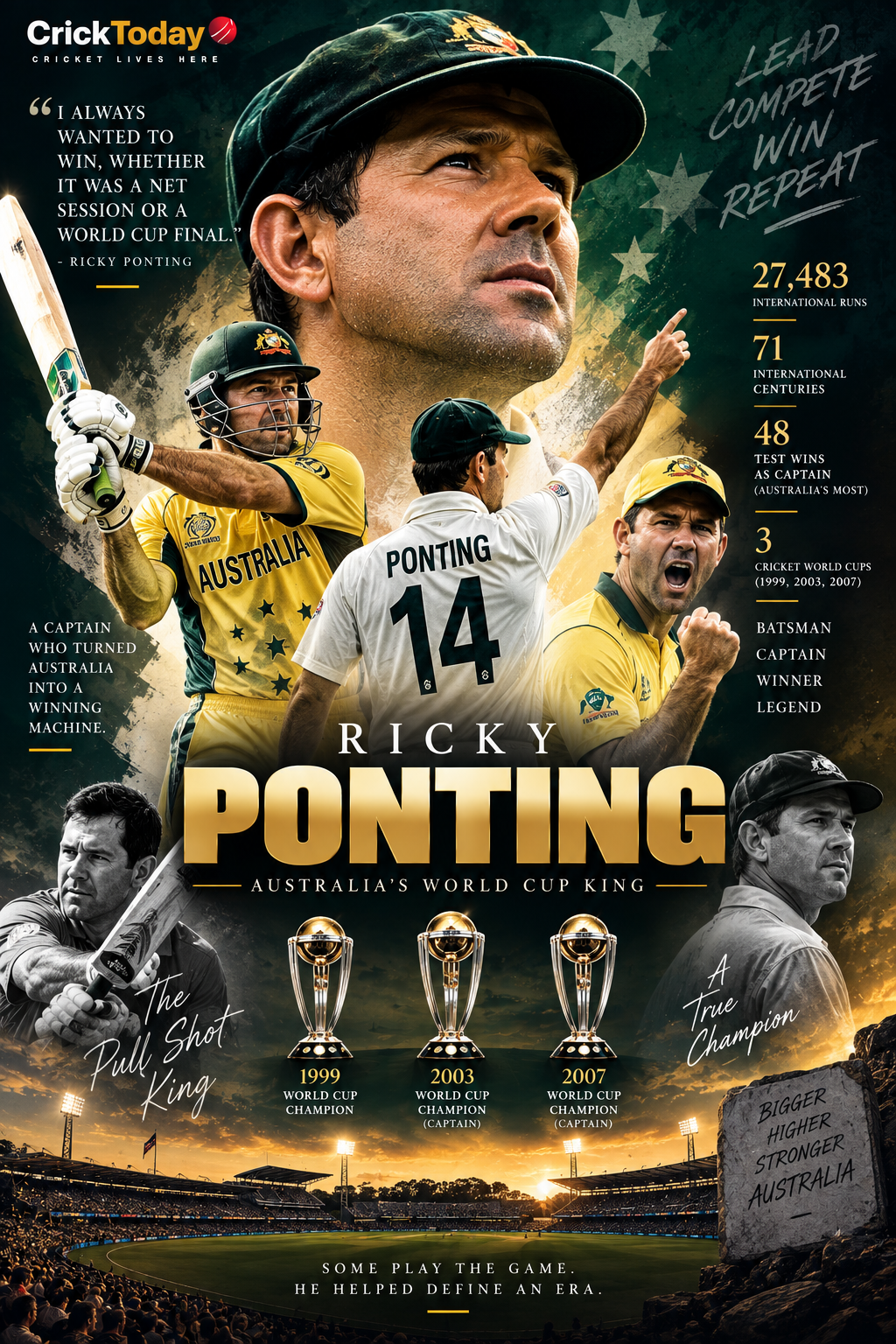
He scored more than 27,000 international runs.
He made 71 international centuries.
He won three Cricket World Cups as a player.
He captained Australia to two of those titles.
And for much of the 2000s, when Australia walked onto a cricket field, Ponting was the man leading them.
His pull shot became iconic.
His aggression became unmistakable.
His desire to win became part of his identity.
Ricky Ponting was not simply a member of Australia’s golden generation.
He became one of its defining figures.
From Tasmania to International Cricket
Ricky Thomas Ponting was born on 19 December 1974 in Launceston, Tasmania.
Cricket talent appeared early.
Ponting progressed through Tasmania’s system and made his first-class debut as a teenager.
It quickly became obvious that he possessed something unusual.
He was compact at the crease, strong on both sides of the wicket and exceptionally confident against fast bowling.
Australia selected him for One Day International cricket in 1995.
His Test debut followed later that year against Sri Lanka in Perth.
Ponting scored 96 in his first Test innings.
He had fallen four runs short of a debut century.
But the innings made something clear.
Australia had found a serious batsman.
The Pull Shot
Every great batsman has strokes that supporters immediately associate with them.
For Ponting, the pull shot became one of the most recognizable.
Fast bowlers attempting to intimidate him with short deliveries often discovered that they had bowled into one of his strongest areas.
Ponting moved quickly onto the back foot.
His hands came through aggressively.
The ball disappeared through square leg or midwicket.
Sometimes it went into the crowd.
He played the shot with such authority that bowlers had to think carefully before attacking him with the short ball.
Against a batsman from Australia, a country famous for fast, bouncy pitches, perhaps that was appropriate.
Batting at No. 3
Ponting spent much of his career at No. 3, one of the most important positions in a batting order.
Sometimes he arrived almost immediately after an early wicket.
Sometimes Australia’s openers provided a large partnership and he entered with the opposition already tired.
Whatever the situation, Ponting’s job was clear.
Control the innings.
He became extraordinarily good at it.
During Australia’s strongest years, opponents often knew that dismissing the openers only brought Ponting to the crease.
There was rarely any relief.
Growing Into a Great Batsman
Ponting’s early career included inconsistency.
He was immensely talented, but international cricket demanded discipline.
Over time, he developed greater control.
His technique tightened.
His decision-making improved.
The aggressive instincts remained.
By the late 1990s and early 2000s, Ponting had developed into one of the finest batsmen in world cricket.
He could dominate pace.
He could attack spin.
He could score quickly enough for ODI cricket and patiently enough for Tests.
Most importantly, he could do it against the best teams in the world.
The 1999 Cricket World Cup
Ponting was part of Australia’s squad at the 1999 Cricket World Cup in England.
Australia began the tournament uncertainly but gradually gained momentum.
They survived a dramatic semi-final against South Africa before facing Pakistan at Lord’s.
Australia won comfortably.
Ponting had his first World Cup title.
He was still only 24.
The tournament marked the beginning of an extraordinary period.
Australia would not lose another World Cup match for more than a decade.
Ponting would become central to that dominance.
The Beginning of an Australian Dynasty
The Australian team around Ponting contained extraordinary talent.
Steve Waugh.
Mark Waugh.
Glenn McGrath.
Shane Warne.
Adam Gilchrist.
Matthew Hayden.
Justin Langer.
Brett Lee.
Jason Gillespie.
Later came players such as Michael Clarke, Andrew Symonds and Mike Hussey.
There were world-class players almost everywhere.
Ponting first contributed as a batsman.
Then he became their captain.
Taking Over the ODI Captaincy
Ponting became Australia’s One Day International captain in 2002.
He inherited a team accustomed to winning.
That can create its own pressure.
Maintaining dominance is sometimes harder than building towards it.
Every opponent wants to defeat the best team.
Every loss becomes news.
Every major tournament is expected to end with a trophy.
Ponting embraced those expectations.
The greatest demonstration came at the 2003 Cricket World Cup in South Africa.
The 2003 World Cup
Australia entered the tournament as defending champions.
Ponting was captain.
The team dominated.
Despite losing key players before and during the competition, Australia continued winning.
They defeated Pakistan.
They beat India.
They overcame Sri Lanka in the semi-final.
Then India waited again in the final at Johannesburg.
Ponting produced one of the most famous innings ever played in a World Cup final.
140 Not Out
Australia batted first.
Adam Gilchrist attacked early.
Matthew Hayden contributed.
Then Ponting took control.
He began patiently.
India’s bowlers initially restricted him.
Then the acceleration came.
Ponting launched the ball repeatedly into the stands.
He finished unbeaten on:
140 from 121 balls.
Australia scored 359 for two.
India were overwhelmed.
Australia won by 125 runs.
Ponting had captained Australia to a World Cup title while producing the defining innings of the final himself.
A World Cup Final Masterpiece
Ponting’s 140* became one of the iconic World Cup final performances.
It was not simply the size of the score.
It was the situation.
World Cup final.
Massive television audience.
Powerful opposition.
Captaincy pressure.
And Ponting produced one of his greatest ODI innings.
Australia had won the 1999 World Cup.
Under Ponting, they had now defended it.
Four years later, they would do it again.
Test Captaincy
Ponting succeeded Steve Waugh as Australia’s Test captain in 2004.
The responsibility was enormous.
Waugh had led one of cricket’s greatest teams.
Ponting now had to continue the standard.
For much of his captaincy, he did.
Australia continued dominating international cricket.
They won at home.
They won overseas.
They reclaimed trophies.
They produced long winning streaks.
Ponting’s own batting remained exceptionally strong throughout much of that period.
Australia’s Most Successful Test Captain by Wins
Ponting captained Australia in 77 Tests.
Australia won 48 of them.
That made him Australia’s most successful Test captain in terms of victories.
His record reflected the strength of the team around him, but leadership was still required to keep such a collection of stars moving in the same direction.
Managing elite personalities is not always easy.
Ponting led aggressively.
He expected high standards.
And Australia kept winning.
The 2005 Ashes
Not every chapter was successful.
The 2005 Ashes in England became one of the most famous Test series ever played.
Australia entered as overwhelming champions.
England challenged them brilliantly.
The series moved from one dramatic match to another.
Ponting produced one of his finest captain’s innings at Old Trafford.
Australia were fighting to save the Test on the final day.
Ponting scored 156.
He batted for hours under enormous pressure.
Australia survived with one wicket remaining.
England ultimately won the series 2–1.
For Australia, the defeat hurt deeply.
For Ponting, it became motivation.
The 2006–07 Revenge
England travelled to Australia for the next Ashes series.
Australia responded brutally.
The series finished:
Australia 5–0 England.
A complete whitewash.
Ponting scored heavily throughout the series.
Australia regained the Ashes.
Several legends, including Shane Warne and Glenn McGrath, would retire soon afterwards.
The victory became the final great Test campaign of Australia’s original golden generation.
Ponting had led them to it.
The Peak of His Batting
Ponting’s batting reached extraordinary levels during the mid-2000s.
He accumulated centuries across different continents.
He dominated both Test and ODI cricket.
In 2006, he was named ICC Player of the Year and ICC Test Player of the Year.
He won the ICC Player of the Year award again in 2007.
Very few players have sustained such a high standard across both formats while simultaneously carrying the responsibilities of captaincy.
Ponting did.
The 2007 World Cup
Australia entered the 2007 World Cup in the Caribbean as two-time defending champions.
Again, Ponting was captain.
Again, Australia dominated.
They played 11 matches.
They won all 11.
Nobody defeated them.
Sri Lanka reached the final.
Australia scored 281 for four in a rain-shortened match, powered by Adam Gilchrist’s magnificent 149.
Australia won by 53 runs under the Duckworth-Lewis method.
Ponting had now captained Australia to back-to-back undefeated World Cup campaigns.
Three World Cup Titles
Ponting’s personal World Cup record became remarkable.
1999 — Champion
2003 — Champion as captain
2007 — Champion as captain
Three consecutive World Cups.
He became one of the central figures in the most dominant World Cup era men’s cricket has seen.
Australia went unbeaten across the 2003 and 2007 tournaments.
Ponting captained both campaigns.
26 Consecutive Unbeaten World Cup Matches as Captain
From 2003 through the early stages of the 2011 tournament, Australia went 26 consecutive World Cup matches without defeat under Ponting’s captaincy.
That run illustrates the scale of the team’s control over the competition.
World Cups are designed to produce pressure and unpredictability.
One poor game can end a tournament.
Australia avoided that fate for years.
Ponting’s captaincy became inseparable from that run.
The Champions Trophy
Ponting also led Australia to major success outside the World Cup.
Australia won the ICC Champions Trophy in 2006.
Then they won it again in 2009.
Ponting captained both teams.
By this stage, his international leadership record contained virtually every major white-ball trophy available.
The only notable omission was the T20 World Cup.
The First T20 International
Ponting also owns an unusual place in T20 history.
Australia and New Zealand played the first men’s Twenty20 International in 2005.
Ponting scored an unbeaten 98.
He was named Player of the Match.
Nobody yet knew how dramatically T20 cricket would transform the sport.
Ponting had already produced one of the format’s first great international innings.
More Than 13,000 Test Runs
Ponting finished his Test career with:
13,378 runs in 168 matches.
His batting average was 51.85.
He scored 41 Test centuries.
At retirement, only Sachin Tendulkar had scored more Test runs.
Even today, Ponting remains among the highest run-scorers the format has produced.
For Australia, his total remains one of the defining batting records in the nation’s history.
More Than 13,000 ODI Runs
His ODI record was equally extraordinary.
Ponting played 375 ODIs.
He scored 13,704 runs.
He made 30 ODI centuries.
He remains Australia’s leading ODI run-scorer.
Very few batsmen in cricket history have passed 13,000 runs in both Tests and ODIs.
Ponting did it.
That consistency across formats separates him from most players.
27,000 International Runs
Across Tests, ODIs and T20 Internationals, Ponting accumulated more than 27,000 international runs.
His totals were:
13,378 Test runs
13,704 ODI runs
401 T20I runs
Combined:
27,483 international runs.
He also scored 71 international centuries.
Those numbers place him among the most prolific batsmen international cricket has ever produced.
The No. 3 Position
Ponting’s career helped define what teams want from a great No. 3 batsman.
He could rescue an innings after an early wicket.
He could dominate after a strong opening partnership.
He could accelerate.
He could defend.
He could attack fast bowling.
He could score big hundreds.
Australia rarely needed to hide him.
Ponting wanted responsibility.
No. 3 gave him plenty.
Ponting Against Fast Bowling
One of Ponting’s defining strengths was his confidence against pace.
His back-foot play was exceptional.
The pull shot was obvious, but he also cut aggressively and drove through the off side.
On Australian pitches, where bounce can expose technical weakness, Ponting often looked completely at home.
Fast bowlers could not simply attack his body.
He enjoyed the contest.
That fearlessness became part of his reputation.
Ponting Against Spin
Ponting was not always as naturally dominant against spin as he was against pace.
High-quality spin occasionally challenged him, particularly in Asian conditions.
But great careers require adaptation.
Ponting developed methods to counter slow bowling and still scored heavily across a wide variety of conditions.
His battles against bowlers such as Muttiah Muralitharan, Harbhajan Singh and Anil Kumble became part of the tactical richness of his era.
The India Rivalry
Few opponents challenged Ponting and Australia more intensely than India.
The rivalry produced some of the defining series of the 2000s.
India famously ended Australia’s winning streak in Kolkata in 2001.
Australia later won a Test series in India in 2004.
The teams met in World Cup matches.
They played controversial Tests.
They repeatedly pushed each other.
Ponting experienced both triumph and frustration against India.
That rivalry became one of the major themes of his career.
A Fierce Competitor
Ponting’s body language was unmistakable.
He was intense.
He was vocal.
He celebrated wickets aggressively.
He demanded high standards from teammates.
Critics sometimes viewed him as confrontational.
Supporters saw a captain determined to win.
Whatever the interpretation, Ponting rarely appeared indifferent.
He played cricket with obvious competitive fire.
That intensity became part of Australia’s identity during his captaincy.
One of Cricket’s Greatest Fielders
Ponting’s contribution was not limited to batting.
He was one of the finest fielders of his generation.
At point or inside the circle, he was exceptionally quick.
His throws were powerful and accurate.
He created run-outs that many fielders would not even attempt.
Later, he also became an outstanding slip catcher.
Opponents could not relax simply because Ponting was not batting.
He remained dangerous in the field.
The Run-Out Threat
Ponting attacked the ball.
That sounds simple, but it mattered.
A batsman seeing Ponting moving towards the ball knew that a casual single could become dangerous.
His ability to release quickly created pressure.
Fielding does not appear in career statistics as dramatically as centuries or wickets.
But across hundreds of matches, saving runs and creating dismissals can change outcomes.
Ponting did it repeatedly.
The End of the Golden Generation
As the late 2000s progressed, many of Ponting’s great teammates retired.
Warne left.
McGrath left.
Gilchrist left.
Hayden left.
Langer left.
Australia entered a transition.
Ponting remained.
The team was no longer as overwhelmingly dominant.
That period changed the context of his captaincy.
Winning became more difficult.
Expectations, however, remained enormous.
Ponting carried both.
The 2011 World Cup
Australia entered the 2011 World Cup as three-time defending champions.
The extraordinary unbeaten run finally ended when Pakistan defeated them in the group stage.
India then eliminated Australia in the quarter-final.
Ponting scored 104.
Even in defeat, the captain produced a World Cup century.
It would be his final appearance in the tournament.
His World Cup story had begun as a champion in 1999 and ended after more than a decade of extraordinary Australian dominance.
Stepping Down as Captain
After the 2011 World Cup, Ponting stepped down from the Australian captaincy.
Michael Clarke became the team’s new leader.
Ponting continued playing as a specialist batsman.
That transition demonstrated another side of his career.
After years of leading the team, he had to return to being simply one member of the XI.
He continued working.
The hunger remained.
Final Test
Ponting played his final Test against South Africa in Perth in December 2012.
It was his 168th Test match.
His international career had lasted 17 years.
Australia lost the match.
Ponting walked away from international cricket as the country’s leading run-scorer in both Tests and ODIs.
Few Australian batsmen had ever produced anything comparable.
Hall of Fame
In 2018, Ricky Ponting was inducted into the ICC Cricket Hall of Fame.
The honour recognized one of the most accomplished careers in the history of Australian cricket.
His achievements included:
Huge run totals.
World Cup trophies.
Captaincy records.
ICC awards.
And membership of one of the most dominant teams sport has seen.
The induction was a natural conclusion to an extraordinary international career.
Life After Playing
Ponting remained deeply involved with cricket after retirement.
He moved into coaching and commentary.
His tactical knowledge made him highly respected.
He worked in the Indian Premier League and with Australian teams in various coaching capacities.
The transition made sense.
Ponting had spent years studying the game intensely as both batsman and captain.
His career after playing allowed him to transfer that knowledge to a new generation.
Ricky Ponting’s Career Numbers
Ponting’s international record included:
168 Test matches
13,378 Test runs
Test average: 51.85
41 Test centuries
375 ODIs
13,704 ODI runs
30 ODI centuries
17 T20 Internationals
27,483 international runs
71 international centuries
77 Tests as captain
48 Test wins as captain
1999 World Cup champion
2003 World Cup-winning captain
2007 World Cup-winning captain
2006 Champions Trophy-winning captain
2009 Champions Trophy-winning captain
ICC Player of the Year: 2006 and 2007
ICC Test Player of the Year: 2006
ICC Hall of Fame: 2018
Why Ricky Ponting Was Different
Ponting’s career combined three identities.
The batsman.
The captain.
The competitor.
Remove the captaincy and he still finishes as one of the greatest Australian batsmen.
Remove his batting and his leadership record still includes two undefeated World Cup titles and 48 Test victories.
Combine both and the career becomes exceptional.
Ponting played during an era when Australia expected victory almost every time they entered the field.
He did not hide from that expectation.
He helped create it.
Ricky Ponting’s Lasting Legacy
Cricket history will always remember Australia’s golden generation.
Shane Warne turning the ball.
Glenn McGrath hitting the perfect length.
Adam Gilchrist attacking from behind the stumps and at the top of the order.
Matthew Hayden bullying fast bowlers.
Steve Waugh refusing to surrender.
But in the middle of that era stood Ricky Ponting.
The No. 3 batsman.
The pull shot.
The fierce captain.
The man lifting World Cups.
His unbeaten 140 in the 2003 final remains one of the defining performances in tournament history.
His 13,378 Test runs and 13,704 ODI runs demonstrate extraordinary longevity.
His two World Cup victories as captain demonstrate extraordinary leadership.
And his 27,000-plus international runs place him among cricket’s greatest run-scorers.
Ponting played in a great team.
He was also one of the main reasons it was great.
For more than a decade, Ricky Ponting represented the confidence, aggression and winning mentality of Australian cricket at its most dominant.
Quick Facts
Full Name: Ricky Thomas Ponting
Born: 19 December 1974
Country: Australia
Playing Role: Top-order batsman
Batting Style: Right-handed
International Career: 1995–2012
Test Matches: 168
Test Runs: 13,378
Test Average: 51.85
Test Centuries: 41
Highest Test Score: 257
ODI Matches: 375
ODI Runs: 13,704
ODI Centuries: 30
Highest ODI Score: 164
T20I Matches: 17
International Runs: 27,483
International Centuries: 71
Tests as Captain: 77
Test Wins as Captain: 48
1999 World Cup: Champion
2003 World Cup: Champion Captain
2007 World Cup: Champion Captain
2003 World Cup Final: 140*
2006 Champions Trophy: Champion Captain
2009 Champions Trophy: Champion Captain
ICC Player of the Year: 2006, 2007
ICC Test Player of the Year: 2006
ICC Hall of Fame: 2018