

There are great bowlers, record-breaking bowlers and bowlers who force the sport to rethink what is possible.
Muttiah Muralitharan belonged to all three categories.
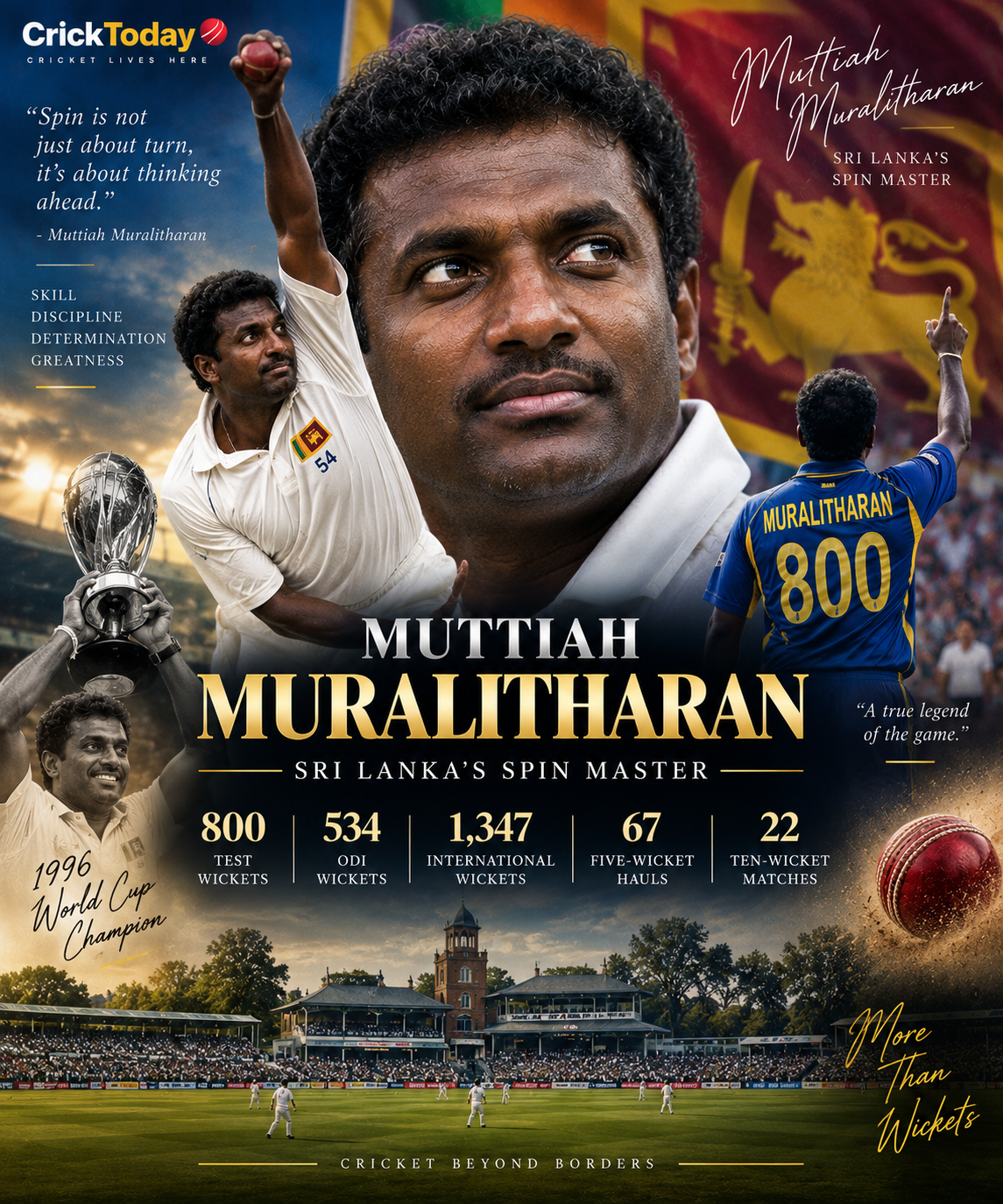
The Sri Lankan off-spinner finished his Test career with 800 wickets, more than any other bowler in the history of the format.
He also took 534 wickets in One Day Internationals.
Together with his T20I wickets, Muralitharan ended international cricket with 1,347 wickets.
No international bowler has taken more.
From Kandy to International Cricket
Muttiah Muralitharan was born on 17 April 1972 in Kandy, Sri Lanka.
He developed into an off-spinner with an unusual action, exceptional wrist flexibility and the ability to generate far more turn than most traditional finger spinners.
Muralitharan made his Test debut for Sri Lanka against Australia in 1992.
At the time, Sri Lankan cricket was still building its reputation at the highest level.
Over the next two decades, Muralitharan would become one of the players most closely associated with the country’s rise.
A Bowler Unlike Almost Anyone Else
Muralitharan did not bowl like a conventional off-spinner.
The amount of spin he generated made even good deliveries difficult to predict.
His standard off-break could turn sharply.
He could change pace.
He could alter trajectory.
Later, his use of the doosra added another major weapon.
The doosra moved in the opposite direction from the traditional off-break, giving batsmen another problem to solve.
A batsman could believe he had read the delivery correctly and still find the ball moving the other way.
More Than Turn
It is easy to describe Muralitharan simply as a huge spinner of the ball.
That would underestimate his skill.
His greatest strength was control.
A bowler can spin the ball dramatically and still be ineffective if he cannot land it consistently.
Muralitharan combined extreme turn with accuracy.
He could attack for long spells without losing control.
He changed pace intelligently and understood how to build pressure over several deliveries.
That made him dangerous not just on turning pitches, but across many different conditions.
Sri Lanka’s 1996 World Cup Triumph
One of the most important moments of Muralitharan’s early career came at the 1996 Cricket World Cup.
Sri Lanka entered the tournament with a bold approach to One Day cricket.
Their opening batsmen attacked from the first over, while players such as Aravinda de Silva, Arjuna Ranatunga and Muralitharan gave the team balance and experience.
Sri Lanka reached the final against Australia in Lahore.
They won the match and became world champions for the first time.
Muralitharan was part of that historic squad.
The victory transformed Sri Lankan cricket and announced the country as a major international force.
Building a Test Bowling Empire
As the years passed, Muralitharan became Sri Lanka’s central Test bowler.
Captains could ask him to bowl enormous spells.
He could attack from one end for session after session while continuing to threaten wickets.
This reliability allowed Sri Lanka to build their bowling plans around him.
By the end of his career, Muralitharan had taken 800 wickets in 133 Tests.
That record remains unmatched.
The Five-Wicket Hauls
Muralitharan did not simply collect wickets one or two at a time.
He regularly destroyed entire batting orders.
He recorded 67 five-wicket innings hauls in Test cricket.
He also achieved 22 ten-wicket match hauls.
Those figures show how frequently he dominated full matches rather than merely contributing to them.
A five-wicket haul can decide an innings.
A ten-wicket match can define an entire Test.
Muralitharan did both repeatedly.
The Battle for the Test Wicket Record
During Muralitharan’s career, another great spinner was building an extraordinary record of his own.
Australia’s Shane Warne.
For years, Muralitharan and Warne climbed the all-time Test wicket list together.
Their styles were completely different.
Warne was a leg-spinner.
Muralitharan was an off-spinner.
Both became central figures for their countries.
The rivalry was not always direct on the field, but cricket followers closely watched their pursuit of bowling records.
Eventually, Muralitharan moved ahead.
In 2007, he surpassed Warne’s Test wicket total and continued until reaching 800.
The Final Test
Muralitharan entered his final Test match against India at Galle in 2010 with 792 wickets.
He needed eight more to reach 800.
That created enormous pressure.
Eight wickets in one match is difficult even for a great bowler.
Muralitharan kept taking them.
He reached 799.
One wicket remained.
India’s Pragyan Ojha became his final Test victim.
Muralitharan had reached 800 wickets with his final delivery in Test cricket.
It was a remarkably fitting ending.
Sri Lanka won the Test, and Muralitharan retired from the format with the record exactly where he wanted it.
ODI Greatness
Muralitharan’s success was not limited to Test cricket.
He also became the leading wicket-taker in One Day International history.
Across 350 ODIs, he took 534 wickets.
His ability to control scoring while still attacking for wickets made him especially valuable in limited-overs cricket.
Batsmen could not simply wait for him to finish his spell.
If they became too defensive, he created pressure.
If they attacked recklessly, he created chances.
That balance made him difficult to handle.
Five World Cups
Muralitharan represented Sri Lanka across several World Cup generations.
He played in five Cricket World Cups.
He was part of the championship-winning side in 1996 and later appeared in the 2007 and 2011 finals.
Across World Cup cricket, he took 68 wickets, making him the most successful spinner in the tournament’s history.
That record demonstrates his ability to perform on cricket’s biggest limited-overs stage.
Controversy Around His Action
Muralitharan’s career was also accompanied by controversy over his bowling action.
He was called for throwing during international matches, particularly early in his career.
The issue became one of cricket’s major technical debates.
His bowling action was later subjected to extensive biomechanical examination.
Changes in cricket’s understanding and regulations regarding permissible elbow extension also became part of the wider discussion.
For Muralitharan, the controversy created pressure that went far beyond ordinary performance.
Yet he continued playing and continued taking wickets.
The Doosra
As batsmen became more familiar with his off-break, Muralitharan continued developing his bowling.
The doosra became one of his most famous weapons.
Delivered with a similar action, it moved away from a right-handed batsman rather than turning into him.
That variation made reading him even more difficult.
Batsmen could no longer simply play for the traditional off-break.
They had to consider the possibility of the ball turning in either direction.
That uncertainty was a major part of Muralitharan’s success.
Bowling With Chaminda Vaas
Muralitharan’s success also formed part of an important Sri Lankan bowling partnership with Chaminda Vaas.
Vaas provided left-arm pace and movement with the new ball.
Muralitharan offered spin and sustained pressure.
Together, they gave Sri Lanka two very different wicket-taking threats.
Opponents who survived Vaas still had to deal with Muralitharan.
That partnership became an important feature of Sri Lankan cricket for many years.
A Record Across Formats
Muralitharan finished with:
800 Test wickets
534 ODI wickets
13 T20 International wickets
That produced a total of 1,347 international wickets.
The scale of that number demonstrates not just brilliance, but longevity.
To take that many wickets, a bowler must remain effective across different opponents, conditions and stages of a career.
Muralitharan did.
First Sri Lankan in the ICC Hall of Fame
In 2017, Muralitharan became the first Sri Lankan cricketer to be inducted into the ICC Cricket Hall of Fame.
The honour recognised both his individual records and his role in the development of Sri Lankan cricket.
By then, his achievements had already placed him permanently among cricket’s most successful bowlers.
Why Muralitharan Was So Important to Sri Lanka
Muralitharan’s importance cannot be measured only through individual statistics.
Sri Lanka became a far stronger international team during his career.
He gave the country a bowler capable of winning Test matches almost anywhere.
On helpful pitches, he could become overwhelming.
On flatter surfaces, his control allowed him to keep searching for wickets.
For a developing cricket nation, having a player of that quality changed expectations.
Sri Lanka were no longer participating simply to compete.
They expected to win.
Muttiah Muralitharan’s Lasting Legacy
Spin bowling has always required imagination.
The bowler must deceive the batsman through turn, flight, pace and variation.
Muralitharan pushed those qualities to extraordinary levels.
His action was distinctive.
His turn was extreme.
His variations were difficult to read.
And his numbers remain enormous.
The record of 800 Test wickets may stand for generations.
His 534 ODI wickets remain another landmark.
But perhaps his greatest achievement was demonstrating how one specialist spinner could become the central force in an international team for nearly two decades.
Sri Lanka produced many brilliant cricketers.
Muttiah Muralitharan became one of the most important of them all.
And in the record books, no bowler has taken more international wickets.
Quick Facts
Full Name: Muttiah Muralitharan
Born: 17 April 1972
Country: Sri Lanka
Playing Role: Bowler
Batting Style: Right-handed
Bowling Style: Right-arm off-spin
Test Matches: 133
Test Wickets: 800
Test Five-Wicket Hauls: 67
Test Ten-Wicket Matches: 22
ODI Matches: 350
ODI Wickets: 534
T20I Wickets: 13
International Wickets: 1,347
World Cup Winner: 1996
ICC Hall of Fame: 2017