

Cricket has produced great batsmen.
It has produced great bowlers.
Finding one player capable of performing at an elite level in both disciplines for nearly two decades is considerably rarer.
Jacques Kallis was one of those players.
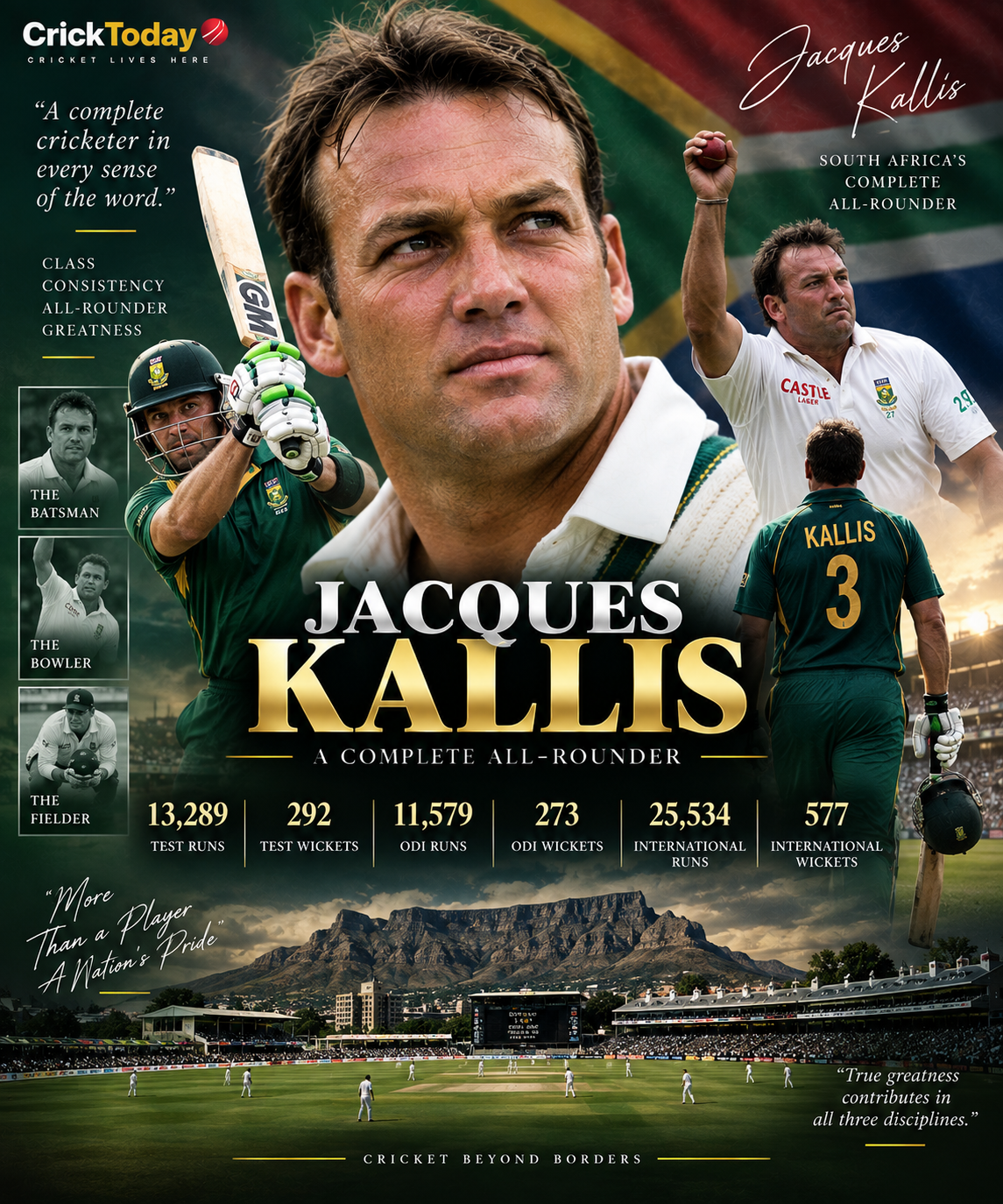
The South African all-rounder finished his international career with more than 25,000 runs and 500 wickets, numbers that would be remarkable even if they belonged to two different cricketers.
Kallis combined the patience and technique of a specialist top-order batsman with the ability to bowl fast-medium seam and take important wickets.
Add exceptional slip catching to the equation, and his career becomes one of the most complete statistical profiles international cricket has ever seen.
From Cape Town to International Cricket
Jacques Henry Kallis was born on 16 October 1975 in Cape Town, South Africa.
He developed his cricket at Wynberg Boys’ High School and gradually emerged as one of South Africa’s most promising young players.
Kallis entered international cricket in 1995, making his Test debut against England.
His beginning was not spectacular.
Runs were difficult to find during his first few Tests, and nothing about those early numbers suggested that he would eventually become South Africa’s leading Test run-scorer.
But Kallis possessed something that would define his entire career:
Patience.
He continued developing his game rather than attempting to become an overnight star.
The results eventually followed.
The Century That Changed Everything
A major turning point came against Australia at the Melbourne Cricket Ground during the 1997 Boxing Day Test.
South Africa were trying to save the match against a powerful Australian side.
Kallis produced a determined century.
His 101 was not the kind of aggressive innings designed for highlight reels.
It was something more important at that stage of his career.
It proved he belonged at Test level.
From there, Kallis began developing into the reliable top-order batsman South Africa would depend upon for more than a decade.
A Batsman Built for Test Cricket
Kallis was rarely described as flamboyant.
He did not need to be.
His batting was built around balance, judgment and control.
He understood where his off stump was.
He defended patiently.
He waited for bowlers to make mistakes.
And when a scoring opportunity appeared, he possessed enough power and technique to punish it.
His cover drive became particularly recognizable, but Kallis could score all around the wicket.
He was equally comfortable against pace and spin.
That adaptability allowed him to succeed in South Africa, Australia, England, India, the Caribbean and elsewhere.
The Value of Patience
One of Kallis’s greatest strengths was his willingness to build an innings slowly.
Modern audiences sometimes judge batsmen by how quickly they score.
Kallis belonged to a period when Test cricket frequently demanded something different.
South Africa often needed someone capable of batting through difficult sessions.
Kallis became that player.
He could absorb pressure while wickets fell around him.
He could leave deliveries outside off stump for hours.
He could wear down a bowling attack.
Then, once conditions became easier, he could accelerate.
This ability made him extremely difficult to remove.
More Than 13,000 Test Runs
By the end of his Test career, Kallis had scored 13,289 runs in 166 matches.
He averaged 55.37.
He also scored 45 Test centuries.
Those numbers alone would have been enough to establish him as one of the outstanding batsmen of his generation.
But Kallis was doing something else at the same time.
He was bowling.
Kallis the Bowler
Kallis bowled right-arm fast-medium and was far more than an occasional part-time option.
At his best, he could generate good pace, movement and bounce.
He was especially useful when conditions offered assistance to seam bowlers.
South Africa already possessed outstanding fast bowlers during much of Kallis’s career, including Allan Donald, Shaun Pollock, Makhaya Ntini, Dale Steyn and Morné Morkel.
That meant Kallis was not always required to carry the attack.
Instead, he gave his captain another genuine wicket-taking option.
When the frontline bowlers needed a rest, Kallis could maintain pressure.
When a partnership needed to be broken, he could produce an important wicket.
Nearly 300 Test Wickets
Kallis finished Test cricket with 292 wickets.
Think about what that means alongside 13,289 runs.
Many international cricketers spend their entire careers developing one discipline and never approach either number.
Kallis accumulated elite batting statistics while simultaneously delivering thousands of overs as an international seam bowler.
That workload helps explain why comparisons with other all-rounders are so fascinating.
He was effectively performing two jobs.
The Complete Test Cricketer
Kallis’s Test career eventually produced an extraordinary combination:
13,289 runs
45 centuries
292 wickets
200 catches
He became one of only a tiny number of players whose batting, bowling and fielding records could each stand on their own.
His slip catching was particularly valuable.
Standing behind the batsman required sharp reactions, concentration and reliable hands.
Kallis provided all three.
Across international cricket, he finished with 338 catches.
The 1998 ICC KnockOut Trophy
One of Kallis’s most important early international achievements arrived in 1998.
South Africa competed in the ICC KnockOut tournament in Bangladesh, a competition that later evolved into the ICC Champions Trophy.
Kallis played a central role.
He scored an unbeaten 113 in the semi-final.
Then, in the final against the West Indies, he produced a devastating bowling performance.
Kallis took 5 for 30.
South Africa won the tournament, securing their first senior men’s ICC trophy.
It was one of the clearest early demonstrations of what Kallis could offer.
One match could be decided by his batting.
Another could be decided by his bowling.
Sometimes he could influence both.
Four Centuries in Four Tests
During the 2003–04 season, Kallis produced one of the finest periods of his batting career.
Against the West Indies, he scored a century in each of the four Tests.
Across the series, he accumulated more than 700 runs.
It was an extraordinary display of consistency.
One century is an achievement.
Producing another in the next match is difficult.
Doing it repeatedly across an entire Test series demonstrates complete control of form and concentration.
Kallis was operating at that level.
The Double-Century Barrier
For all his enormous run-scoring achievements, one milestone took Kallis surprisingly long to reach.
A Test double century.
He had produced many hundreds and several huge innings, but 200 continued to escape him.
That changed against India at Centurion in 2010.
Kallis scored an unbeaten 201.
After years of waiting, he finally had his first Test double hundred.
He did not stop there.
In 2012, against Sri Lanka at Newlands, he scored 224, the highest Test score of his career.
Even in his mid-thirties, Kallis remained one of the world’s leading batsmen.
ODI Excellence
Kallis’s achievements were not limited to Test cricket.
He was also one of South Africa’s most productive One Day International batsmen.
Across 328 ODIs, he scored 11,579 runs.
He also took 273 ODI wickets.
That combination placed him in extremely rare territory.
Kallis became the only player to achieve the double of at least 10,000 runs and 200 wickets in both Test and ODI cricket.
It is one of the strongest statistical arguments for his status as one of cricket’s great all-rounders.
A Different Role in One-Day Cricket
Kallis’s ODI batting sometimes attracted criticism because his natural style was more controlled than explosive.
But South Africa often relied on him to provide stability.
While aggressive players attacked around him, Kallis could hold an innings together.
His value became particularly obvious when early wickets fell.
He could rebuild.
He could bat deep into an innings.
And unlike most specialist batsmen, he could then contribute with ten overs of seam bowling.
That versatility gave South Africa enormous tactical flexibility.
One of His Finest ODI Performances
Against India in Durban in 2006, Kallis demonstrated his complete value.
He scored 119 as South Africa made 248.
Then he took the ball.
Kallis returned remarkable figures of 3 for 3 as India were bowled out for 91.
One player had produced a century and then helped dismantle the opposition batting line-up.
That was the kind of performance that made Kallis unique.
Playing in a Powerful South African Era
Kallis spent much of his career surrounded by outstanding cricketers.
He played alongside names such as:
Allan Donald
Shaun Pollock
Gary Kirsten
Herschelle Gibbs
Mark Boucher
Graeme Smith
AB de Villiers
Hashim Amla
Dale Steyn
South Africa possessed enough talent to challenge almost any team in the world.
Kallis became the bridge between different generations of that side.
He began his career alongside players who had helped rebuild South African cricket after its return to international competition.
He finished alongside a newer generation that became one of the strongest Test teams in the world.
The Kallis-Pollock Combination
One particularly important partnership was with Shaun Pollock.
Pollock was primarily a world-class bowler who could contribute valuable runs.
Kallis was primarily an elite batsman who could take important wickets.
Together, they gave South Africa remarkable balance.
A team with several genuine all-round options can select stronger batting without weakening its bowling.
Kallis was at the centre of that flexibility.
Kallis Versus the World’s Best
Kallis’s career overlapped with an extraordinary collection of international bowlers.
He faced Wasim Akram, Waqar Younis, Glenn McGrath, Shane Warne, Muttiah Muralitharan, Anil Kumble, Curtly Ambrose, Courtney Walsh, Brett Lee, James Anderson and many others.
Later in his career, younger attacks emerged.
Kallis kept scoring.
This longevity matters.
It is one thing to master a particular generation of bowlers.
It is another to remain successful as opponents, tactics and conditions change over nearly two decades.
The Debate Around Great All-Rounders
Whenever cricket’s greatest all-rounders are discussed, several names appear repeatedly.
Sir Garfield Sobers.
Imran Khan.
Ian Botham.
Kapil Dev.
Richard Hadlee.
And Jacques Kallis.
Comparing them directly is difficult because they played in different eras and performed different roles.
Some were more dominant bowlers.
Some were more aggressive batsmen.
Kallis’s distinction comes from the extraordinary volume of elite-level batting combined with hundreds of international wickets.
His career was built on sustained excellence rather than short bursts.
A Remarkable International Double
Across all international formats, Kallis played 519 matches.
He scored 25,534 runs.
He took 577 wickets.
He also held 338 catches.
Those numbers illustrate the breadth of his contribution better than any single batting or bowling record.
Kallis did not have to choose between being a batsman, bowler or fielder.
He influenced the game in all three disciplines.
The Final Test Century
Kallis announced his retirement from Test cricket during South Africa’s series against India in late 2013.
His final Test was played in Durban.
Rather than quietly disappearing from the format, he produced one more century.
Kallis scored 115.
It was his 45th Test hundred.
His Test career therefore ended with the kind of innings that had defined it for years: patient, controlled and valuable.
The End of an International Career
Kallis continued playing limited-overs cricket into 2014.
When his international career finally ended, it had lasted approximately 19 years.
He had represented South Africa in:
166 Tests
328 ODIs
25 T20 Internationals
Few players remain internationally relevant across such a long period.
Even fewer carry significant responsibility with both bat and ball throughout that time.
Recognition in the ICC Hall of Fame
In 2020, Jacques Kallis was inducted into the ICC Cricket Hall of Fame.
The recognition placed him formally among the game’s most celebrated players.
By then, however, the numbers had already made his position in cricket history difficult to ignore.
More than 25,000 international runs.
More than 500 wickets.
Hundreds of catches.
Nearly two decades at international level.
There has rarely been another career quite like it.
Why Kallis Was Different
Kallis was not always the most spectacular player on the field.
That may actually explain why his greatness could sometimes be underestimated.
He made difficult cricket look routine.
A 70-run innings followed by two wickets might attract less attention than a spectacular century or a five-wicket haul.
But Kallis produced those combined contributions again and again.
A team does not need every player to dominate the headlines.
It needs players who repeatedly improve its chances of winning.
Few cricketers did that in as many different ways as Jacques Kallis.
Jacques Kallis’s Lasting Legacy
Statistics alone cannot decide who the greatest all-rounder in cricket history was.
Different eras produced different conditions, schedules and tactical demands.
But any serious discussion of cricket’s most complete players has to include Jacques Kallis.
As a batsman, he scored more than 13,000 Test runs.
As a bowler, he took almost 300 Test wickets.
In ODI cricket, he passed 11,000 runs while taking more than 270 wickets.
In the field, he became one of the safest slip catchers of his generation.
That combination is what defines his legacy.
Kallis was not simply a batsman who could bowl.
He was not simply a bowler who could bat.
For almost two decades, he was a cricketer capable of changing a match with the bat, the ball or his hands.
South Africa has produced many world-class players.
Few have given their team more.
That is why Jacques Kallis remains one of the most complete all-rounders international cricket has ever seen.
Quick Facts
Full Name: Jacques Henry Kallis
Born: 16 October 1975
Country: South Africa
Playing Role: All-rounder
Batting Style: Right-handed
Bowling Style: Right-arm fast-medium
International Career: 1995–2014
Test Matches: 166
Test Runs: 13,289
Test Average: 55.37
Test Centuries: 45
Highest Test Score: 224
Test Wickets: 292
Test Catches: 200
ODI Matches: 328
ODI Runs: 11,579
ODI Centuries: 17
ODI Wickets: 273
International Runs: 25,534
International Wickets: 577
International Catches: 338
ICC Hall of Fame: 2020