

There are batsmen who dominate scorecards.
Then there are batsmen who dominate the imagination.
Sir Vivian Richards belonged to the second category.
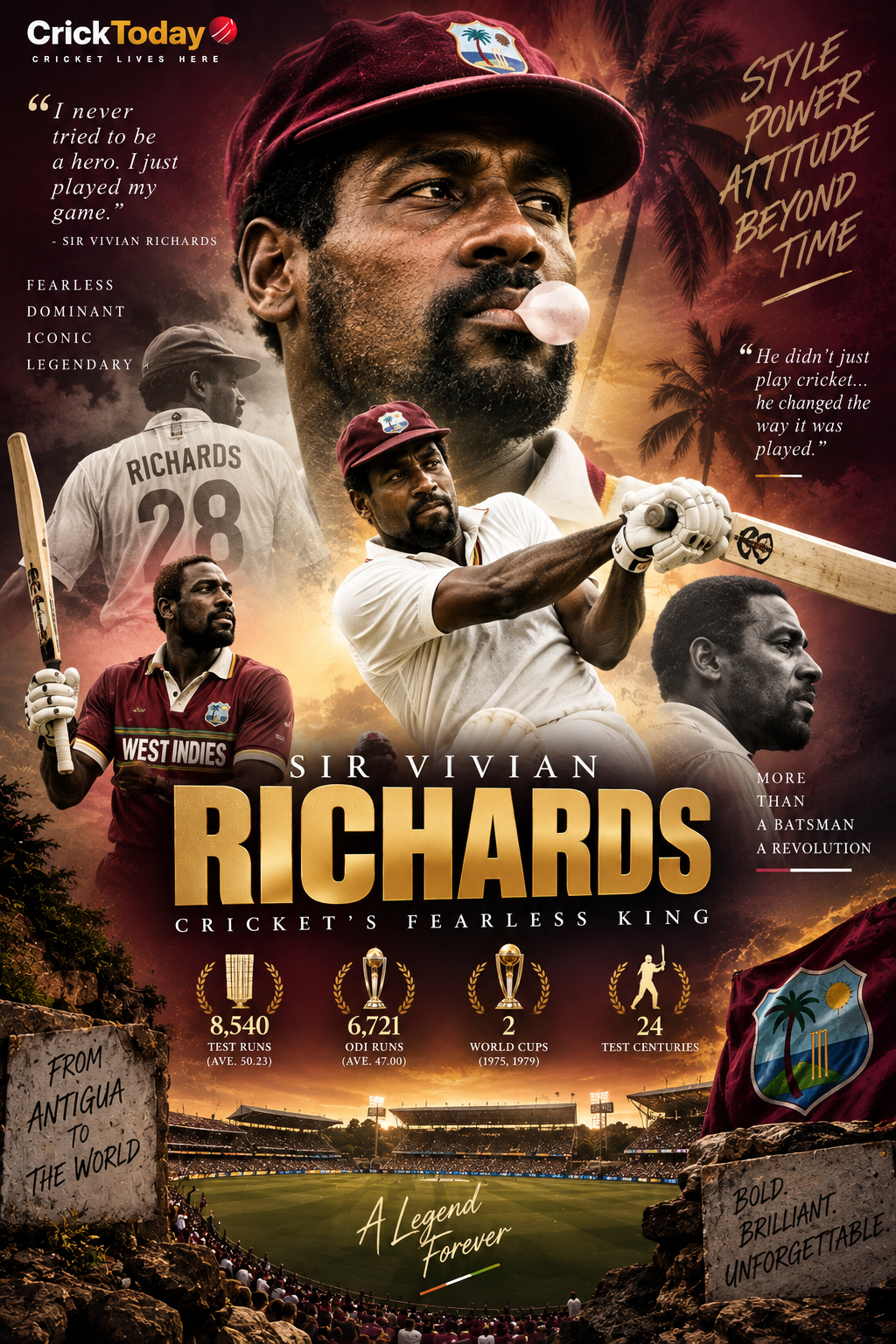
He walked to the crease without a helmet, chewing gum, shoulders relaxed, bat in hand and confidence visible before a ball had even been bowled.
Fast bowlers tried to intimidate him.
Richards often intimidated them instead.
For almost two decades, he became one of the most destructive batsmen international cricket had ever seen and a central figure in the great West Indies teams that dominated world cricket.
He scored 8,540 Test runs at an average above 50.
He added 6,721 ODI runs at a strike rate dramatically ahead of his era.
He won two Cricket World Cups.
He captained the West Indies through one of their most powerful periods.
And he became one of the defining personalities in cricket history.
From Antigua to the West Indies
Isaac Vivian Alexander Richards was born on 7 March 1952 in Antigua.
Cricket was everywhere around him.
Like many Caribbean players of his generation, Richards developed his game in an environment where cricket carried enormous cultural importance.
His natural ability was obvious.
He possessed exceptional hand-eye coordination, powerful wrists and a confidence that eventually became almost as famous as his batting.
Richards made his Test debut against India in November 1974.
His first match produced only modest returns.
That did not last.
By his second Test, he was already showing signs of the player he would become.
Soon, world cricket had a serious problem.
A Batting Style Built on Authority
Richards did not look like a batsman trying merely to survive.
He looked as if he expected to control the contest.
His stance was relaxed.
His movements were economical.
But once the bowler released the ball, everything changed.
Richards could drive powerfully through the covers.
He could whip deliveries from outside off stump through midwicket.
He could hook and pull fast bowling.
And he could hit over the top long before attacking aerial shots became normal in international cricket.
The word most often associated with his batting was not elegance.
It was authority.
No Helmet
Perhaps the most powerful image of Richards remains the simplest.
Viv Richards walking out to face fast bowling without a helmet.
Modern cricket offers batsmen far greater protection.
Richards played during an era featuring some of the most dangerous fast bowlers the sport had produced.
Yet he frequently faced them wearing only a cap.
This did not make him invincible.
But it became symbolic of his confidence.
Opposition bowlers could see it.
Supporters could see it.
Richards rarely looked afraid.
The Great West Indies Era
Richards entered international cricket at exactly the moment West Indies were becoming one of the most powerful teams the game had ever seen.
The side included extraordinary players such as:
Clive Lloyd
Gordon Greenidge
Desmond Haynes
Alvin Kallicharran
Michael Holding
Andy Roberts
Joel Garner
Colin Croft
Malcolm Marshall
and many others.
The batting was powerful.
The fast bowling was frightening.
The fielding was athletic.
Richards became one of the most important pieces of the entire system.
The 1975 Cricket World Cup
The first men’s Cricket World Cup was held in 1975.
West Indies entered as one of the leading teams.
Richards did not dominate the tournament with the bat in the way he later would.
But he still influenced the final.
Against Australia at Lord’s, his fielding played a major role.
West Indies won by 17 runs.
Clive Lloyd lifted the trophy.
Richards had become a World Cup champion.
Four years later, the final would belong to him.
The Extraordinary Year of 1976
The year 1976 established Richards among the elite batsmen in world cricket.
He scored 1,710 Test runs during the calendar year.
At the time, it was a world record.
That record survived for three decades before Mohammad Yousuf surpassed it in 2006.
Richards’ dominance was especially obvious during the tour of England.
Across the Test series, he scored 829 runs at an average of 118.42.
England simply could not contain him.
The 291 at The Oval
The final Test of the 1976 series came at The Oval.
Richards produced the highest Test score of his career.
291.
It was a brutal innings.
England had already spent most of the summer searching for a method to control him.
Nothing worked.
West Indies won the series 3–0.
Richards had made one of the strongest individual statements ever seen in an overseas Test series.
Playing Fast Bowling Differently
Richards’ success against pace was not simply about courage.
It was technical.
He picked up length early.
His balance allowed him to move quickly.
His wrists gave him unusual scoring options.
A delivery outside off stump could disappear through midwicket.
A short ball could be pulled or hooked.
A full ball could be driven straight back past the bowler.
This made conventional field settings difficult.
Richards could score in areas the bowler did not necessarily expect.
Changing One-Day Batting
Richards was equally influential in One Day International cricket.
This is especially important because ODI batting in his era was much slower than it later became.
Most teams approached one-day cricket conservatively.
Richards did not.
He attacked.
He finished his ODI career with 6,721 runs at an average of 47.00 and a strike rate of 90.20.
Those numbers become even more remarkable when placed in historical context.
A strike rate above 90 was extraordinary for his generation.
Richards was playing modern attacking ODI cricket years before it became normal.
The 1979 World Cup Final
The defining ODI innings of Richards’ career came in the 1979 Cricket World Cup final.
West Indies faced England at Lord’s.
The defending champions were in trouble.
They slipped to 99 for four.
Then Richards and Collis King transformed the match.
King attacked aggressively.
Richards remained at the centre of everything.
Together, they added 139 runs.
Richards continued until the end.
138 Not Out
Richards finished unbeaten on 138 from 157 balls.
He struck 11 fours and three sixes.
West Indies reached 286 for nine.
England were eventually bowled out for 194.
West Indies won by 92 runs.
Richards was named Player of the Match.
It gave West Indies consecutive World Cup titles.
And it gave Richards one of the most famous innings ever played in a World Cup final.
The Shot From the Final Ball
One moment from that innings became particularly memorable.
Richards moved across his stumps and flicked a full delivery from outside off stump over the leg side for six.
The shot looked almost impossible.
It captured everything about his batting.
Confidence.
Power.
Improvisation.
And complete disregard for conventional limits.
Richards did not always play the shot cricket textbooks recommended.
He played the shot he believed would work.
189 Not Out
Another extraordinary ODI performance arrived against England at Old Trafford in 1984.
West Indies were struggling badly.
Richards responded with an unbeaten 189.
It became the highest ODI score of his career.
The innings was particularly remarkable because he received limited support from the lower order.
Richards effectively carried the innings.
At the time, 189* was one of the greatest ODI scores ever made.
The Master of Pressure
Richards often seemed to improve when the situation became difficult.
This separated him from players who accumulated runs only when conditions were comfortable.
Strong opposition?
He attacked.
World Cup final?
He scored 138 not out.
Team collapsing?
He could produce 189 not out.
Fast bowling?
He looked for ways to dominate it.
Pressure did not disappear.
Richards simply appeared less affected by it than most.
The 1983 World Cup
West Indies entered the 1983 Cricket World Cup attempting to win a third consecutive title.
They reached the final.
India were the opponents.
India scored only 183.
West Indies appeared to have control of the match.
Then wickets began falling.
Richards attacked and scored 33.
He looked dangerous.
Then Kapil Dev produced one of the most famous catches in cricket history, running backwards to dismiss him.
West Indies collapsed for 140.
India became world champions.
For Richards, it was one of the rare major tournament finals that ended in disappointment.
The Rivalry With England
England became one of Richards’ most frequent opponents.
The rivalry generated many unforgettable performances.
English bowlers repeatedly tried to find methods to contain him.
By the mid-1980s, Richards was still dominating them.
The clearest example came in Antigua in 1986.
The 56-Ball Test Century
West Indies were completing another dominant series against England.
At Antigua, Richards attacked from the beginning.
His century arrived from just 56 balls.
At the time, it was the fastest hundred in Test cricket by balls faced.
The record stood until Misbah-ul-Haq surpassed it in 2014.
The innings was classic Richards.
Aggressive.
Fearless.
And years ahead of its time.
Captain of the West Indies
Richards eventually succeeded Clive Lloyd as West Indies captain.
Leading that side carried enormous expectations.
West Indies had become cricket’s dominant force.
Anything short of victory was viewed as failure.
Richards captained the team in 50 Tests.
West Indies won 27 and lost only eight.
Most remarkably, West Indies did not lose a Test series during his captaincy.
Maintaining the standards established during the Lloyd era was an enormous achievement.
Leading a Team of Superstars
The West Indies side under Richards included exceptional personalities.
Malcolm Marshall.
Michael Holding.
Joel Garner.
Courtney Walsh.
Gordon Greenidge.
Desmond Haynes.
Richie Richardson.
Jeff Dujon.
These were not ordinary players.
Managing a team filled with elite cricketers required authority.
Richards possessed it.
His own performances helped.
Players tend to follow a captain more easily when he is also one of the best batsmen in the world.
West Indies Dominance
During Richards’ era, West Indies cricket represented power.
Opposition batsmen faced waves of fast bowling.
Then, when West Indies batted, they faced Greenidge, Haynes and Richards.
There was little relief.
Richards became perhaps the most visible symbol of that dominance.
He carried the swagger.
The confidence.
The belief that West Indies belonged at the top.
The No. 3 Position
Richards spent much of his career batting at No. 3.
It suited him perfectly.
An early wicket could bring him to the crease against the new ball.
A good opening partnership could bring him in against tired bowlers.
Either situation worked.
Richards scored heavily from the position and frequently took control before opposition teams had time to settle.
For years, dismissing a West Indies opener simply meant Viv Richards was coming next.
That was not much of a reward.
His Test Career
Richards played 121 Test matches.
He scored 8,540 runs.
His batting average was 50.23.
He made 24 Test centuries.
He also scored 45 half-centuries.
His highest score was 291.
Those are elite numbers in any generation.
But once again, the way he scored the runs mattered almost as much as the totals.
His ODI Career
Richards played 187 ODIs.
He scored 6,721 runs.
His average was 47.00.
He made 11 centuries.
His highest score was 189 not out.
And his career strike rate was 90.20.
For modern audiences, a strike rate around 90 may appear normal.
For Richards’ era, it was revolutionary.
An Attacking Player Before the Attacking Era
Modern ODI batsmen regularly target 300-plus totals.
Powerplays encourage aggression.
Bats are larger.
Boundaries can be shorter.
Field restrictions are different.
Richards played in another environment entirely.
Yet his batting already looked like it belonged to the future.
He attacked bowlers rather than waiting for bad deliveries.
He hit over the field.
He scored quickly without sacrificing his average.
He combined aggression and consistency decades before that balance became the central goal of white-ball batting.
The Fear Factor
Statistics cannot fully measure intimidation.
Richards possessed it.
Bowlers understood that one loose delivery could disappear.
Captains knew defensive fields might simply give him easier singles.
Attack him and risk boundaries.
Defend and let him control the game.
There was no obvious solution.
That uncertainty gave Richards an advantage before many innings had really begun.
The Confidence
Richards’ confidence was visible in everything.
The walk.
The gum.
The cap.
The open shirt.
The relaxed shoulders.
There was no attempt to hide personality.
Some players grow larger after they begin scoring.
Richards appeared larger than life before he faced his first ball.
Then he backed it up with runs.
That is why the image became so powerful.
County Cricket
Richards also enjoyed a long and successful career in English county cricket.
He became closely associated with Somerset.
Later, he played for Glamorgan.
County cricket exposed him to English conditions year after year and gave supporters outside international cricket the opportunity to watch him regularly.
His influence extended far beyond the West Indies team.
He became a global cricket star.
Richards and the Great Fast Bowlers
One unusual feature of Richards’ career was that many of the world’s most feared fast bowlers were his own teammates.
He did not have to face Michael Holding, Andy Roberts, Joel Garner or Malcolm Marshall in Test cricket.
But he still faced outstanding attacks from Australia, Pakistan, England, India and elsewhere.
Players such as Dennis Lillee, Jeff Thomson, Imran Khan and others tested him.
Richards remained successful.
A Global Icon
The Caribbean’s cricket culture extended across individual islands.
The West Indies team represented something larger.
Players from Antigua, Jamaica, Barbados, Guyana, Trinidad and other territories came together under one badge.
Richards became one of the most prominent figures in that shared identity.
His success belonged to Antigua.
But it also belonged to the wider Caribbean.
The End of an Era
Richards played his final Test in 1991.
His international career had lasted from 1974 to 1991.
By the time he retired, cricket was changing.
West Indies still remained powerful, but the generation that had dominated for years was gradually moving on.
Richards’ retirement symbolized the end of one of the sport’s most extraordinary eras.
Knighthood and Hall of Fame
Richards’ achievements continued to receive recognition after his playing days.
He was knighted in 1999.
He later became Sir Vivian Richards.
In 2009, he was inducted into the ICC Cricket Hall of Fame.
The honours reflected a career whose importance went far beyond statistics.
Richards and Modern Cricket
It is tempting to imagine how Richards might have played in modern T20 cricket.
Larger bats.
Powerplays.
Shorter boundaries.
Franchise leagues.
His natural aggression seems perfectly suited to the format.
But such comparisons remain hypothetical.
What matters more is what he actually did.
Richards attacked at a modern pace under older conditions.
That is why his ODI strike rate remains so important historically.
He was not simply great for his era.
In some ways, he was ahead of it.
Sir Vivian Richards’ Career Numbers
Richards’ international record includes:
121 Test matches
8,540 Test runs
Test average: 50.23
24 Test centuries
45 Test half-centuries
Highest Test score: 291
187 ODIs
6,721 ODI runs
ODI average: 47.00
ODI strike rate: 90.20
11 ODI centuries
Highest ODI score: 189*
1975 World Cup champion
1979 World Cup champion
1979 World Cup Final: 138*
50 Tests as captain
27 Test victories as captain
ICC Hall of Fame: 2009
Why Viv Richards Was Different
Great batsmen score runs.
Richards changed the mood of the match.
The moment he walked out, the contest felt different.
Fast bowlers became targets.
Defensive fields became invitations.
Pressure became entertainment.
That is extremely rare.
Brian Lara had elegance.
Sachin Tendulkar had technical perfection and longevity.
Don Bradman produced numbers almost beyond comparison.
Virat Kohli brought modern intensity.
Richards brought intimidation.
He made batting look like an act of defiance.
Sir Vivian Richards’ Lasting Legacy
Viv Richards’ legacy is not complicated.
He was one of cricket’s greatest batsmen.
But the reason people still talk about him goes beyond that.
It was the way he played.
No helmet.
No fear.
No obvious respect for reputations.
He helped West Indies dominate world cricket.
He scored 291 in Test cricket.
He produced 1,710 Test runs in one year.
He smashed a 56-ball Test century.
He made 138 not out in a World Cup final.
He captained West Indies without losing a Test series.
And he played ODI cricket at a scoring rate that belonged to a future generation.
Many cricketers become legends because of what they achieved.
Viv Richards became a legend because of what he achieved — and because of how he made the opposition feel while he was doing it.
He did not simply occupy the crease.
He owned it.
Quick Facts
Full Name: Sir Isaac Vivian Alexander Richards
Born: 7 March 1952
Country: West Indies / Antigua
Playing Role: Batsman
Batting Style: Right-handed
International Career: 1974–1991
Test Matches: 121
Test Runs: 8,540
Test Average: 50.23
Test Centuries: 24
Test Half-Centuries: 45
Highest Test Score: 291
ODI Matches: 187
ODI Runs: 6,721
ODI Average: 47.00
ODI Strike Rate: 90.20
ODI Centuries: 11
Highest ODI Score: 189*
1976 Test Runs: 1,710
1976 England Series Runs: 829
Fastest Test Hundred at the Time: 56 balls
1975 World Cup: Champion
1979 World Cup: Champion
1979 World Cup Final: 138*
Tests as Captain: 50
Test Wins as Captain: 27
ICC Hall of Fame: 2009